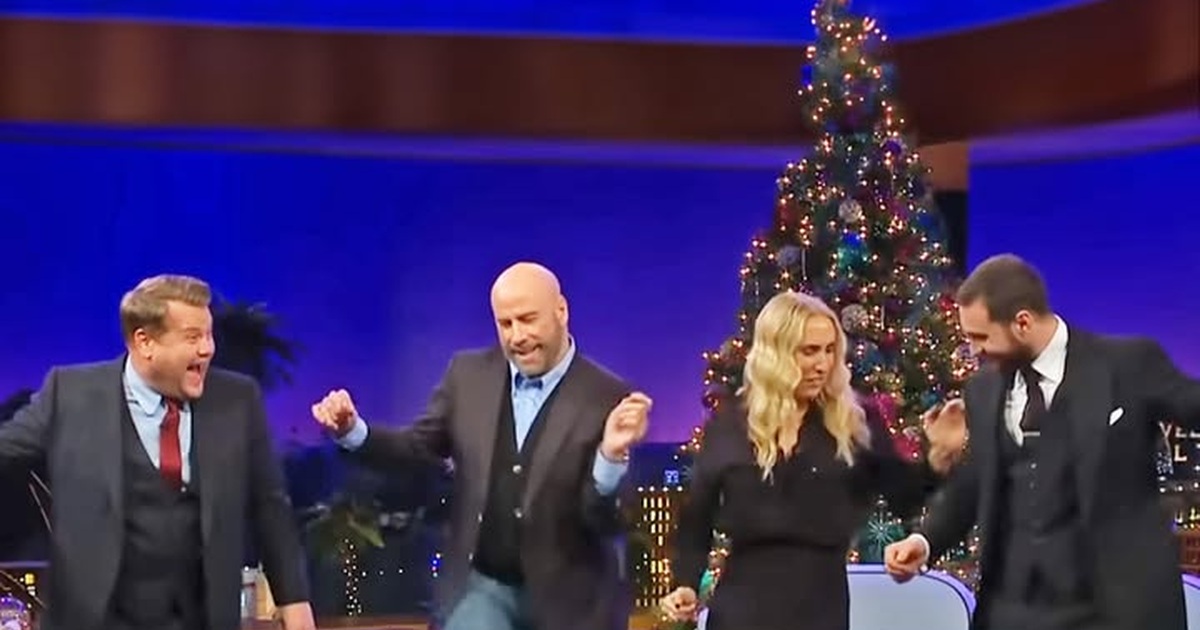
A familiar film scene can be recognized long before someone knows how its movements are put together. John Travolta’s Pulp Fiction dance demonstration on The Late Late Show turns that gap into the subject of a television encounter.
The program’s own description places Aaron Taylor-Johnson and Sam Taylor-Johnson’s Halloween costumes at the beginning of the conversation. Travolta then discusses developing the film’s movements with Quentin Tarantino and gives the group a brief lesson. Recognition supplies the reference; participation changes what happens next.
The studio demonstration
Watch on YouTube ↗
An image and an action are different kinds of knowledge
Remembering a pose is not the same as knowing how a movement proceeds. A pose gives a point that can be recognized. An action has a beginning, a continuation and relationships among parts of the body.
A demonstration makes some of that sequence available. Instead of relying only on a verbal description, another person can observe direction and timing, then attempt the action in a shared setting.
This does not mean a short television item becomes a complete dance course. Its practical job is smaller: give participants an intelligible starting point and something they can do together within the conversation.
A film reference becomes present-tense work
The movie supplies a remembered example, but the studio guests cannot simply become footage from the film. They have to undertake movements in their current space with the people present.
That difference is part of the interest. A recognizable source remains available while the encounter acquires its own timing and company. A demonstration can acknowledge an earlier performance without reproducing every element of its production.
Travolta’s account also gives credit a particular shape. The program identifies a collaboration with Tarantino in developing the movements. A famous screen image has a making history, not only a later life as a pose people remember.
Explanation has to become usable
In a practical demonstration, an explanation matters because another person can respond to it. The movement needs to be small enough to follow and clear enough to attempt. The next response shows whether a shared reference has been established.
That exchange distinguishes a lesson-shaped encounter from a solo display. The featured performer’s ability remains relevant, but another person’s participation is part of the structure rather than a distraction around it.
A prepared school ensemble
The Whitmer teachers’ Uptown Funk routine changes the frame from a short studio lesson to a named group presentation. The original publisher identifies the 2017 homecoming assembly and organizer Katie Peters.
Watch on YouTube ↗
The comparison separates learning within an encounter from presenting an already organized sequence. Both depend on shared references, but they have different public tasks.
A prop-based talent-show routine
The final fifth-grade selection brings another kind of designed stage idea into view. Its comic premise is presented as a complete number rather than a demonstration built from a film conversation.
Watch on YouTube ↗
Travolta’s television appearance occupies a useful space between recognition and performance. The guests begin with something they know as viewers, then encounter a way to undertake it. The film remains the reference while a present group makes the movement part of its own shared moment.