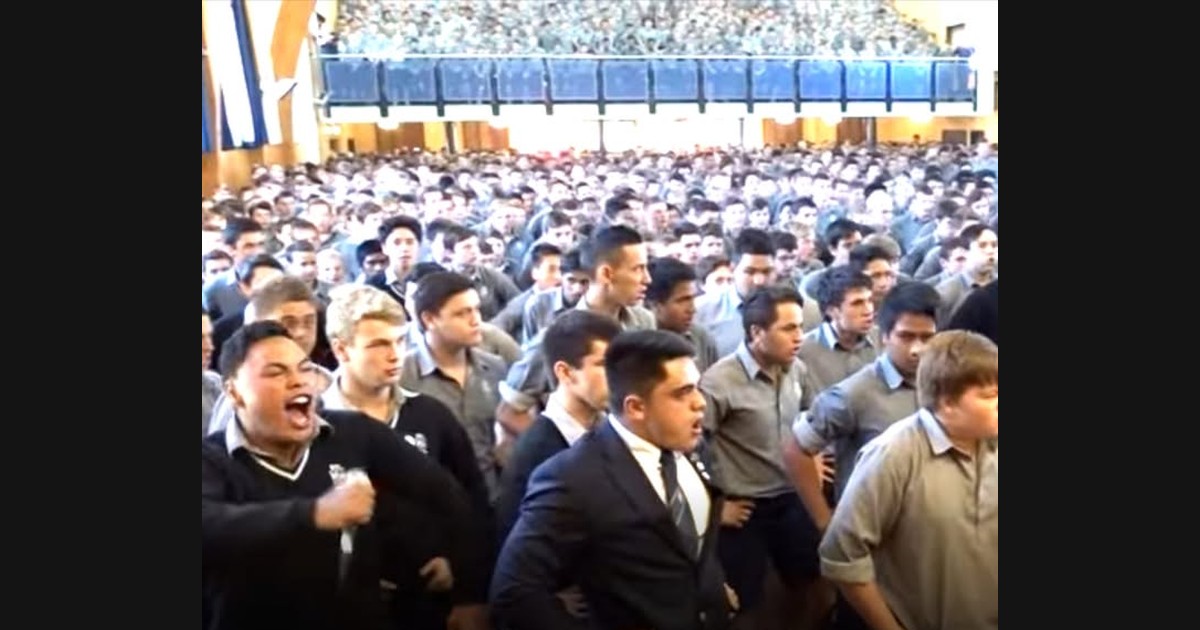
A school’s life contains departures of different kinds. A staff member ends a period of service; a year group moves beyond its final school year. Palmerston North Boys’ High School’s separately identified farewell recordings make it possible to consider how an institution acknowledges both individual contribution and continuing cycles of membership.
John Adams’ farewell belongs to the school’s 2016 assembly history. The accompanying Year 13 leavers’ recording is labeled 2021 by the school itself. The shared institution connects them, while the people being acknowledged and the occasions remain distinct.
Watch on YouTube ↗
A particular person is being acknowledged
The Adams recording names its recipient. That matters because the performance is not simply a free-floating example of intensity. It belongs to a relationship between a school community and a person whose contribution the school is recognizing.
Follow the event through that relationship. Who is identified by the institution, and what public purpose does the title establish? Those are more secure starting points than inventing individual students’ stories or deciding that an expression on screen explains an entire private history.
Haka also needs its cultural context. Te Ara’s Māori scholarship describes a living art with varied forms and social purposes. A viewer should not replace the particular words with a guessed translation or treat every haka as an identical message regardless of occasion.
An institution continues after a farewell
A farewell marks an ending for particular participants, while the school carries on. That relationship can give a shared practice continuity without making every performance interchangeable. The people, recipient, and circumstances give each occasion its identity.
This is a useful distinction between repetition and sameness. A recurring form can become a way of recognizing different transitions. Its recurrence does not erase the specific contribution or relationship being acknowledged on a particular day.
Watch on YouTube ↗
The Year 13 leavers are a different recipient
The 2021 recording shifts the focus from one departing staff member to student leavers. Its title establishes another public purpose within the same school. It should not be presented as additional footage of Adams’ assembly.
Compare how the recipient changes the frame of the occasion. One recording names an individual; the other names a group at a stage of school life. That difference is clear before a viewer attempts to interpret any particular movement or phrase.
A practical comparison has three columns: institution, recipient, and occasion. The institution stays constant; the other two columns change. This keeps the viewing selection intelligible without requiring an outside account of what each participant privately experienced.
Watch on YouTube ↗
The spoken farewell restores individual context
The rector’s address returns attention to Adams’ departure. Use the school’s own spoken account for specific information about the person rather than asking the later leavers’ recording to stand in for it.
The address and student performance can be considered parts of a documented institutional acknowledgment. Their relationship does not make the 2021 occasion another chapter of the same event.
After the comparison, identify what is shared and what is particular. A school, a recurring form, and a practice of marking transitions can provide continuity. Named recipients and separately dated occasions give that continuity its real shape. Keeping both levels visible is more informative than turning all three recordings into a single generalized farewell spectacle.


