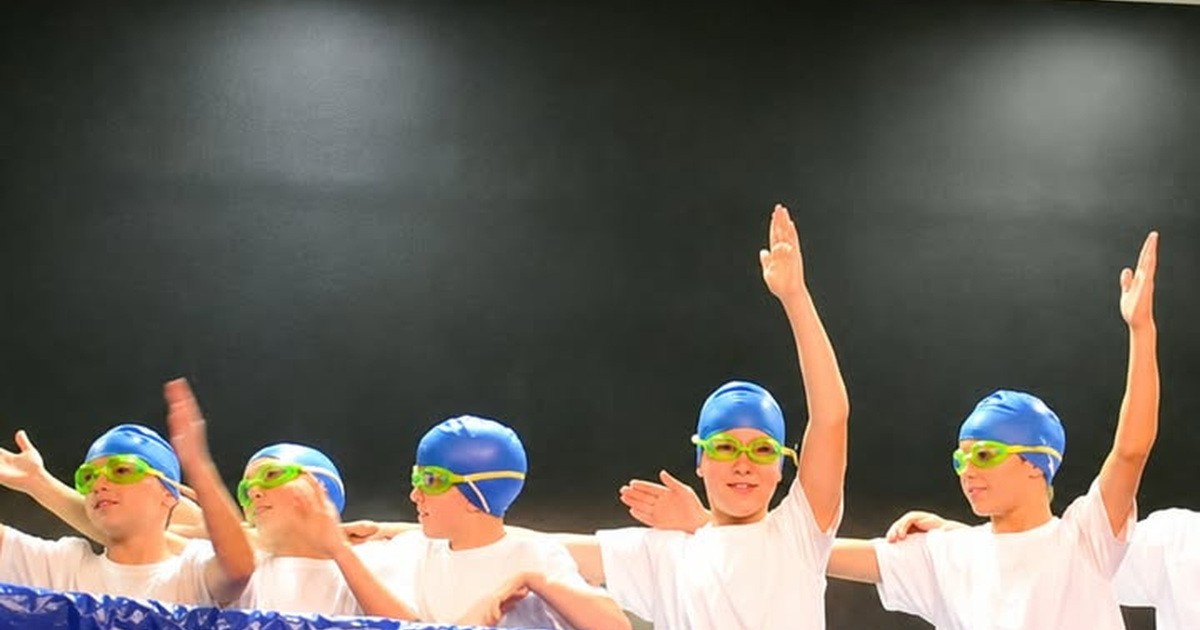
A swimming routine without a swimming pool begins with an obvious contradiction. The fifth-grade performers in the Porter Elementary talent-show clip turn that contradiction into a stage joke. A blue boundary suggests water, while the audience supplies the imaginary space around it.
Contemporary reporting places the routine at W.A. Porter Elementary in Hurst, Texas, in 2014. ABC interviewed principal Greg Bicknell and identified eight fifth graders in the act. The performance belongs to a school talent show, not an actual synchronized-swimming competition or an Olympic event.
Watch on YouTube ↗
Suggestion does more than scenery
A stage illusion does not always need elaborate realism. One clear sign can establish the premise if performers and audience agree to use it consistently. In this case, the published account identifies a blue “water wall,” swimming caps, and goggles. Together those elements tell viewers which imaginary activity to follow.
The joke depends on recognizing both realities at once. We know the performers are on a stage, yet we can read their actions through the idea of a pool. Hiding the absence of water completely would remove part of the comic pleasure. The visible mismatch is the premise.
A group can make a simple idea legible
Coordinated movement helps several performers appear to occupy the same imaginary world. A shared entrance, a repeated action, or a simultaneous change can make that world clear even for a viewer who is far from the stage.
For a useful viewing focus, follow the transitions between group ideas rather than searching only for the largest gag. The act has to move from one shared image to another. Those transitions show why a simple premise still needs preparation and agreed timing.
This does not require guessing at the children’s private emotions or describing their future careers. The visible act and its established school context are enough. The principal’s interview also notes that the show did not award prizes, so the clip should not acquire an invented first-place finish when retold.
A familiar activity becomes theatrical material
Air swimming belongs to a wider stage principle: an everyday or recognizable activity can become performance when its scale, setting, or timing changes. The audience recognizes the reference and then follows what the performers do with it.
The school setting contributes another layer of recognition. A talent show invites participants to present different kinds of work, so the audience is prepared to accept a brief invented world before moving to the next act.
Another collective school performance
The next video is labelled a Whitmer teacher flash mob at homecoming in 2017. It changes the school, performers, and occasion. Its connection here is the transformation of a familiar institutional group into a coordinated performing ensemble.
Watch on YouTube ↗
Rather than treating the two clips as the same kind of prank, compare how quickly each establishes its premise. A flash-mob presentation and a talent-show skit arrive with different audience expectations, even when both use shared movement.
A professionally produced music-video frame
Mark Ronson’s official “Uptown Funk” video featuring Bruno Mars supplies the final comparison. It changes the production context again, placing coordinated movement within a music video rather than a school event.
Watch on YouTube ↗
The Porter routine’s particular strength is the economy of its premise. A small set of recognizable signs gives the group something clear to perform and the audience something clear to imagine. The missing pool becomes the reason the stage illusion works as comedy.