Laura Lāce’s “Canon Rock” video belongs to a chain of interpretation rather than a composition appearing for the first time. The embedded title identifies it as a cover of JerryC’s arrangement. That credit is worth keeping beside the performer’s name: arranging a piece and realizing that arrangement on an instrument are connected but different contributions.
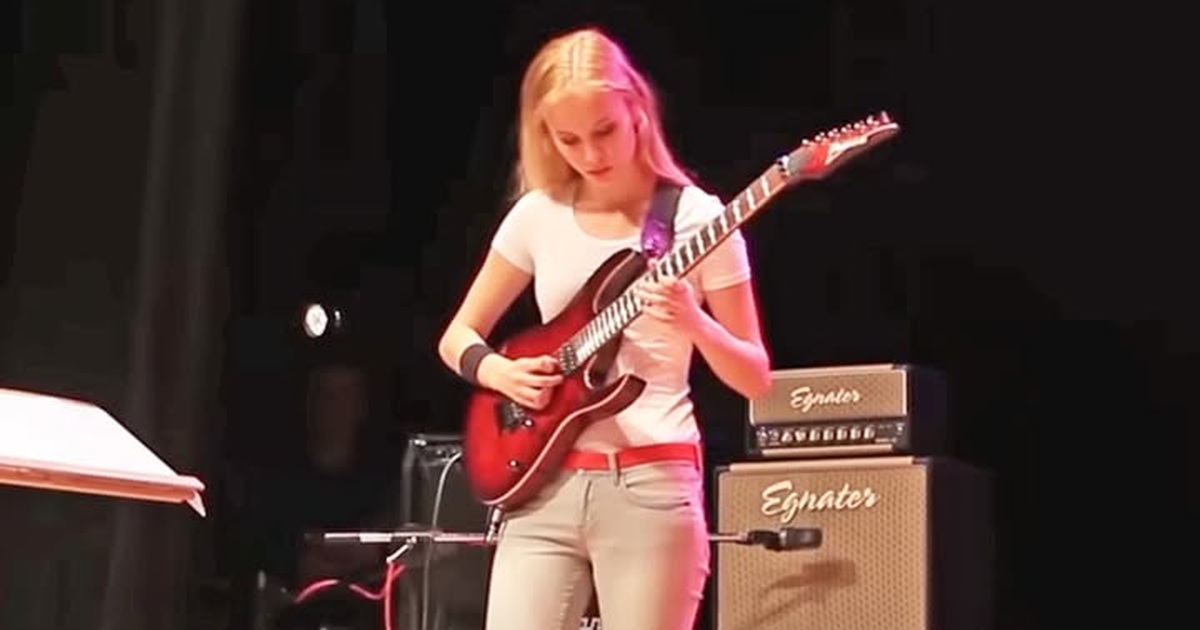
Ibanez’s official artist profile identifies Lāce with the online name Laura6100 and connects the “Canon Rock” upload with her teacher’s Vi Gi channel. The profile provides a firmer identity than treating the guitarist as an anonymous person discovered inside a widely shared clip.
Watch on YouTube ↗
What an arrangement gives a performer
An arrangement supplies more than a recognizable tune. It can establish a sequence of sections, accompanying patterns, contrasts, and places where a lead line becomes more elaborate. A performer then has to make those relationships intelligible in time.
JerryC’s own released Canon Rock catalog establishes the arranged work as part of his output. Its later circulation through other guitarists does not transfer that underlying arrangement credit to whichever performance a viewer happens to encounter first.
Listen for continuity before speed
Fast notes are easy to notice, but they are not a complete explanation of an instrumental performance. A passage also has to begin somewhere, travel through a phrase, and connect to what follows. The sense of direction can remain important even when a listener does not recognize the fingering involved.
Choose a recurring musical idea as a reference. Follow how the lead line approaches it, moves away from it, and makes a return recognizable. That provides a more concrete listening task than counting notes or assuming that the most difficult-looking section is automatically the musical center.
Space matters too. A sustained note and a dense run can define each other through contrast. An instrumental arrangement can use changes in activity to keep a larger shape clear, rather than simply maintaining maximum speed from beginning to end.
Another source work on electric guitar
The next selection is “A. Vivaldi — Summer Presto” on Laura6100. It changes the musical material while retaining the performer. The comparison concerns how an instrumental line carries structure across different pieces, not whether electric guitar has replaced the instruments associated with the source work.
Watch on YouTube ↗
A different instrument changes what is convenient, what can be sustained, and how articulation is produced. An effective adaptation makes choices around those possibilities. It is not necessary for a listener to know the full original score to recognize that adaptation involves decisions rather than a simple change of timbre.
The live version changes the frame
The final upload identifies a live “Summer” performance. This keeps the source material closer to the previous selection while changing its presentation. A stage context and a closely framed cover recording can make different aspects of playing visible.
Watch on YouTube ↗
Neither label establishes that the audio is untreated or that the music was played without preparation. The useful comparison remains musical: how the phrases connect, how contrasts are established, and how the accompaniment supports the featured line.
Seen across the three videos, Lāce’s playing becomes a study in carrying arranged music through a recognizable instrumental voice. Speed is one feature a viewer may notice; clarity of structure is what gives that speed somewhere to go.