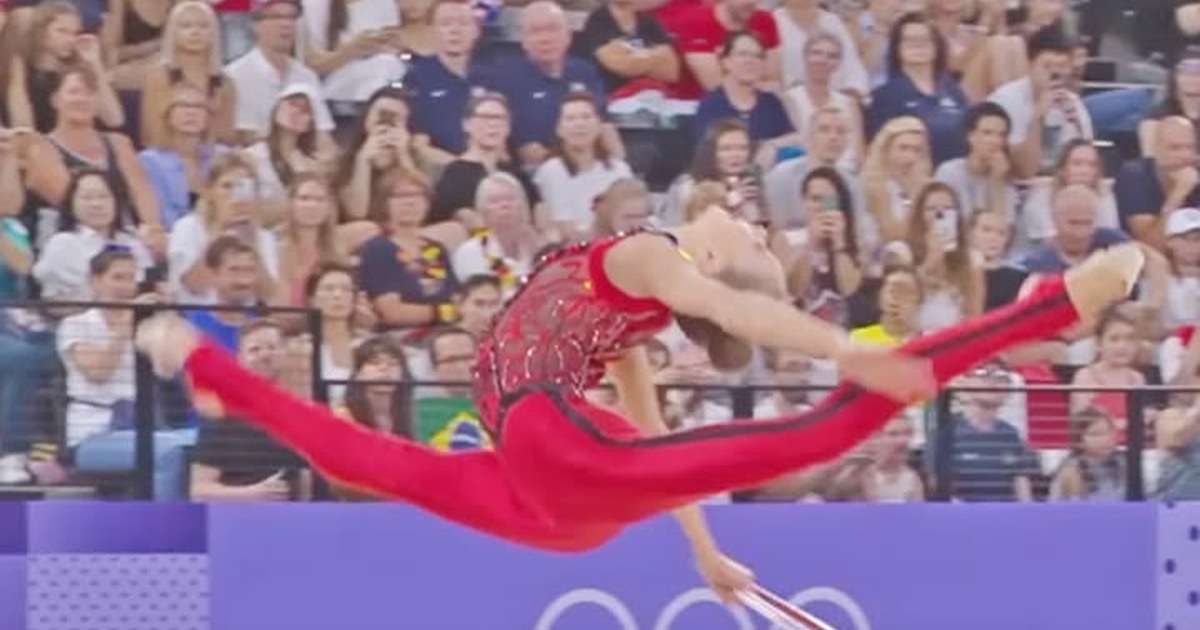
Taisiia Onofriichuk’s hoop performance brings “Thriller” into a form with different demands from a music video. Rhythmic gymnastics combines movement with apparatus work inside a competition program. A recognizable song supplies a cultural reference, but the gymnast still has to make that reference function within the routine’s own structure.
The official Olympic uploads identify the “Thriller” connection. The International Gymnastics Federation’s athlete record places Onofriichuk of Ukraine at Paris 2024, where she finished ninth in the individual all-around final. That result belongs to the complete competition, not to an online popularity contest or to one short sequence taken out of it.
Watch on YouTube ↗
The hoop is a performing partner
A dance interpretation without apparatus can direct attention entirely through bodies and space. A hoop adds another moving object whose position matters. The audience has to follow its relationship with the gymnast as well as the gymnast’s relationship with the music.
That creates overlapping lines of attention. A musical accent may offer a point of arrival, but the apparatus also has its own path and timing. The routine has to connect those demands into something that can be followed as a continuous performance, rather than a set of unrelated tasks.
Recognizable music does not require a replica
A familiar song can make a new performance accessible before viewers know the sport’s technical vocabulary. Recognition provides an entry point. It does not require the routine to reproduce every scene or movement from the earlier screen work.
The distinction is especially relevant to “Thriller.” The Library of Congress catalogs Michael Jackson’s 1983 work as a short film incorporating dramatic narrative and choreography. A gymnastics program is neither that film nor a shortened attempt to tell all of its story. It selects musical and theatrical possibilities for another purpose.
Follow the routine’s broad sections before trying to name difficult elements. Notice how the apparatus remains part of the performance during changes in musical emphasis. This viewing focus gives the sport its own identity rather than treating it merely as an imitation of a pop star.
A second official view
The next selection comes from Olympics Gymnastics and again identifies the hoop performance with “Thriller.” A shorter or differently framed upload can direct attention toward a particular moment. It should not automatically be assumed to document a different competition round.
Watch on YouTube ↗
This is also why a clip alone should not be used to reconstruct a final ranking. Qualification and final are distinct parts of the event. The FIG record provides the standings; the videos provide a view of the performed material. They answer related but different questions.
Return to the screen source
The final video is Michael Jackson’s official “Thriller” film. It allows a direct comparison of formats: a screen production with editing and narrative on one side, and an apparatus routine organized for competition on the other.
Watch on YouTube ↗
The most useful comparison concerns what is retained and what has to change when material crosses forms. Musical recognition can carry across immediately, while narrative duration, camera possibilities, space, and the role of the hoop impose different conditions.
Onofriichuk’s program is therefore an adaptation rather than a duplicate. Its interest lies in making a familiar musical reference work within rhythmic gymnastics, where the apparatus and the competition structure remain essential parts of what the viewer is watching.