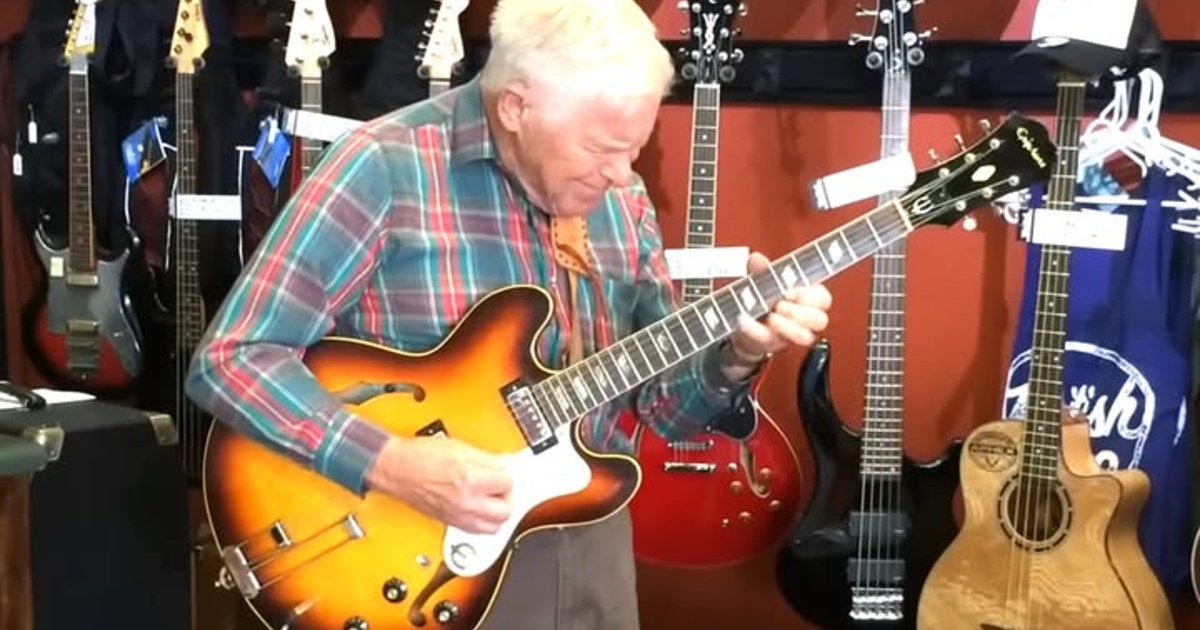
A short shop recording can introduce a musician without supplying his whole biography. British Audio’s Bob Wood video does exactly that. The publisher identifies Wood with Nashville and introduces him as having just turned eighty. The clip was published in October 2014, giving the introduction a particular point in time rather than an age that should be carried into every later recording.
The two companions add different kinds of context. GoPro presents a broader profile, while Epiphone documents a visit with a named instrument. Together they create a clearer account than a single repeated story about an unknown customer being discovered by chance.
The British Audio introduction
Watch on YouTube ↗
A setting is useful evidence, but not a complete story
A music-shop context gives the performance a practical frame. Instruments and equipment belong to the setting, so playing can become part of an encounter outside a formally billed concert. That does not independently establish every circumstance of a visit.
The publisher’s short description identifies the person and place connection. It does not explain a detailed repair errand, a crowd’s first reaction or a conversation before the camera started. Those additions would turn a compact record into a more elaborate narrative without adding evidence.
The musical contribution can be interesting without that expansion. A viewer encounters someone undertaking a piece in a relatively direct presentation. The person’s prior experience need not be imagined as a secret waiting for the internet to reveal it.
Age is a date-dependent credit
The title’s age describes the publisher’s introduction at one point. A later profile may use another age because time has passed, not because the records necessarily contradict each other. Keeping the publication and the claim connected avoids treating a changing detail as a timeless label.
It also allows the playing to remain the subject. Age can explain why a caption initially draws attention, but it does not describe a phrase, an instrumental responsibility or a musician’s complete relationship with the repertoire. Those deserve attention beyond the surprise built into a headline.
A produced profile widens the frame
GoPro’s Bob Wood Plays It Cool is another kind of presentation. Its own description connects Wood with a longer musical journey and names both Wood and William Ryan Fritch in the music credits.
Watch on YouTube ↗
A profile selects material to tell a story about a person. That differs from a short performance introduction. Credits help distinguish the musician being profiled from every sound used to construct the finished film.
An instrument-centered visit
Epiphone’s official upload identifies Wood visiting its Nashville headquarters with his mid-1960s Riviera. The instrument now becomes a named part of the presentation, rather than something that needs to be guessed from a passing image.
Watch on YouTube ↗
The three records connect without becoming interchangeable. British Audio introduces a player, GoPro builds a profile and Epiphone documents a specific visit. Each adds a different kind of information. Wood’s contribution remains musical throughout, while accurate credits preserve more of the person than an exaggerated story of sudden discovery would allow.