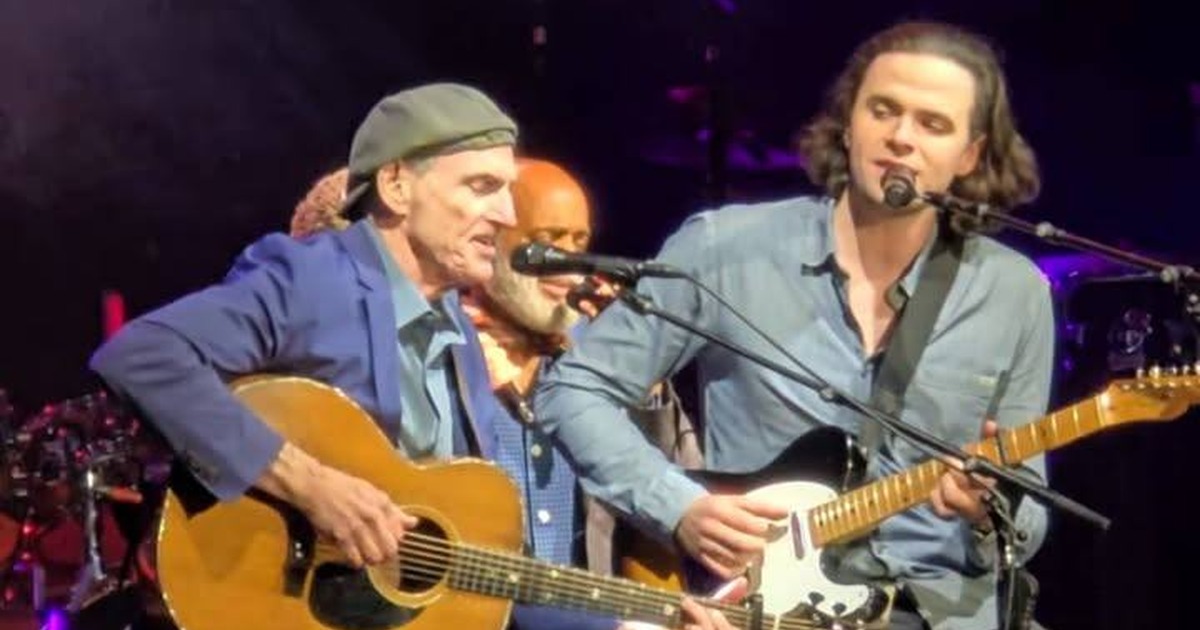
A concert ending has a practical task: music must stop, yet the audience’s relationship with the evening does not disappear at the final sound. James and Henry Taylor’s You Can Close Your Eyes in Anaheim offers a useful way to consider that transition.
Taylor’s official upload identifies the Honda Center on October 30,2021. His site’s account places the father-and-son duet at the close of the show. The song already belonged to James’s 1971 Mud Slide Slim and the Blue Horizon repertoire, giving the final item a history beyond this particular concert.
The Anaheim closing selection
Watch on YouTube ↗
An ending can offer continuity
A final song does not have to summarize every earlier number. It can instead establish a relationship that remains intelligible once the program ends. A direct address gives the departing audience something more focused than an inventory of what has happened.
You Can Close Your Eyes offers reassurance within the passage of time. That makes its placement at a concert ending an interesting relationship between song and occasion. The evening must finish, while the writing leaves room for continuity beyond the present moment.
This does not establish why every programming decision was made. A set’s published sequence gives us a position to interpret, not unrestricted access to the artist’s private planning. The connection between a closing piece and its occasion is available without inventing a backstage discussion.
A final address can be shared
Henry’s participation changes who undertakes the farewell. The relationship is documented as father and son, but the musical task remains one that two performers have to carry together. A family credit supplies context without explaining each phrase automatically.
A shared closing piece can make the last address less exclusively attached to one person. The evening still belongs within James Taylor’s concert, while another voice participates in its departure. Both facts can remain visible without describing the moment as a transfer of ownership or a prediction about a career.
It is useful to distinguish a duet’s place in the program from its exact internal arrangement. The first is established by the event record. Detailed claims about vocal division or instruments would need further evidence from the performance itself.
Another song supplies a different retrospective frame
The second uploader labels Fire and Rain as a DTE performance from August 1,2021. It provides another part of Taylor’s repertoire, rather than another camera angle on the Anaheim ending.
Watch on YouTube ↗
The title changes the playlist’s dramatic situation. A repertoire can accommodate recollection and reassurance without requiring every piece to perform the same emotional job. A clear comparison preserves those differences.
Return to a direct offer of support
The last embedded recording is labeled You’ve Got a Friend from the same DTE selection. It creates another connection with companionship, while remaining a distinct song and event label.
Watch on YouTube ↗
A concert ending is one use of repertoire among many. The Anaheim duet gains a particular function from its position: a performance closes an evening while the song’s address leaves a sense of continuing company available. Understanding that position gives the recording a purpose beyond a general observation that two relatives sang together.