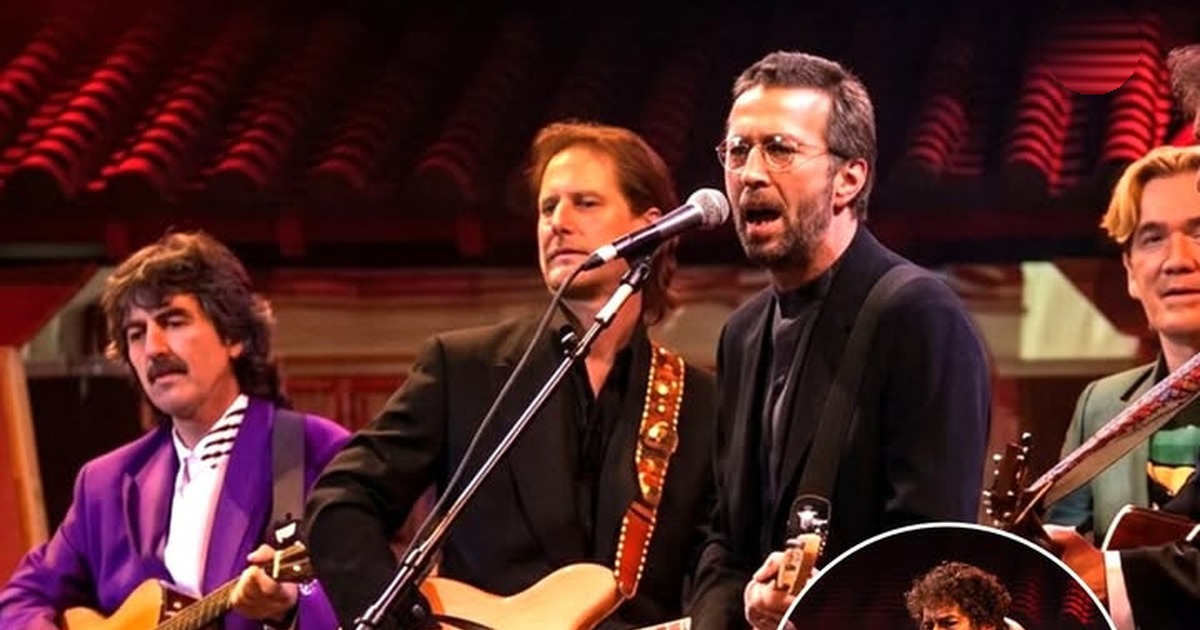
Bob Dylan’s 30th anniversary concert offered a direct way to celebrate a songwriter: let other musicians perform his work, then let him join them. “My Back Pages” brings that idea into focus. The official release credits Dylan alongside Roger McGuinn, Tom Petty, Neil Young, Eric Clapton, and George Harrison, with a supporting ensemble behind them.
The event took place at Madison Square Garden on October 16, 1992. That date belongs to the performance; later releases and online uploads are different stages of its publication. The occasion celebrated thirty years of Dylan’s recording career, rather than marking his thirtieth birthday or the age of this particular song.
Watch on YouTube ↗
The composition provides continuity
Sharing a song among recognizable singers creates a practical musical challenge. Each voice brings its own tone and phrasing, but the piece still needs to feel continuous. The recurring structure gives the listener a stable route while the featured personality can change.
That is different from a medley, in which several compositions are joined together. Here a single song supplies the common ground. The interest lies in how a shared form can accommodate more than one musical identity without requiring the performers to sound alike.
Read the credits beyond the headline
The official credits name supporting players as well as the six featured artists. This matters because an all-star picture can make accompaniment disappear from the story. A shared pulse, harmonic support, and the management of transitions are part of what allow featured musicians to occupy the foreground.
A useful viewing approach is to follow the backing ensemble through a change of featured voice. Rather than treating each new face as a fresh beginning, notice what continues. The performance can then be understood as collective coordination instead of a row of isolated celebrity appearances.
The credits also prevent a misleading simplification: Dylan is a participant in this performance of his own composition. The event does not merely place admirers at a distance from an absent honoree. Its musical situation includes the writer among the interpreters.
A Harrison song at another anniversary
The second selection, Paul Simon with David Crosby and Graham Nash performing “Here Comes the Sun,” comes from the Rock and Roll Hall of Fame’s 2009 anniversary concerts. It changes both the song and the institutional occasion. George Harrison’s writing provides the shared material this time.
Watch on YouTube ↗
The comparison is about methods of tribute. An anniversary program can honor a broad tradition through repertoire, while a songwriter’s anniversary can organize many performers around one catalog. Neither requires an attempt to imitate the original recording exactly.
Another way of sharing a familiar composition
The final clip is the official George Harrison channel’s “Something,” performed by Paul McCartney and Eric Clapton. Its smaller headline partnership offers another point of comparison with the six-name “My Back Pages” credit. The number of featured performers changes the relationships a viewer can follow.
Watch on YouTube ↗
In all three cases, a song does more than identify the person being honored. It gives the participating musicians a concrete activity to share. That is why the writing deserves as much attention as the guest list: the form of the song turns an assembly of major names into a performance that can proceed together.