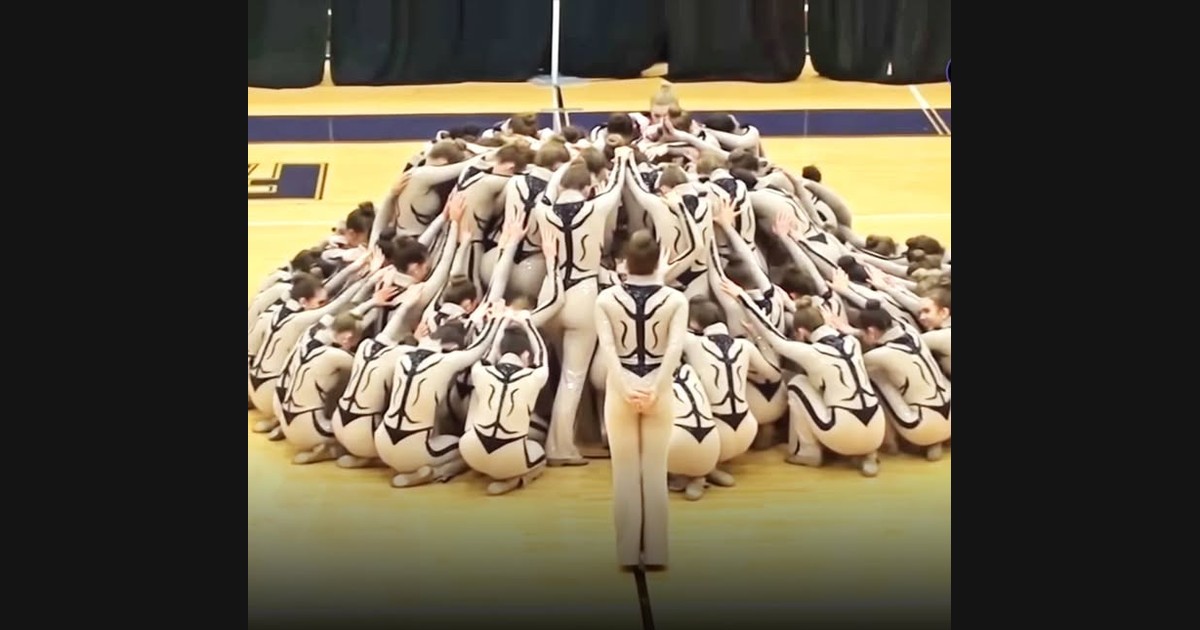
A large dance team creates two performances at once. Each person executes movement, while the group produces shapes that exist only because the positions relate to one another. The Emerald Belles’ 2017 high-kick routine makes that second level an especially useful focus.
The original production identifies the Southlake Carroll Varsity Emerald Belles at the Showmakers of America Dance Competition. It lists eighty dancers in the super division and names “Sweet Dreams” as the concept. That is the production’s concept label, rather than a reason to assume that every musical passage comes from one particular song.
Watch on YouTube ↗
Start with the outline
When there are many performers, following one dancer immediately can make the overall arrangement harder to see. Begin with the outer shape. Ask where the ensemble appears wide, concentrated or divided into separate groups. These are visual relationships rather than judgments about individual technique.
Then look at the space between people. A gap can help define a line or make one part of a formation distinct from another. The empty floor is therefore part of what the audience reads, even though it is not a performer or a prop.
Three scales of attention
| Scale | Useful focus |
|---|---|
| Whole formation | The outline and direction of the group |
| Section of dancers | How one region relates to another |
| Individual performer | How a movement contributes to the shared result |
These perspectives complement one another. A single movement may look straightforward on its own but become visually striking when repeated across a large group. Conversely, a complicated individual action may be difficult to notice from a wider view. Ensemble choreography must consider what remains readable at that scale.
Credits identify different kinds of construction
The upload names Melissa Page as director and choreographer, with Curtis L. Harnagel responsible for creative direction, concept and costume design. Those credits separate the movement’s organization from the broader visual presentation while showing that they belong to the same production.
A costume can make a formation easier to read through repeated color and silhouette. Choreography determines what happens within that visual frame. Neither contribution alone explains the complete result; their relationship helps the audience recognize a coordinated group.
Television introduces another frame
The second recording is labeled as an Emerald Belles audition for America’s Got Talent in 2019. This is a later television appearance, not another view of the 2017 competition routine.
Watch on YouTube ↗
A camera presentation changes what viewers can attend to. A wide view preserves the ensemble outline, while a closer view can show individuals more clearly. The trade-off is simple: more detail about one performer can mean less information about the whole formation at that moment.
Follow development without borrowing the verdict
The third upload presents a judge-cuts appearance from the same television season. Its promotional wording is an opinion about improvement, not a measurement that the viewer needs to adopt.
Watch on YouTube ↗
Across the recordings, the most useful comparison is how the group becomes readable in each frame. Looking from the outside in gives the audience a practical way to appreciate the work: first the formation, then the relationships within it, and finally the individual actions that make the larger image possible.