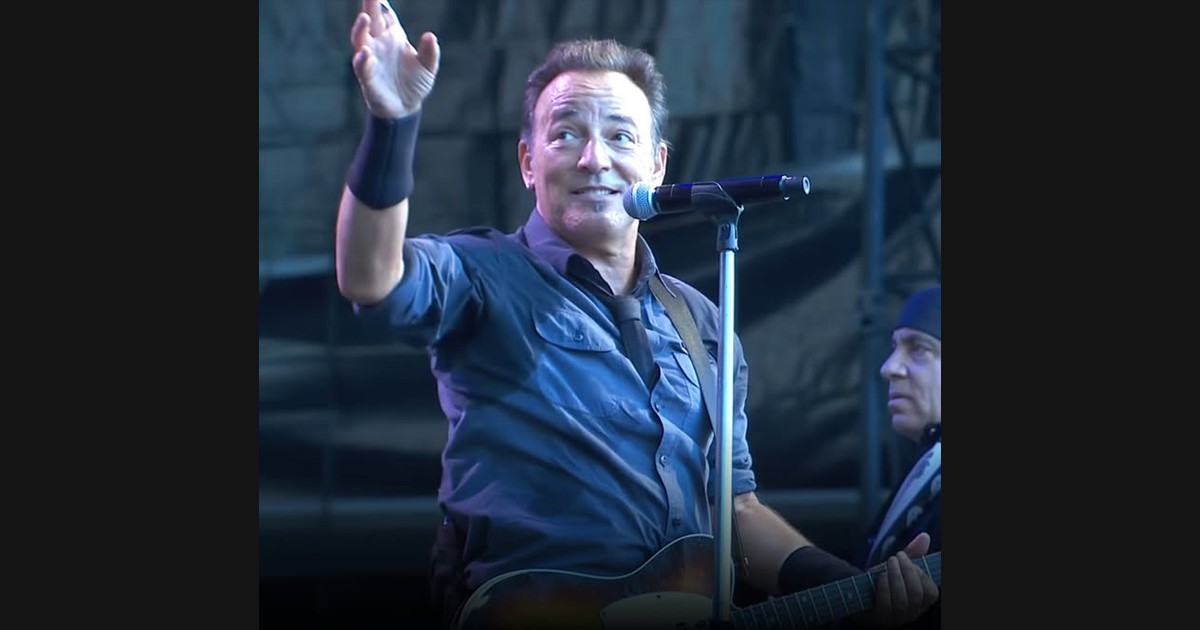
The request story around Bruce Springsteen’s Leipzig “You Never Can Tell” can draw attention away from the story inside the song. Chuck Berry’s composition follows a young couple through a wedding and the material details of a shared life. Furniture, food, records, work, and an anniversary journey make the account specific without turning it into a long dramatic scene.
Springsteen’s official report identifies the 2013 performance as an unexpected request. That explains why the song entered the program. Berry’s narrative offers a separate reason to remain with it after the request has been accepted.
Watch on YouTube ↗
Objects do some of the storytelling
The song does not explain the couple only through abstract declarations. Its ordinary possessions and activities make a developing household visible. A domestic object can suggest a stage of life more efficiently than a general claim that the characters are happy or successful.
The record collection is especially useful to the song’s musical world. Music exists inside the story as part of the couple’s everyday experience, while the listener is encountering that story through another piece of music. The detail gives the narrative a connection to the setting in which it is being performed.
These are features of a constructed account, not evidence that the song documents one verified household. A singer can make the scene intelligible without presenting it as personal autobiography.
A returning comment gathers the details
As the narrative moves through different aspects of the couple’s life, a recurring verbal and musical return supplies continuity. Each new detail arrives within a familiar frame, allowing the listener to follow development without learning an entirely new musical form at every step.
For the Leipzig performance, follow one verse as an act of storytelling. Notice how the delivery keeps the information moving toward its return. Then listen through the return as a musical event, rather than treating it only as a signal that another verse is coming.
The relationship between detail and repetition is part of the composition’s economy. The story can move forward while the listener remains oriented by material already heard.
A different Berry narrative
The Rock Hall’s official “Johnny B. Goode” selection brings Berry and Springsteen together. It changes the composition while retaining a direct connection to Berry’s songwriting.
Watch on YouTube ↗
Compare how quickly a song establishes a recognizable world. A named figure, an activity, or a particular setting can give a listener a starting point before the larger musical performance develops. The comparison concerns narrative construction, not a claim that both songs describe the same kind of life.
Another writer uses a different scale
“Here Comes the Sun,” with Paul Simon, David Crosby, and Graham Nash in the related selection, changes both writer and performing group. It offers a contrast to a narrative built from accumulated domestic particulars.
Watch on YouTube ↗
Consider how a recurring image can organize a song differently from a sequence of events. Both approaches can create recognition, but they ask the listener to follow different kinds of development.
Returning to “You Never Can Tell” makes Berry’s specific construction easier to appreciate. The live request gives the performance an occasion; the composition gives it a world. Its ordinary details remain a substantial part of the listening experience, even when the surrounding concert story is more immediately famous.