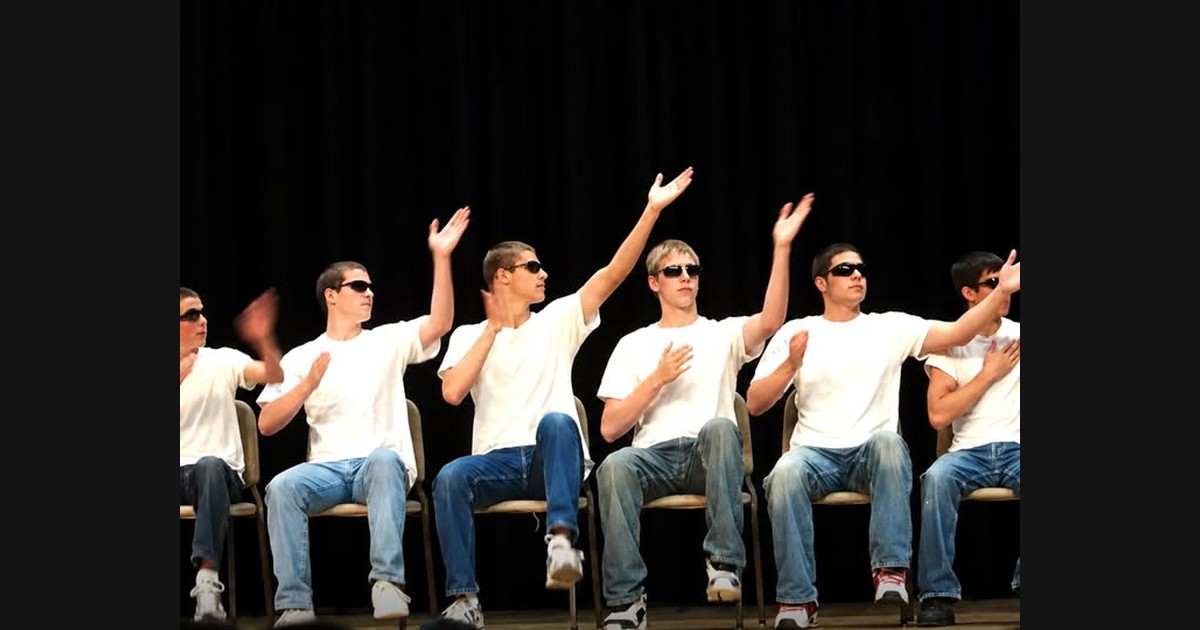
The “Hand Clap Skit” makes a useful distinction between a funny action and a performer telling you that an action is funny. Its restrained stage presentation leaves the developing pattern at the center. The audience has room to discover the joke rather than having every moment explained by a comic expression.
The original uploader describes the setting as a youth-conference talent show. The performers are seated in a row, using hand movements and body percussion as their principal materials. That compact premise supports a form of visual comedy based on expectation: first the audience understands a rule, then it notices how the rule changes.
Watch on YouTube ↗
A rule gives the surprise somewhere to land
Repetition makes an action recognizable. Once the audience expects a gesture to recur, a delay, a new direction or a contrasting response can become meaningful. Without the established pattern, the same change may look like an unrelated movement rather than a comic event.
This is why simplicity can be useful in a short act. A consistent formation and a small vocabulary of actions reduce the amount of information viewers must learn. The performance can spend its attention on relationships between those actions instead of continually introducing new equipment or scenery.
Understatement shifts attention toward the pattern
A restrained facial presentation can create a contrast with increasingly involved physical activity. The visual frame seems composed while the task becomes more elaborate. That opposition is one possible source of humor; it does not require dialogue, a named comic character or a narrative about the performers’ private thoughts.
For a focused viewing, follow where you expect the next event to occur. Then notice whether your expectation is met. The exercise concerns the audience’s developing understanding, rather than an attempt to label every gesture as a specific kind of joke.
A simple hypothetical example shows the principle. Imagine a row of people each making one gesture in turn. Once the sequence becomes predictable, a person who waits an extra beat changes the experience. The humor depends on the rule the viewer has learned. This is a conceptual illustration, not a claim that this exact incident occurs in the video.
Timing also works without comedy
The Barcelona Guitar Trio and Dance performance of “Billie Jean” offers another way to connect visible movement and musical expectation. Its presenting organization identifies it as a tribute to Paco de Lucía.
Watch on YouTube ↗
Here the same broad questions remain useful: what establishes a pattern, what makes an entrance readable, and how does one performer leave room for another? The difference is purpose. Coordination can create musical intensity without a comic payoff; a surprise is not automatically a joke.
A contrasting performance frame
The swing-dance recording below places timing within a competition presentation. The dancers’ relationship and movement through space give viewers another framework for following anticipation and response.
Watch on YouTube ↗
The hand-clap skit is distinctive because it achieves a readable comic premise with so little spatial change. Its restraint lets the pattern do expressive work. Looking at it through expectation and understatement reveals a second layer beyond the coordination itself: the act is organized not only around what the performers do, but around when the audience is ready to recognize it.