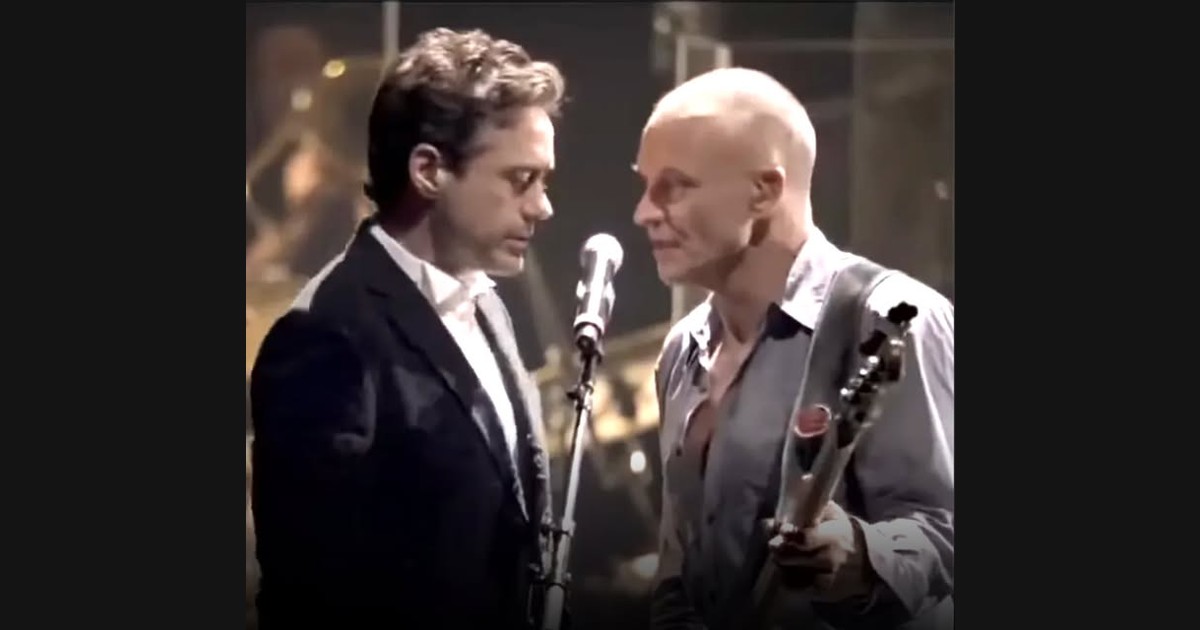
Robert Downey Jr. beside Sting on “Driven to Tears” can look like a story about an unexpected talent. Downey’s own later account offers a more useful explanation: the appearance involved preparation, a demanding host and a musical partnership. The surprise is the point of entry, rather than the whole story.
The performance came from Sting’s 2011 sixtieth-birthday fundraiser at New York’s Beacon Theatre. During a 2016 Howard Stern interview, Downey discussed how Sting prepared him for the occasion. His account replaces the idea of an effortless celebrity walk-on with something closer to a properly worked musical invitation.
Watch on YouTube ↗
A guest still has a musical responsibility
In the interview, Downey described Sting as exacting during preparation. He also credited Sting’s ability to support another performer onstage. Those two parts belong together: preparation establishes what the guest needs to do, while responsive collaboration helps that contribution fit into the performance.
This is a more interesting standard than asking whether an actor can imitate a singer. A guest needs to enter at the right place, understand the shape of the song and maintain a relationship with the surrounding musicians. Sounding exactly like the established performer is not the essential task.
What support means inside a duet
A duet can divide lines, join voices or let one person briefly become the other’s support. These are different relationships, even when both participants are listed as featured performers. The balance can change without either person disappearing from the musical exchange.
Downey’s recollection draws attention to that flexibility. He did not frame the result solely as proof of his own ability; he acknowledged the person helping make the shared performance work. A listener can use that perspective to follow cooperation rather than treating each entrance as a contest.
For a focused viewing, choose a complete phrase and follow what happens around it. Does another voice reinforce it, leave room or prepare the next entry? The question concerns musical roles. It does not require guessing what the performers privately felt or inventing how many rehearsals they completed.
The song with a different performance purpose
Sting’s “Driven to Tears” at Live Aid in 1985 provides a useful reference in which the song serves another kind of event. The composition already had a performance life before the later birthday collaboration.
Watch on YouTube ↗
Compare the place of the guest, rather than trying to reproduce the entire occasion. What changes when a familiar lead part becomes something two people can share? Keeping the song as the reference makes the practical demands of the new partnership easier to recognize.
A tribute with the songwriter listening
Bruno Mars’s 2014 Kennedy Center Honors performance of “So Lonely” and “Message in a Bottle” changes the arrangement of people again. Here Sting is the honoree, while another performer presents his repertoire.
Watch on YouTube ↗
The birthday duet and the honors tribute offer two different forms of generosity: sharing the musical task and receiving an interpretation. Downey’s account adds the less visible work behind the first. An effective guest performance is not made only by the person who surprises the audience; it also depends on the preparation and support that give that guest somewhere meaningful to stand.