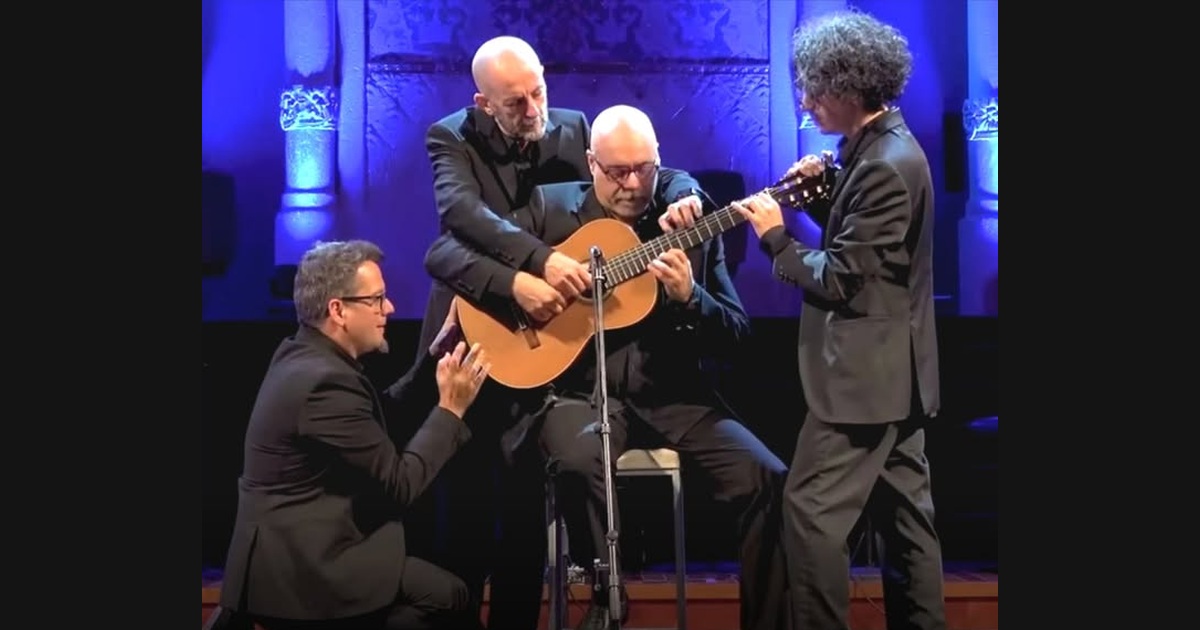
Four people sharing one guitar is an immediately striking premise. The more useful question is what the arrangement asks that instrument to do. Barcelona Guitar Trio’s “Billie Jean” presentation makes musical roles and physical space part of the same problem.
Producer Maestros de la Guitarra explicitly describes the four-person, one-guitar “Billie Jean” among the encores associated with its Barcelona Guitar Trio program. The larger show honors Paco de Lucía; that program context should not be confused with authorship of Michael Jackson’s song.
Watch on YouTube ↗
One object can carry several musical jobs
Instrument count and musical-part count are different things. A guitar can support a melody, a low repeating figure, harmonic information, and rhythmic articulation. Several performers sharing it must divide access to the same physical space as well as divide the arrangement’s responsibilities.
This makes the presentation more than a novelty about the number of hands involved. Its underlying task is to preserve enough information for the composition to remain intelligible. If a listener recognizes the song, consider which musical feature makes that recognition possible before trying to identify every action at once.
Then follow one function through a short passage. Concentrate on the recurring pulse, the principal melodic line, or the material filling the spaces between phrases. The camera may make some physical contributions easier to see than others, so visual prominence should not automatically be equated with musical importance.
Shared access changes coordination
Separate instruments allow players to occupy their own physical work areas. A shared instrument introduces another constraint: an action has to fit beside the actions of the other performers. The arrangement therefore has a spatial dimension that a recording alone would not fully explain.
It is possible to appreciate that constraint without inventing exact hand assignments, rehearsal duration, or an account of who designed each passage. The public performance presents a coordinated result; its complete preparation history is another subject.
The Jackson reference restores the vocal song
Michael Jackson’s official “Billie Jean” video supplies the second selection. It brings the composition back into an artist-centered vocal presentation, changing more than the visible instrument count.
Watch on YouTube ↗
Compare the features you used to recognize the guitar arrangement with the features that organize your attention here. An instrumental adaptation may ask one recurring idea to carry information that a vocal recording distributes across words, melody, and accompaniment.
That does not make the instrumental version incomplete. It makes its choices easier to describe. An arrangement can emphasize some relationships and suggest others, rather than preserving every part in its original form.
A different kind of reduction
Pentatonix’s official “Bohemian Rhapsody” video changes the song and the performing resources again. The useful connection is the redistribution of musical jobs, rather than a claim that both ensembles use the same technique.
Watch on YouTube ↗
A vocal ensemble can assign contrasting functions to voices, just as an instrumental group can divide functions among players. The listener can follow what supplies pulse, what gives harmonic direction, and what becomes the featured line.
The Barcelona arrangement remains distinctive because those jobs converge on a single shared instrument. Returning to it after the related selections makes the physical premise more informative: the spectacle of shared space supports a concrete arrangement problem, while the recognizable song gives the audience a way to hear how that problem is solved.