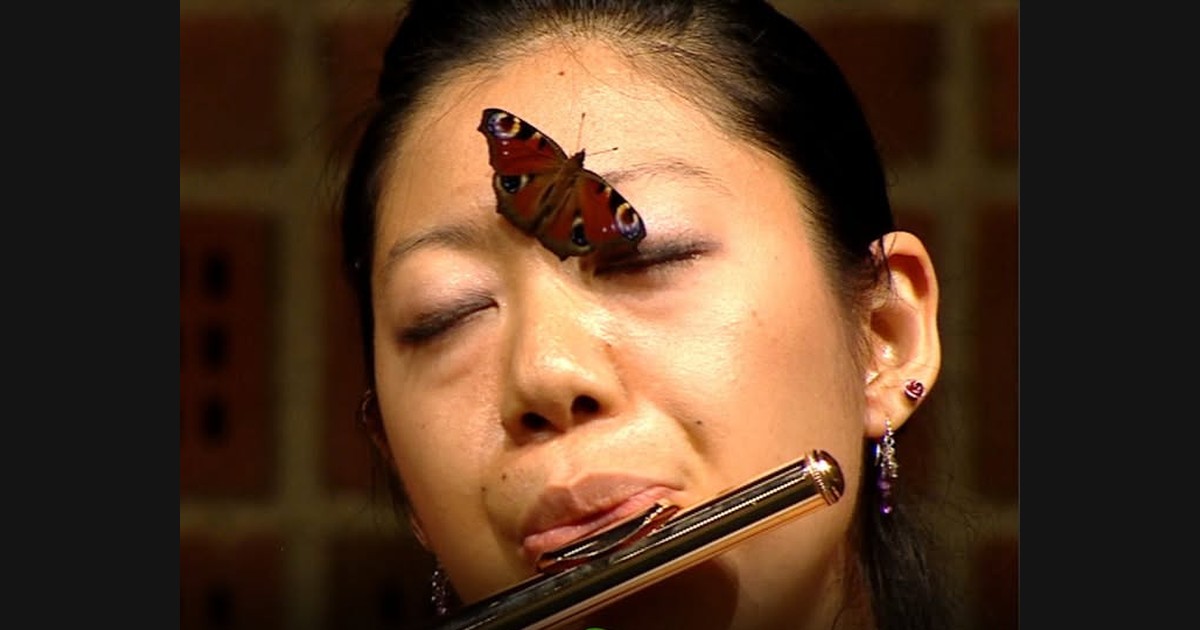
A butterfly landing on a musician’s face is easy to turn into the whole story. Yukie Ota’s own account confirms the unexpected visitor and her decision to continue playing during a competition performance. Yet the interruption becomes more interesting when attention returns to what was already happening: a musician carrying a phrase while another musician shares the musical structure.
The clip can therefore support two kinds of attention. One follows an unusual visible event; the other follows the performance’s continuity. Neither requires inventing what Ota was thinking or treating a brief incident as an explanation of her entire career.
Watch on YouTube ↗
Continuity has more than one layer
Continuing to play is a visible action. Maintaining a musical line is a more particular listening task. A phrase has direction, points of arrival, and relationships with what comes before and after it. Watching for the butterfly alone can distract from those relationships even while the music remains audible.
For a second pass, listen without following the insect’s movement. Notice how the flute’s line relates to the accompaniment and where a musical thought seems complete. This changes the clip from a spectacle about distraction into an example of how attention can be divided between a screen’s foreground event and the music’s ongoing form.
There is no need to infer that Ota felt entirely calm, that concentration cannot be disturbed, or that every performer should respond identically. Those claims go beyond a recording. The event is compelling enough when described proportionately: something unexpected occurred, and the performance continued.
Give Sancan’s Sonatine its own hearing
Watch on YouTube ↗
The accompanying video identifies Pierre Sancan’s Sonatine. Its publisher specifies flute and piano, a detail worth taking seriously. The piano is not merely furniture behind the soloist. In this kind of comparison, listen for changes in who supplies movement, who introduces a gesture, and how the two parts shape an arrival together.
A simple listening map can use three columns: flute, piano, and shared transition. In the first two, note a distinct role rather than every note. In the third, describe where the relationship changes. For example, a listener might notice that one part sustains a thought while the other continues moving, then test that observation on a replay.
This is more informative than counting visible difficulties. A work’s identity survives across performances through its musical material, while the pacing and balance of that material remain interpretive choices. The separate Sonatine video gives space to consider those choices without making an unexpected visitor the center of every sentence.
The ceremony is another context
Watch on YouTube ↗
The award-ceremony video adds a different setting to the selection. A competition performance and a ceremony presentation have different public purposes, even when a musician appears in both. The presence of an award ceremony does not, by itself, establish a particular ranking or tell us which detail decided an adjudication.
Keep the comparison focused on what each recording offers: the unusual incident, a named composition, and a later presentation context. Together they create a fuller portrait than a single dramatic headline can provide.
After watching, try naming the composer and one relationship between the flute and piano before recounting the butterfly. That small reversal restores the music to the center while allowing the unexpected moment to remain memorable.


