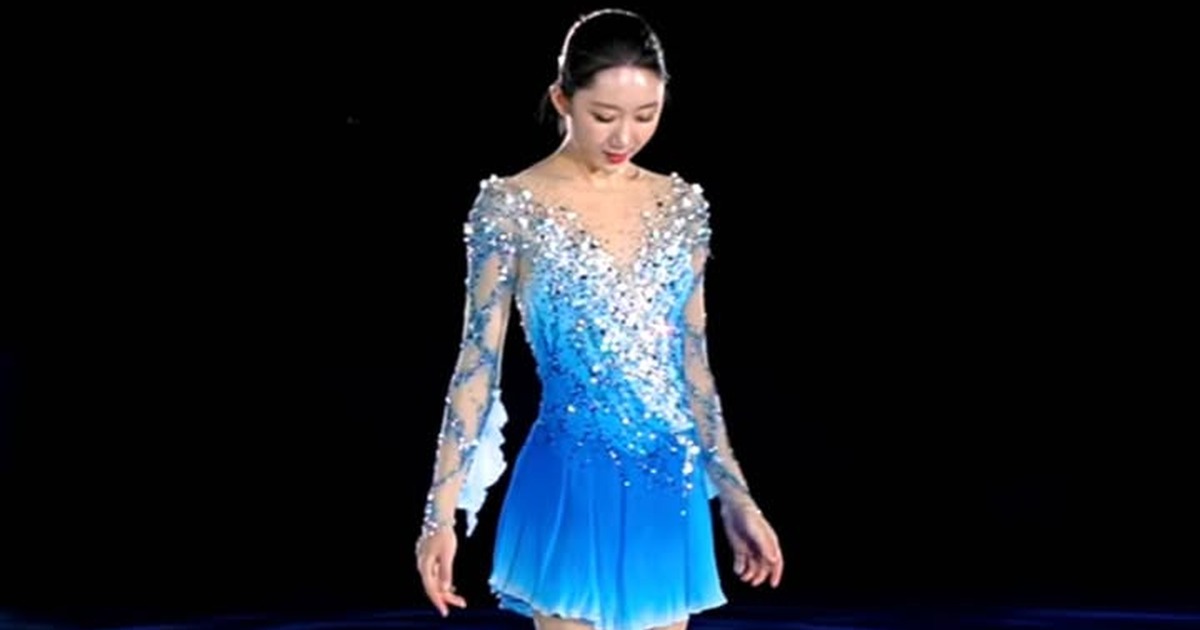
Skating gives a song another kind of shape: a melody can become travel across the ice, a pause can become held space, and a musical return can acquire a new physical direction. Ye-lim Kim’s A Thousand Years selection, identified by On Ice Perspectives as part of An Evening with Champions in 2023, provides a useful setting for looking at that relationship.
The event is a charity skating exhibition associated with Harvard and supporting the Jimmy Fund. Exhibition is an important word here. A viewer does not need to turn the program into a scoring exercise to understand it. The relationship between sound, movement and presentation is a complete subject in itself.
Follow a phrase instead of hunting for a highlight
Watch on YouTube ↗
A musical phrase works somewhat like a sentence: it establishes an idea and gives it a direction. A skating movement does not have to match every beat to belong to that phrase. It may begin before a musical arrival, continue through it or finish after the sound has changed. These offsets are part of what makes movement more than an illustrated metronome.
For a practical approach, choose one stretch of music with a clear beginning and ending. Follow the skater through that whole stretch. Notice whether a change in direction, speed or body shape helps you recognize the musical boundary. This is a question about organization, not a claim about the difficulty of a particular element.
Three layers that do not always move together
- The pulse: the recurring beat that can support smaller actions.
- The phrase: a longer musical thought that can support a journey or a change of direction.
- The larger section: a return or contrast that can reshape the program’s overall presentation.
Imagine an arm gesture matching a single beat while the skater continues a longer path. The small action and the larger movement are doing different jobs. Describing both gives a more accurate account than saying that everything is simply in time with the music.
Stillness also belongs in this framework. A held position can allow a musical event to come forward; motion can then make the next passage feel different. The useful issue is the relationship, rather than whether the program contains constant activity.
A second song changes the reference points
Watch on YouTube ↗
The related Veronika Zhilina Hallelujah selection offers another music-and-movement pairing. Compare one kind of relationship across the clips, such as the end of a vocal phrase and the continuation of a movement. Avoid assuming the two recordings use the same singer or arrangement merely because both songs are familiar.
There is no need to label a jump from an uncertain camera angle. A description of direction, spacing or the length of an action can be both specific and accessible without claiming technical expertise.
An exhibition is also a presentation choice
Watch on YouTube ↗
The Alexandra Trusova selection is labeled as the 2019 Skate Canada gala exhibition. Its different context makes it a useful reminder that a program’s identity includes its chosen music and performance frame. Comparing programs works best when the criterion remains clear: musical phrasing, use of space or the contrast between traveling and staying in place.
Returning to Kim’s selection with one of those criteria lets the music become easier to see. The point is not to reduce the performance to a diagram. It is to recognize how several scales of movement can coexist inside one song, giving a viewer more to follow than a sequence of isolated spectacular moments.