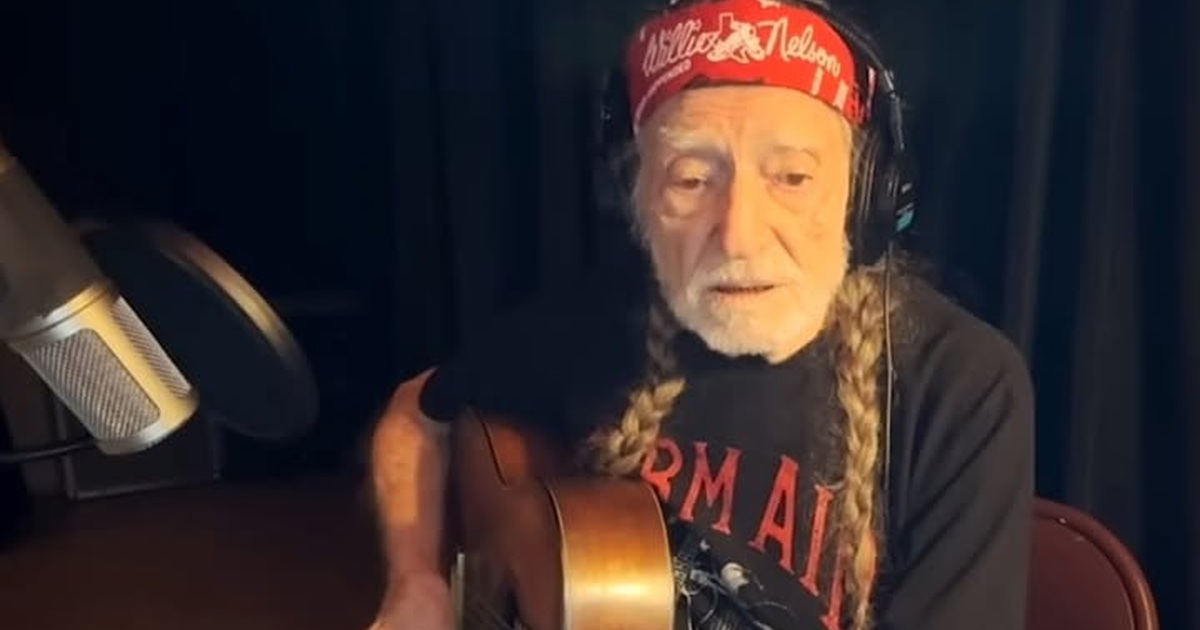
A song with a nation in its title sets an unusually large stage. Who gets to speak, who is being addressed and what kind of belonging is being imagined? Those questions offer a useful way into Willie Nelson’s Heart of America, beyond simply describing it as hopeful or patriotic. They let you examine a public-facing song without assuming that every listener will hear the same message.
The recording belongs to the 2026 soundtrack for The Gray House, a series set during the American Civil War. Its writers are Erin Enderlin, Jim “Moose” Brown and Jeff Fahey; Nelson is its vocalist. That separation between writing and interpretation is a productive place to begin.
Watch on YouTube ↗
Separate three kinds of voice
First, there are the songwriters, who choose the language and musical setting. Second, there is the singer, whose delivery gives those choices a particular sound. Third, there is the speaking position created within the song: the voice that addresses its audience. These roles can overlap, but they do not automatically become one person’s autobiography.
Here, knowing that Nelson interprets a song written by others prevents a familiar shortcut. The recording’s message need not be read as a newly written personal statement from him. His contribution can instead be considered as interpretation: what does this particular voice bring to words intended for a wider public?
Read the title as a scale change
The title joins something intimate, a heart, to something collective, America. One possible reading is that it makes a national idea available through a human image. That is an interpretation to examine, rather than a claim about what every writer or listener intended.
On a first listen, summarize the address in one sentence without repeating the lyrics. Ask whether the song sounds as though it is describing an existing community, asking for one or moving between those positions. Then identify what led you to that reading: a repeated idea, a shift in address or the relationship between a statement and the music around it.
Keep the soundtrack frame in view
The Civil War setting places the recording beside a story of a divided country. That context gives a listener a historical frame, but the recording itself is a modern soundtrack contribution. Treating it as a period document would confuse the time of the story with the time of the song.
Try two descriptions of its function. In the first, consider the song as part of a dramatic narrative. In the second, consider someone encountering it as a standalone recording. What background does the first listener bring that the second may not have? This comparison explains how context shapes an interpretation without requiring you to claim that a song resolves the history it accompanies.
Compare the size of the address in Last Leaf
The accompanying Last Leaf clip offers a different title image to consider alongside a nation-sized subject. Listen for how the song establishes its speaking position. Does your attention stay close to an individual presence, or move toward a broader idea? Keep the comparison attached to the address rather than making the singer’s age explain every line.
Watch on YouTube ↗
Consider viewpoint in The Border
In the next clip, use the same distinction between performer and speaking position. Ask who seems to be telling the story and what that viewpoint allows the listener to notice. A singer can interpret different perspectives across a repertoire; each song deserves to establish its own terms.
Watch on YouTube ↗
Make a reading you can explain
Return to Heart of America with three headings: speaker, audience and context. Under each, record one observation and the interpretation it supports. If you hear an invitation, explain what makes it an invitation. If you hear a declaration, identify the feature that creates that effect.
This approach leaves room for agreement, hesitation or a mixed response. Its value is specificity. Instead of asking one recording to stand for an entire country, you can describe how a particular song, a particular interpreter and a dramatic setting work together to address people beyond the screen.