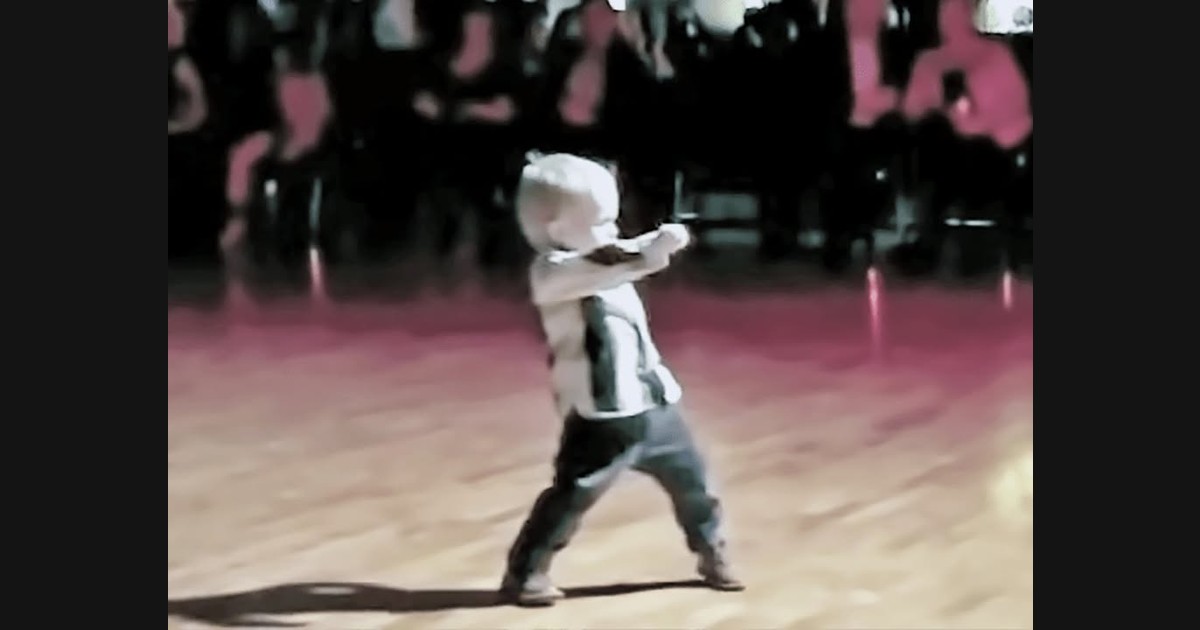
William Stokkebroe’s early Jailhouse Rock recording is often presented as a child appearing from nowhere to surprise a room. The original studio account supplies a more interesting setting. He had been watching dancers, including his parents, at a studio opening before taking to the floor during an interval.
Studie 43 identifies the occasion as the gala opening on 2 March 2012 and names Kristina and Peter Stokkebroe alongside the dancers of Beat Fabrikken. That context places the recorded moment inside an existing dance community.
Watch on YouTube ↗
Watching is part of the occasion
The account does not need an invented story about formal lessons or a hidden rehearsal. It describes a child surrounded by performance, with an opportunity to participate. That is enough to change the emphasis from isolated novelty to a relationship with an activity happening around him.
A dance community offers more than a polished show. It creates spaces in which people watch, recognize music, respond and sometimes try something themselves. Those roles can change during an evening without making every participant a competitor.
This is a useful way to approach the clip without making developmental claims. One recording cannot explain a child’s complete learning history or predict a career. It can preserve a particular act of participation in a particular social setting.
An interval is different from a competition round
The studio’s description places William’s dance in an interval. That matters because the surrounding event is not the same thing as a judged solo entry. Viewers can enjoy the movement without assigning an imaginary score or comparing it with adult championship standards.
Music supplies a shared reference between the floor and the people around it. Even when they are not performing together, the same recorded sequence lets participants understand an entrance, a continuation and an ending. A response from the room belongs to that relationship, not to a universal verdict on future ability.
Watch on YouTube ↗
A later upload does not create another early event
The second Jailhouse Rock upload revisits the young dancer through a different online presentation. It should not be counted as evidence of an additional studio appearance merely because its title is phrased differently.
Keeping the original account in view also prevents the historic age label from becoming a present-day description. The child in the 2012 recording is being seen at a particular point in time, not remaining that age whenever the clip is reposted.
Watch on YouTube ↗
A later performance extends the context
Studie 43’s 2018 upload identifies William with Specific Kidz in a break-show presentation. It supplies a later performance reference, with a different format and company. It is not a reason to invent an uninterrupted training chronology between the videos.
The valuable continuity is simpler: the same named participant appears in more than one recorded dance setting. The early clip gains depth when it is treated as a moment within a community and a life, rather than a permanent novelty defined only by the viewer’s surprise.


