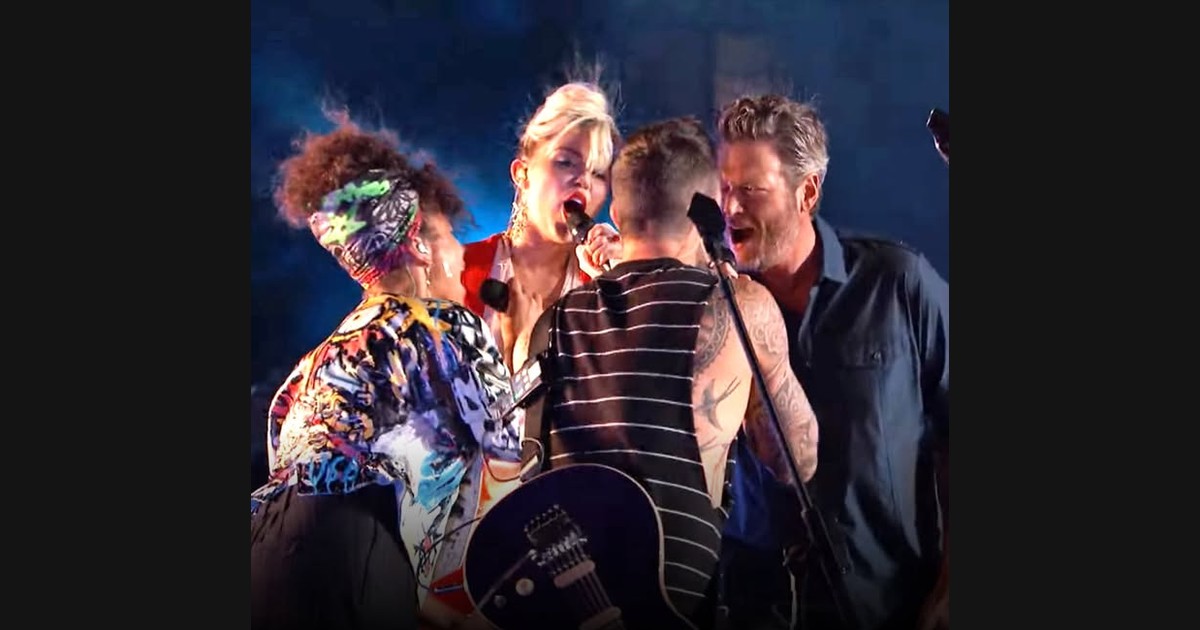
A coaches’ performance changes the usual viewing relationship in The Voice. The people normally identified with selecting and guiding contestants become the featured performers themselves. The “Dream On” upload naming Miley Cyrus, Alicia Keys, Adam Levine, and Blake Shelton is useful for hearing how several established voices share one musical task.
The related “Crazy” and Australian coaches’ “Dream On” selections create two different comparisons. One changes the song within the broader coaches-performance format; the other returns to the same composition with another named panel.
Watch on YouTube ↗
A panel is not automatically an ensemble
Several recognizable singers can occupy a stage without doing the same musical work at every moment. One voice may introduce a statement while another supports it, supplies a contrast, or helps make a returning idea feel shared.
Begin by following the principal line through a complete passage. Then replay it while concentrating on what the other contributions add. The division of attention can be more informative than a simple comparison of vocal size.
Individual sounds do not have to become identical for the performance to feel coherent. Their differences can supply contrast, provided the arrangement gives each contribution a place within the work’s course.
A shared arrival needs preparation
A simultaneous passage can attract immediate attention, but its effect depends on what precedes it. An individual statement, a handoff, or a change in the accompaniment may prepare the moment when the texture expands.
Choose a point that feels like a destination and follow the route toward it. Consider where your expectation begins. This keeps the whole arrangement involved in the explanation rather than assigning the effect only to whichever voice is most prominent at the end.
The program’s coaches also bring recognizable public identities. Those identities can help viewers follow the handoffs, but a familiar name is not a substitute for describing the actual musical relationship.
A different song changes the framework
The “Crazy” selection names Christina Aguilera, Shelton, CeeLo Green, and Levine. It changes the composition and some of the named performers while retaining a shared coaches presentation.
Watch on YouTube ↗
Use it to test the same division-of-work approach. Follow what establishes the principal idea, what supports continuity, and what creates a point of shared emphasis.
The comparison should not assume that every coaching panel or program year uses the same arrangement. The format gives a public frame, while each selection supplies another musical problem to organize.
Return to Dream On with another panel
The final upload identifies a Voice Australia coaches’ “Dream On.” It holds the composition in place more closely than the intervening “Crazy” selection while changing the public partnership.
Watch on YouTube ↗
Compare one recurring musical idea rather than rank whole panels by a single impression. A familiar destination can be prepared through different balances and proportions.
The set becomes clearest as a study of shared responsibility. Coaches who normally respond to contestants must themselves establish entrances, handoffs, and a complete course through a song. Their public roles explain the format, while the arrangement gives listeners specific relationships to follow within it.


