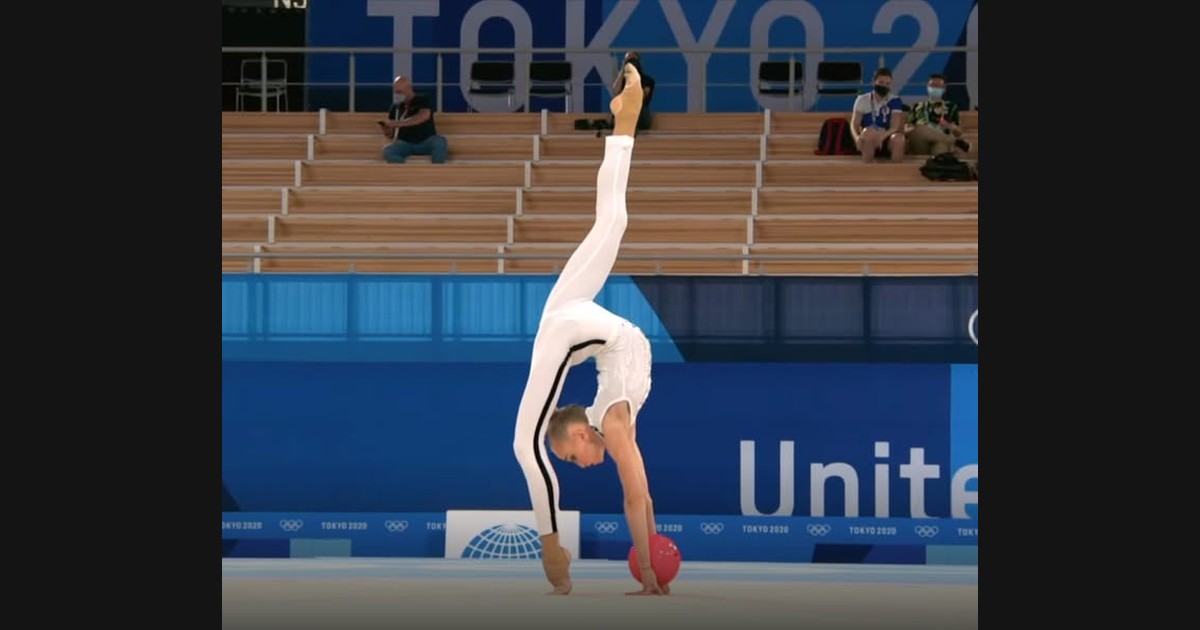
Viktoriia Onopriienko’s “Smooth Criminal” recording is rhythmic gymnastics, with a ball as its apparatus. The Olympic Games channel identifies the Ukrainian athlete and her Tokyo 2020 debut. The music and the object belong to one organized routine, rather than an unrelated display of ball tricks.
The official Tokyo music-selection record also lists Michael Jackson’s song for Onopriienko. The event retained the Tokyo 2020 name when it took place in 2021, an important distinction between the edition’s title and the calendar date.
Watch on YouTube ↗
The object changes the movement’s relationships
A ball gives the routine another visible element to coordinate. The gymnast’s position, the apparatus’s path and the musical sequence can create several relationships at once. The object is not merely decoration attached to a dance.
This gives viewers a useful way to follow the complete performance. Instead of attending only to one conspicuous skill, notice how the apparatus remains part of the continuing sequence before and after it. Transitions connect separate events into a routine.
Music supplies landmarks without explaining every skill
A recognizable song can provide pulse, contrast and points of arrival. The choreography can relate movement to those landmarks without literally acting out every word of the composition. Musical interpretation and apparatus handling meet inside a competition discipline.
For a focused viewing, choose a complete musical phrase. Follow where the athlete and ball are in relation to one another as that phrase develops. The task is to understand continuity, not to assign a difficulty value or recreate the movement.
A short clip does not provide the full scoring rules or every judging decision. The music-focused comparison can remain useful without pretending to evaluate the routine as an accredited official.
A music-selection record answers which composition was chosen. It cannot identify every choreographic intention or explain each judging decision. Keeping that boundary allows the verified Michael Jackson connection to enrich the viewing without turning it into an unsupported account of the athlete’s complete design.
The hoop changes the visible framework
The second Olympic recording presents Onopriienko’s hoop routine at the same edition. The athlete remains the reference while the apparatus changes.
Watch on YouTube ↗
A hoop has a different visual outline and different relationships with the body from a ball. That changes what the audience can follow immediately. The broader task remains connecting the object, the gymnast and the routine’s musical time.
Thriller introduces another athlete
The final official clip identifies Taisiia Onofriichuk performing to “Thriller.” Onofriichuk and Onopriienko are different athletes. Their similar-looking names should not make the recordings appear to be three performances by one person.
Watch on YouTube ↗
The comparison now changes both performer and musical selection. A Michael Jackson reference connects the first and last videos, but it does not establish identical choreography, apparatus or competition circumstances.
Keeping those identities clear makes the opening routine more informative. Onopriienko presents a specific ball program, while the other recordings provide different points of comparison. The composition helps organize the audience’s attention, and the apparatus gives the physical sequence its particular demands. Following their relationship reveals a complete performance design rather than a collection of isolated impressive moments.


