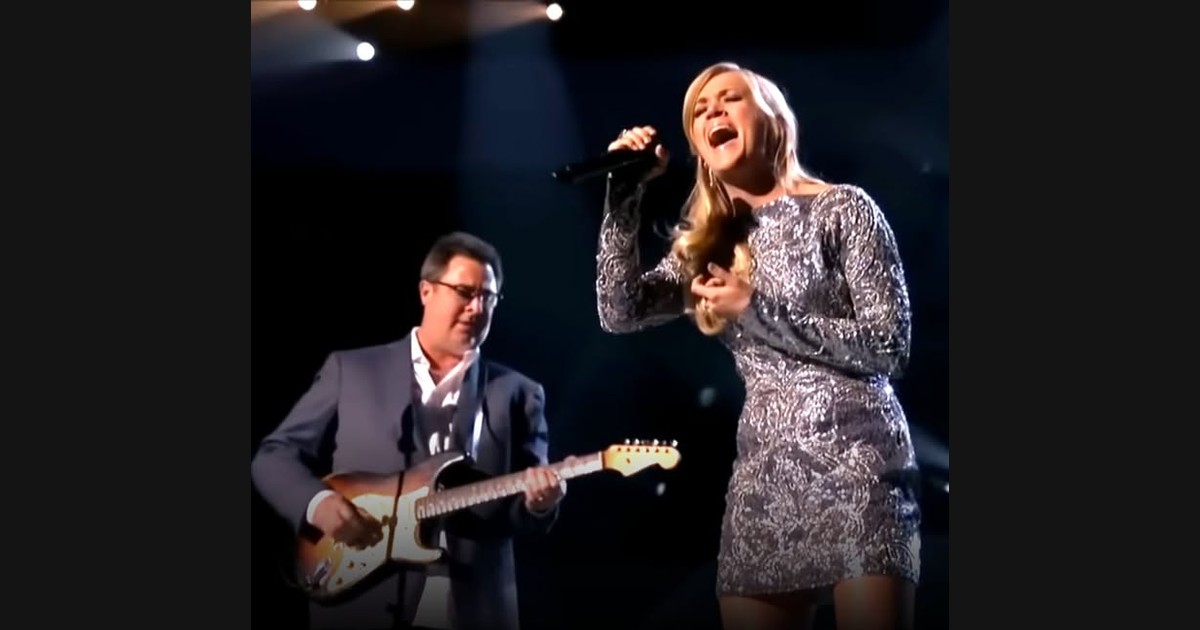
A featured singer does not have to carry every part of a performance’s expression. Carrie Underwood and Vince Gill’s “How Great Thou Art” offers a useful example of a shared musical center: the vocal line supplies words and melody, while guitar can continue the thought when the singer leaves space.
Underwood’s official Greatest Hits: Decade #1 listing identifies the track with Gill as a live recording from ACM Presents: Girls’ Night Out. That is a specific concert presentation, rather than a reason to merge the performance with every annual ACM awards broadcast. The collaboration is preserved in her released catalog as well as the concert video.
Watch on YouTube ↗
Accompaniment can be an active voice
The word “accompaniment” sometimes suggests a secondary layer that simply stays underneath a singer. In practice, an instrumental part can establish motion, mark a boundary or answer a phrase. Those functions allow a performance to develop without putting new words into every available moment.
A guitar response does not need to copy the tune exactly. It can share the direction of a vocal phrase, introduce a contrasting shape or lead the ear toward another entrance. The important relationship is between the two musical thoughts, rather than between a main performer and an interchangeable backing sound.
Follow what happens after a line ends
For a focused listen, begin with one complete vocal thought. Notice its point of arrival, then keep listening during the gap before the next line. Ask what preserves the sense of movement. A continuing pulse, a changing harmony or an instrumental response can all keep a pause from becoming a stop.
Next, reverse your attention. Follow the instrumental part until the voice returns. Does the return feel prepared, like a new beginning or like a continuation of something already underway? These questions direct attention toward ensemble relationships without needing a claim about a particular note, camera shot or exact moment in the recording.
This perspective also gives sustained singing a context. A long note can be an arrival, a point of suspension or part of a continuing phrase. Its expressive force depends partly on what the surrounding musicians do. Duration alone is not a complete explanation of its musical effect.
A different featured-vocal setting
Alexandra Burke’s “Hallelujah,” presented by The X Factor UK, offers another kind of featured vocal performance. The change of song and program lets the listener ask the same ensemble question in a different setting: what carries the performance while the central voice is silent?
Watch on YouTube ↗
The comparison is about musical responsibilities, not equivalence between the songs’ religious language or a claim about either performer’s beliefs. A title cannot establish all the meanings of a composition, and a televised performance does not require every viewer to share one interpretation.
When several voices share the response
The United States Air Force Band’s Singing Sergeants present the third recording, another “Hallelujah.” A vocal ensemble expands the possibilities for supporting and answering a melodic line because another voice can provide continuity directly.
Watch on YouTube ↗
Return afterward to Underwood and Gill. Listening past the featured vocal moments reveals a more complete partnership: expression can pass between words and instrumental sound. That exchange helps explain why the musician beside a singer can be central to a performance’s meaning without occupying its lead position at every moment.


