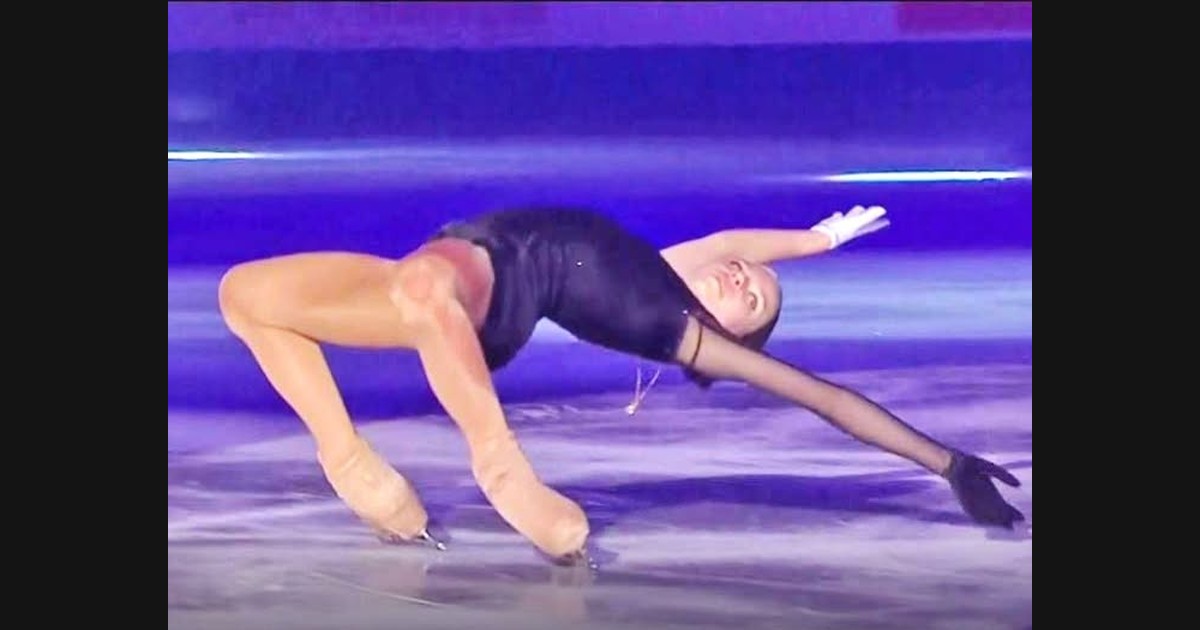
A skating performance occupies a rink, but a video shows a selected view of it. Alexandra Trusova’s 2019 Skate Canada gala is a useful place to consider that difference. A viewer follows not only the skater’s movement, but also the recording’s decisions about distance, direction, and what remains outside the frame.
The event’s official schedule separates the competition from the exhibition gala. Here the gala is the starting point for a viewing exercise, rather than evidence for reconstructing a score. The related free-skating and exhibition clips provide two additional screen encounters.
Watch on YouTube ↗
Begin with position
During one short passage, pay attention to where the skater appears to be within the available space. A broad view can make travel across a rink legible. A closer view can make an expression or a local movement easier to see while withholding part of the larger route.
Neither distance is inherently the correct one for every moment. Each gives access to some information and less access to something else. The first task is to recognize which information is actually available before drawing a conclusion from it.
| Viewing subject | Information to look for |
|---|---|
| Travel | The relation between the skater’s route and the surrounding space. |
| Local detail | A movement’s beginning, continuation, and ending within the visible frame. |
| Screen motion | How much apparent movement comes from the skater and how much from the changing view. |
Follow a route across a musical boundary
Choose an audible phrase ending or other clear musical landmark. Notice whether the visible movement gathers around it or continues onward. This gives a manageable connection between sound and space without requiring a technical name for every element.
Then check what the frame allows you to establish. If the recording changes its view, part of the spatial connection may be less obvious. That does not make the performance discontinuous; it means the screen has supplied another point of attention.
The competition recording changes the context
The ISU’s official free-skating selection is a separate program from the gala. It can be used to compare how you read movement on screen, but the gala’s presentation should not be treated as another scored segment of the event.
Watch on YouTube ↗
Repeat the same small exercise: identify a musical boundary, then follow the visible route through it. Comparing the method is more useful than assuming that a recognizable athlete must be presenting the same choreography in every clip from an event.
A screen recording also does not reproduce the position of every spectator. Someone seated in the arena would have a continuous personal viewing location; the video offers its own changing or fixed relationship to the ice.
A second exhibition broadens the comparison
On Ice Perspectives identifies Ye-lim Kim performing to “A Thousand Years” at An Evening with Champions in 2023. This changes the athlete and occasion, while preserving the exercise of reading a performance through a camera.
Watch on YouTube ↗
Consider how the supplied view changes your sense of distance and travel. Describe a specific relationship you can follow, rather than assigning a universal advantage to one recording style.
Returning to Trusova’s gala afterward may make the camera’s contribution easier to notice. The screen remains a valuable route into the skating, while its boundaries explain why any single clip offers a particular perspective rather than the entire experience of the rink.


