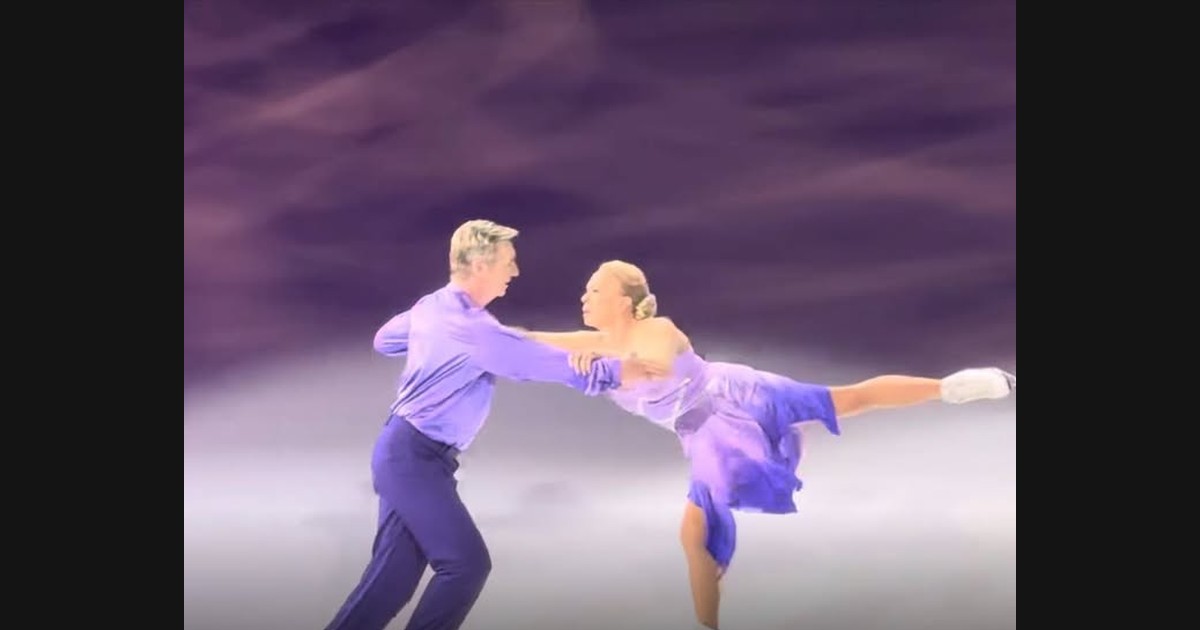
A farewell performance can contain more than one kind of time. The music proceeds through its own patterns, the skaters move through a choreographed sequence, and the audience may remember an earlier performance associated with the same material. Torvill and Dean’s Nottingham “Boléro” recordings make those layers worth separating.
The duo’s official Our Last Dance page lists its final Nottingham dates as July 10–12, 2025. British Ice Skating connects their farewell with the partnership’s history, including the 1984 Sarajevo Olympic gold associated with Ravel’s music. That verified context gives the occasion a retrospective frame.
Watch on YouTube ↗
Three clocks running together
| Layer | What to follow |
|---|---|
| Musical time | A recurring rhythmic reference and the ideas heard around it. |
| Movement time | An approach, a change of shape, and the transition that follows. |
| Remembered time | The connection a viewer makes with an earlier point in the partnership. |
The layers interact, but they are not identical. Recognizing music associated with an earlier routine does not prove that every movement is an unchanged reconstruction. Nor does a farewell context tell us exactly what either performer was thinking during a particular passage.
A repeated reference makes change noticeable
San Francisco Symphony’s educational account emphasizes the repeated snare-drum pattern in Ravel’s Boléro. A stable musical reference gives a listener something against which other developments can be heard. The skating presentation can then be considered in relation to that reference rather than as a list of isolated poses.
Follow one movement phrase from its preparation to its conclusion. Does its arrival coincide with a clear musical point, or does the movement continue across it? The question concerns the relationship visible and audible in the recording. It does not require technical scoring language or an assumption that the skating edit contains the whole orchestral work.
Watch on YouTube ↗
A retrospective is a new occasion
The second Nottingham upload returns to the farewell-tour setting. Its significance comes partly from revisiting familiar material after a long partnership, but it remains a contemporary performance within that tour. It should not be described as newly discovered footage from the Olympic event.
This changes the audience’s task. A competition asks for assessment under a particular sporting framework. A retrospective show invites recognition and reflection within an entertainment program. One recording can be appreciated without importing the exact judging conditions of another era.
Keep the precise event claim proportionate. The official schedule establishes the final Nottingham dates; a fan title does not necessarily distinguish a matinee from an evening show or prove that several uploads document separate performances.
Watch on YouTube ↗
Another viewpoint changes what can be seen
The third recording offers another audience perspective. A wider view may clarify travel across the ice, while a closer one can make an individual shape easier to read. Compare a recognizable musical passage before deciding whether the underlying sequence differs.
The strongest response can acknowledge memory without inventing it for others. Name one recurring musical feature and one movement relationship you can follow. Then describe what the farewell context adds for you. That keeps the music, the skating, and the occasion connected while giving each its own part of the account.


