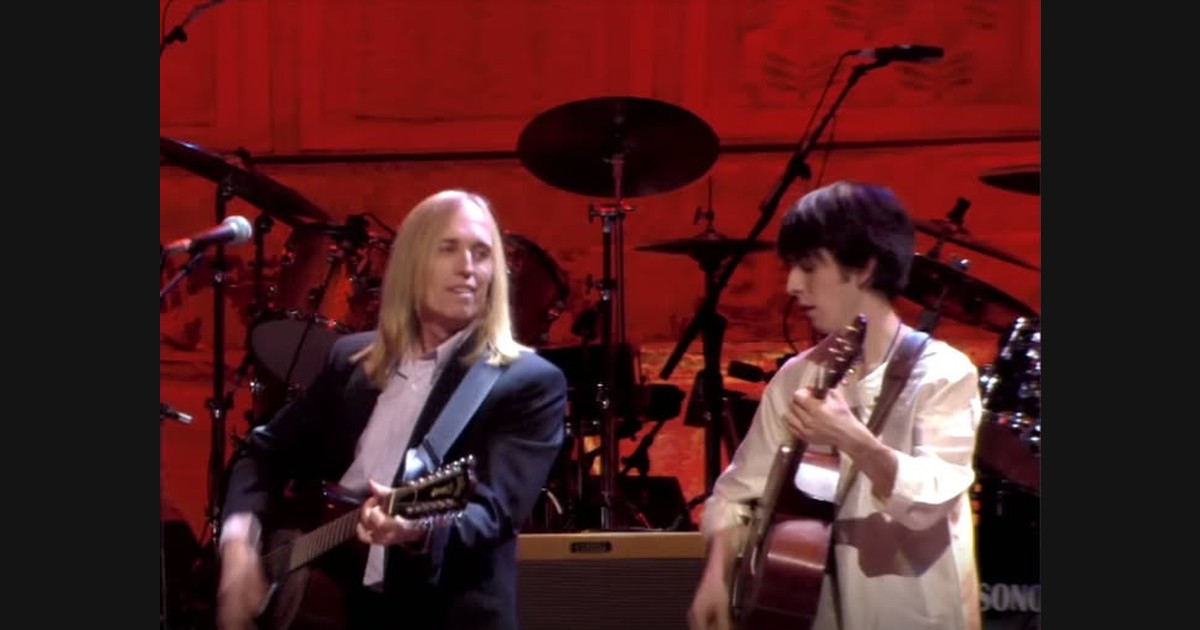
Tom Petty and the Heartbreakers’ “I Need You” at Concert for George reaches back to an early George Harrison composition. The song appears on the Beatles’ 1965 Help! album. Its presence in the later tribute therefore honors a writing career extending across different band and solo contexts, rather than only Harrison’s later catalog.
Harrison’s official concert record dates Concert for George to November 29, 2002, at London’s Royal Albert Hall. The principal official video names Petty and the Heartbreakers as the performing act for this selection.
The writer and the tribute performer have different roles
The Beatles’ official song page credits Harrison as the writer of “I Need You.” Petty’s featured role belongs to the later concert interpretation. Hearing one artist sing another’s composition does not transfer the writing credit or make the song part of the interpreter’s original catalog.
Watch on YouTube ↗
The distinction is especially useful in a tribute whose subject’s name appears throughout the project. “Concert for George” identifies the person being honored; it does not mean Harrison is physically performing in each video carrying the title.
The program can connect different periods
| Reference | Historical role |
|---|---|
| Help!, 1965 | The Beatles album context for Harrison’s composition. |
| Concert for George, 2002 | The later tribute occasion. |
| Petty and the Heartbreakers | The named interpreters in the principal selection. |
| Published concert video | The document through which the interpretation is encountered. |
A tribute program can make early work newly prominent by placing it beside songs from other periods. The selection’s importance need not depend on chart rank or on calling it the songwriter’s definitive work. It contributes one part of a wider career portrait.
Hear the song before importing the occasion’s meaning
A tribute can give an existing song a new public address. That does not mean every line was originally written about the later occasion or the people now performing it. The composition had its own context before the concert.
For a listening focus, follow the recurring melodic idea and its continuation. Notice how a phrase returns within the arrangement. This keeps the song’s musical shape present alongside the larger significance of the tribute.
The second upload’s wording needs the same distinction
The companion title places Harrison’s name beside Petty’s “I Need You.” Read that through the documented tribute context rather than treating it as proof of a live duet with Harrison.
Watch on YouTube ↗
A project name, songwriter credit, and performer credit can appear close together in a headline. Separating them prevents the wording of a later upload from rewriting the actual event.
The next selection broadens the repertoire
The final official video is Paul McCartney and Eric Clapton’s “While My Guitar Gently Weeps” from Concert for George. It retains the tribute occasion while changing both the song and the featured performing relationship.
Watch on YouTube ↗
This is a program comparison rather than three versions of “I Need You.” Consider how different interpreters can contribute distinct selections within the same tribute without requiring a uniform arrangement.
Petty’s number is clearest when its layers remain visible: a Harrison song from the Beatles period, a later performance by named interpreters, and a concert assembled to honor the writer. The early composition belongs to the tribute precisely because the program can reach across those periods.


