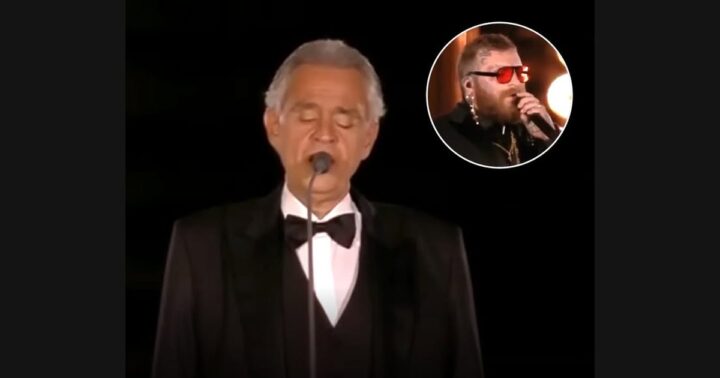
On The Voice UK, Tom Jones is usually associated with the act of listening: a coach hearing a singer and deciding how to respond. His “Tower of Song” performance reverses that direction. The person normally in the listening position becomes the musical subject, and the program briefly asks viewers to attend to his interpretation.
The official Voice UK upload establishes the television context. Its appeal does not require an account of what every other coach privately felt. The shift in role is substantial enough to explain why the moment differs from a regular audition.
Watch on YouTube ↗
The listener has a working method
In a direct interview published on his official site, Jones discussed his approach to auditions. He described wanting to hear as much of a performance as possible rather than deciding from its opening alone. He also emphasized the basic character of a voice before the arrangement surrounding it.
Those comments offer a useful viewing method for his own performance. A song develops through time. Its beginning can establish a reference that a later phrase changes or deepens. Judging only a prominent note can miss the preparation that makes it meaningful.
Follow a complete musical thought
Try listening through the end of a phrase before deciding what defines it. Consider how the line begins, how it moves, and what happens as it gives way to the next one. A sustained sound, a pause, and an accompanying response each occupy part of that sequence.
This is different from ignoring technique. It places technique within a musical purpose rather than treating the performance as a collection of isolated demonstrations. The listener has something concrete to follow even without specialist vocabulary.
A coach’s performance is not a contestant result
A professional feature inside a competition program occupies a different role from a contestant’s appearance. It can illustrate an approach, provide a change of pace, or present repertoire associated with the coach. Its presence does not tell us that the program’s selection rules have been applied to that performance.
Jones had already included Leonard Cohen’s “Tower of Song” in his recorded repertoire. The television clip therefore need not be framed as a song created spontaneously in the chair. It is an interpretation brought into a particular program setting, with its existing relationship to the singer still intact.
Hear a Cohen song through an ensemble
The next recording presents the United States Air Force Band’s Singing Sergeants performing “Hallelujah.” This changes the composition and the vocal setting. The comparison concerns how attention is distributed when an ensemble replaces the single featured voice.
Watch on YouTube ↗
Follow where the principal line is placed and how the accompanying voices support it. A listener can recognize different functions without assuming that every singer must carry the melody at every moment.
Another television setting
Alexandra Burke’s X Factor performance of “Hallelujah” supplies the final comparison. It returns to a featured solo voice within a named television program while retaining the song from the ensemble selection.
Watch on YouTube ↗
The sequence gives Jones’s listening advice practical scope: hear the whole musical thought, then compare how different settings support it. His coach-to-performer moment becomes more than a reaction clip. It becomes an opportunity to use an experienced singer’s stated listening priorities on the performance he offers.