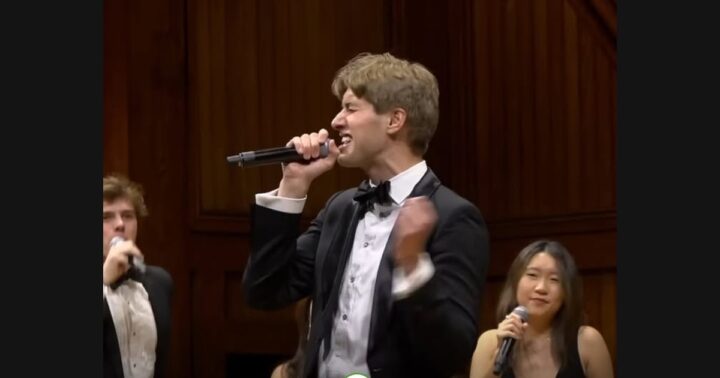
A standard can be strongly associated with a singer without beginning with that singer’s recording. Fever, performed here by Tom Jones and Kelly Rowland in a The Voice UK selection, offers a useful example. Peggy Lee’s official song history identifies Little Willie John as the performer who introduced it in 1956, before Lee’s own version in 1958.
The credited writers are Eddie Cooley and John Davenport, the latter a name used by Otis Blackwell. That authorship remains separate from the later singers whose recordings and performances give the composition further public lives.
The television duet
Watch on YouTube ↗
Two featured singers change the presentation of a song that listeners may remember through one central voice. A phrase can become an exchange, an answer or a shared statement. The difference concerns musical responsibility rather than an assumption that the performers are describing their own relationship.
A duet can retain the same narrator while letting the delivery move between people. It does not need two separate fictional characters to make its partnership clear. Alternating voices supplies contrast; overlapping voices supplies another kind of connection.
What makes an exchange intelligible?
- An opening: one voice establishes the next idea.
- A response: another voice continues, answers or changes its emphasis.
- A shared reference: accompaniment and familiar material keep the exchange within one song.
- A boundary: the phrase finishes clearly enough for the next idea to begin.
These jobs can move between the singers. The person briefly providing support still contributes to the duet’s shape. Attention does not have to remain fixed on whichever line is loudest or highest.
The song’s history also makes variation part of the context. Lee’s own catalogue describes changes she made to its verbal material. Without reproducing those words, the useful point is that a familiar standard has already traveled through distinct interpretations before arriving in a later television partnership.
A solo-associated title changes the comparison
Watch on YouTube ↗
Jones’ It’s Not Unusual selection provides a different song within the same broad program world. It supplies a reference for a performance centered more directly on his featured identity, rather than a sustained exchange with another lead singer.
Compare one responsibility across the clips: how a new phrase is introduced or how accompaniment maintains continuity through a pause. A stable criterion keeps the comparison useful even when the composition changes.
Another duet retains the partnership, changes the material
Watch on YouTube ↗
The official Rowland and Jones You’ll Never Know selection offers another shared performance. Here the partner identities remain recognizable while the song changes. The arrangement may therefore give their voices different kinds of space.
It is more informative to follow those changing musical tasks than to treat a facial expression or gesture as a complete account of private feeling. A public duet can be engaging through the relationship created within the performance itself.
The three selections place Fever within a continuing repertoire history: a credited composition, several influential earlier interpretations and a later shared presentation. Knowing that history adds context while leaving room to hear what two recognizable singers do with the song together.