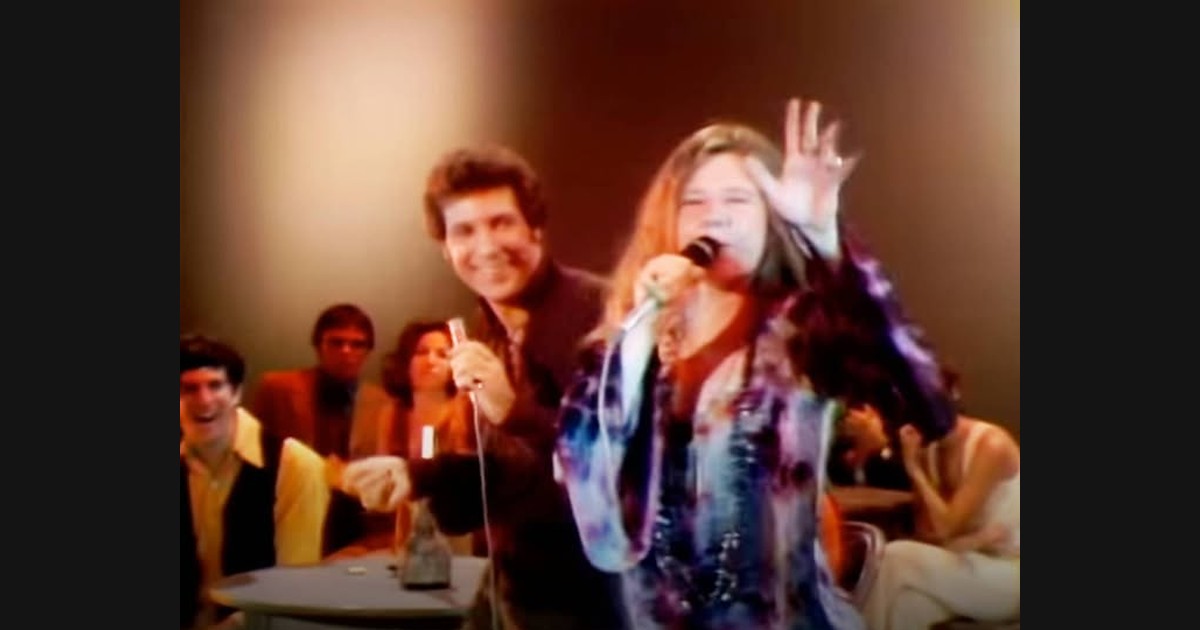
A television duet brings together more than two recognizable names. It gives performers a common composition and a particular setting in which to share it. Tom Jones’s official channel identifies this Raise Your Hand performance with Janis Joplin as an appearance on This Is Tom Jones in 1969.
The same song also belongs to Joplin’s separate television history. The Ed Sullivan archive documents her performance with the Kozmic Blues Band on March 16, 1969. Keeping the programs distinct makes the two selections useful companions rather than treating every surviving clip as footage of one occasion.
The shared television performance
Watch on YouTube ↗
The title Raise Your Hand is an invitation to action. In a duet, an address like that can travel between performers and outward toward an audience. The song supplies a shared purpose even when the participating voices retain different identities.
Listen for how a musical statement is carried onward. Does a second contribution continue the same idea, answer it or change its emphasis? Then consider what happens around the voices: accompaniment can preserve momentum while a singer alters the shape or intensity of a phrase.
These questions focus on the partnership without requiring a verdict about which singer dominates. A duet can work through contrast as well as resemblance. The important relationship is how contributions belong to the continuing piece.
The song has writers as well as interpreters
The Sullivan archive credits Steve Cropper, Eddie Floyd and Al Bell as the song’s writers. That credit separates the composition from any one famous television presentation. Jones and Joplin contribute an interpretation of existing material, not the origin of the song itself.
This distinction is helpful whenever an artist’s strongly recognizable style becomes closely associated with a number. An interpretation can leave a powerful impression while the underlying work remains available for other singers, bands and occasions.
Joplin with her own band
Watch on YouTube ↗
The second selection comes from the Sullivan archive. Its account identifies Joplin and the Kozmic Blues Band, giving the performance a named ensemble context beyond the shared Jones appearance.
Retain the composition as your point of reference while changing the performance frame. Follow what supports the lead voice and how a continuing musical idea gains shape. A common song makes differences between settings easier to investigate without assuming that every arrangement decision must be identical.
The program credit also provides a simple historical safeguard: a performance from another show is another recorded occasion. Similar clothes, the same year or the same composition cannot turn two television productions into a single event.
The performer remembers the encounter
Watch on YouTube ↗
The final selection is Jones’s official retrospective about the duet. Published in 2021, it explicitly looks back to 1969. Its job is recollection rather than another complete performance of the number.
A later account adds a participant’s perspective while the original recording remains available for the music itself. Watch the two forms for their different contributions: one preserves a public performance; the other lets its participant revisit that encounter from a later point in his career.
Across the sequence, Raise Your Hand provides continuity without erasing separate credits, programs or publication dates. That combination gives the duet a clearer place in music history and a more focused set of relationships to hear.


