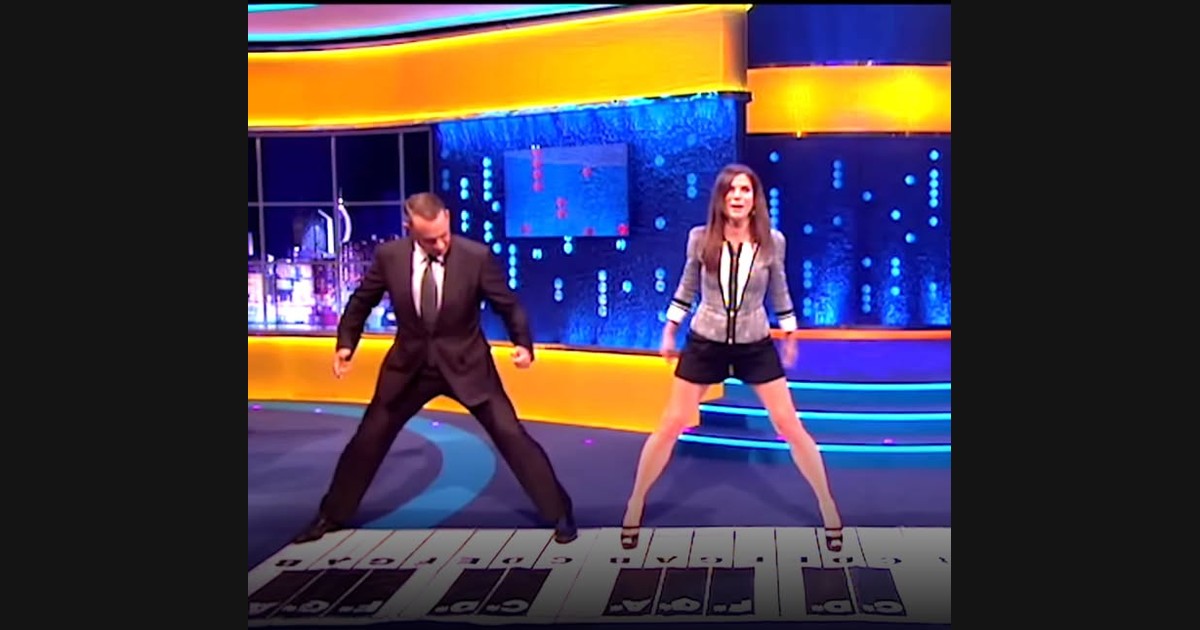
A floor piano makes a simple musical fact impossible to miss: notes have physical locations. Tom Hanks and Sandra Bullock’s Chopsticks appearance on The Jonathan Ross Show turns those locations into places performers have to reach with their bodies.
The programme’s official clip describes Hanks revisiting the famous piano moment from the 1988 film Big, with Bullock joining him. Recognition supplies the premise, but the altered relationship between movement and sound supplies the activity.
Watch on YouTube ↗
The keyboard becomes a shared space
At an ordinary piano, small movements of the hands can cover a sequence of neighboring notes. Enlarging the keys changes the practical problem. Musical distance becomes bodily distance, and moving toward one note affects how easily the next can be reached.
This makes timing visible. A performer cannot merely know which note belongs next; they also have to arrive at its location at the right moment. Preparation becomes part of the action an audience can follow.
With two players, the instrument is also shared territory. Each person’s route has to leave room for the other. A duet therefore involves spatial coordination as well as musical sequence, with the possibility of hesitation becoming part of the entertainment.
Why a familiar pattern helps
Chopsticks gives the segment a recognizable musical reference. Viewers do not have to learn an elaborate new composition before understanding the task. They can attend to the relationship between expected notes and the performers’ efforts to reach them.
That creates a useful comic balance. If the material were entirely unfamiliar, a missed or delayed destination might not be intelligible. Familiarity lets the audience anticipate a route and appreciate the physical negotiation involved.
The segment does not need to be treated as a demonstration of concert pianism. Its pleasure lies in translating a known activity into another bodily scale. The musical pattern is the organizing rule that keeps the movement from becoming arbitrary.
Watch on YouTube ↗
The instrument also has a production history
Mad Professor Ltd’s own upload identifies the floor piano used by the programme as its instrument and describes the show’s finale. That credit supplies another participant in the scene: the people who provided the device that makes the shared task possible.
A prop can be central to a musical sketch without being merely decorative. Here, the keyboard defines what counts as a successful action. It connects a step to a sound and gives the performers something concrete to do together.
Watch on YouTube ↗
Return to the film’s version of play
The Big excerpt gives the television reference its source. Penny Marshall’s film follows a child who finds himself in an adult body, a premise that makes play in an adult world part of the story rather than an isolated musical interruption.
The television version carries that memory into a different encounter. Hanks returns as himself, Bullock becomes his partner, and the floor piano offers a common rule. The familiar scene survives because its central action is so legible: two people making music by negotiating the same space.


