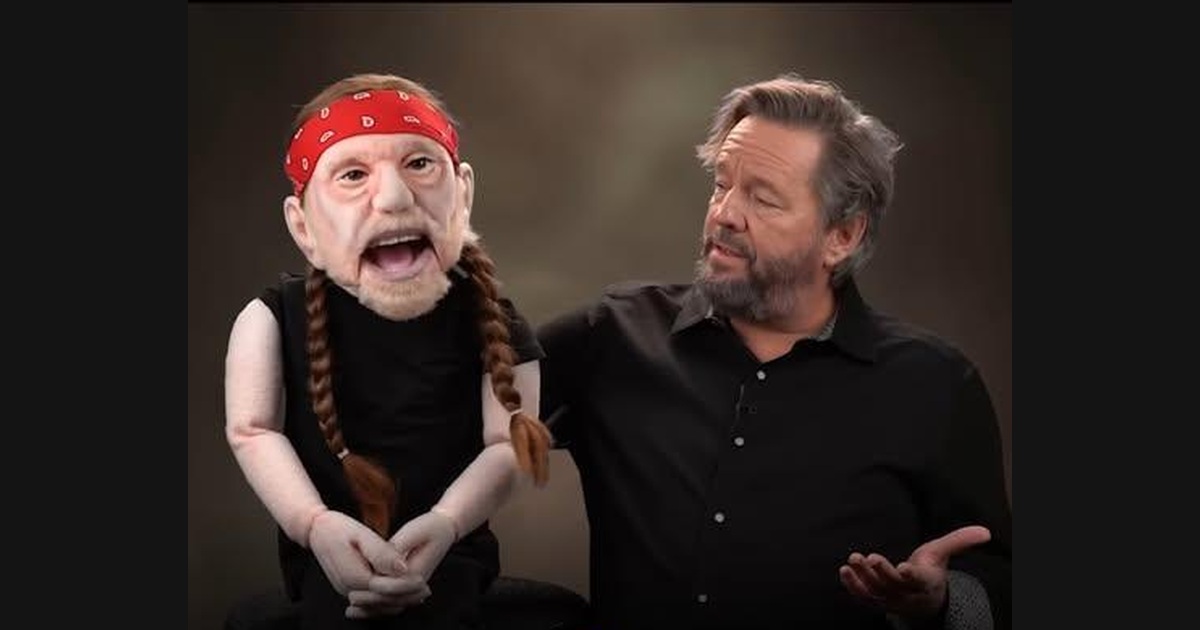
A Willie Nelson puppet creates recognition before a song has finished its first phrase. That is the comic premise of Terry Fator’s “Always on My Mind”: a familiar musical identity becomes a character, while a serious ballad remains available underneath the impersonation. The result can be approached as both a character performance and an interpretation.
Fator’s own channel identifies the singer as Fator and the figure as his Willie Nelson puppet. Keeping that distinction clear matters. The opening video is not a duet with Nelson, and the puppet is not an independent singer. One entertainer is coordinating the musical and theatrical responsibilities.
Watch on YouTube ↗
Recognition creates an expectation
An impression relies on a listener recognizing selected features of an established performer. Costume and a puppet’s appearance can supply visual signals; vocal characterization adds another layer. Those signals create an expectation about who the character represents before the audience assesses the song as a complete performance.
The song then asks for a different kind of attention. “Always on My Mind” centers on regret over care that was not sufficiently expressed. Its meaning does not depend on accepting the puppet as a real person. A comic presentation can preserve a composition’s serious situation while changing the frame around it.
The familiar singer did not write this standard
Nelson’s official site identifies Johnny Christopher, Mark James and Wayne Carson as the writers, and dates Nelson’s recording to 1982. That is a helpful correction to an easy assumption: being closely associated with a song is different from composing it.
There are consequently several identities at work here. The writers supplied the composition; Nelson made a famous recording; Fator performs a character based on Nelson. Treating these as separate contributions makes the entertainment more interesting, because the audience can follow how a song travels through them.
Return to Nelson’s recording
The Nelson audio offers a musical reference with the puppet frame removed. Pay attention to how the speaker moves from acknowledging a failure toward asking that continuing affection be recognized. That sequence is the song’s dramatic work, regardless of which visual presentation accompanies it.
Watch on YouTube ↗
One useful comparison is to consider when you attend to the performer and when you attend to the character speaking in the composition. With an impression, a recognizable vocal gesture may bring the entertainer back into focus. A complete line of the ballad may redirect attention toward its narrator. These shifts are part of the format’s distinctive appeal.
There is no need to turn the comparison into a technical diagnosis of how the voice is made. A released video alone does not establish recording conditions or prove the absence of editing. The supported point is the combination of singing, celebrity impression and puppet characterization that Fator himself presents.
A recurring character rather than a one-off disguise
The third video is another recording on Fator’s channel featuring the same song and puppet. It places the character within an ongoing act, allowing viewers to consider how a recognizable persona can return in more than one presentation.
Watch on YouTube ↗
Across both Fator recordings and the Nelson reference, the important distinction is between recognizing a signature and understanding a song. The first can produce an immediate smile; the second depends on a complete musical thought. Fator’s premise brings those two forms of attention into the same small theatrical space.


