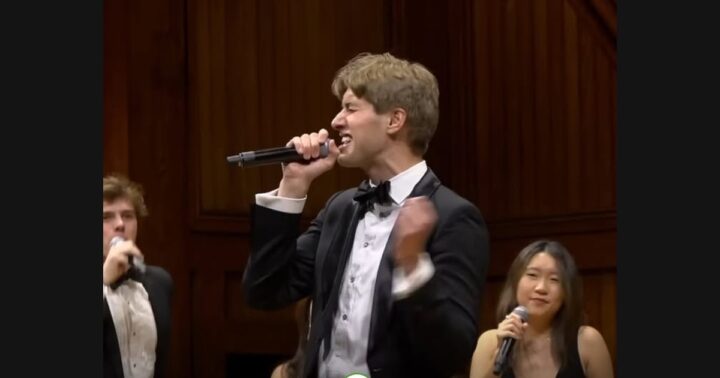
BBC Radio 1 identifies Teddy Swims’s Live Lounge selection as a cover of Taylor Swift’s “Cruel Summer.” That familiar shorthand points listeners toward the recording they may know, but it does not supply the entire songwriting credit.
The official Universal Music Group-delivered recording credits Taylor Swift, Jack Antonoff, and Annie Clark as composer-lyricists. It places the song on Lover, released in August 2019. Swims’s later performance therefore offers a useful opportunity to follow a composition from its credited writers into another artist’s repertoire.
Watch on YouTube ↗
Three contributions can coexist
The writing credit identifies the people credited with creating the song. The artist credit identifies the performer under whose name a recording is released. A cover-performance credit identifies another interpretation of the material. None has to cancel out the others.
“A Taylor Swift song” remains useful conversationally because it locates a familiar repertoire connection. A more detailed note can preserve that connection while also naming Antonoff and Clark. The extra information recognizes collaboration without requiring a speculative account of who supplied each individual note or phrase.
That last distinction matters. A list of co-writers does not establish an equal division of every task, nor does it reveal the precise sequence of a writing session. Credits give a defensible starting point; they are not a transcript of the creative process.
What Swims contributes here
Swims’s task in the Live Lounge is interpretation. He undertakes the existing composition with a different performing identity and a particular arrangement. An account of the cover can explain those choices without suggesting that changing delivery transfers authorship.
For example, imagine describing a familiar melody played by two different ensembles. The melody can remain identifiable while the supporting texture changes. The interpretation has made a meaningful contribution, but the songwriting credit remains attached to the composition.
Apply the same separation when discussing this recording. A vocal phrase, an accompanying part, and a released mix operate at connected levels. A striking performance choice does not, by itself, tell us which co-writer originally developed the material being interpreted.
“The Door” changes the repertoire relationship
Watch on YouTube ↗
Warner Music Ireland’s upload presents “The Door” in a Dublin pub. Warner’s release information places the song in Swims’s I’ve Tried Everything But Therapy (Part 1) repertoire, alongside “Lose Control.” That makes it a different comparison from another version of Swift’s song.
Calling a track part of an artist’s own repertoire does not automatically mean that artist is its sole writer. For a playlist description, distinguish the repertoire connection from the full composition credit rather than guessing at the latter.
A second Swims title completes the map
Watch on YouTube ↗
The artist’s live “Lose Control” gives another recording to identify through performer, song, and version. A short catalog entry containing those three fields is more useful than labeling everything “original” and leaving the meaning of that word uncertain.
This sequence can therefore teach a precise habit: follow the composition credit when discussing authorship, the release credit when identifying a recording, and the musical performance when explaining an interpretation. Swims’s cover adds a new reading of “Cruel Summer” while leaving its collaborative songwriting history visible.