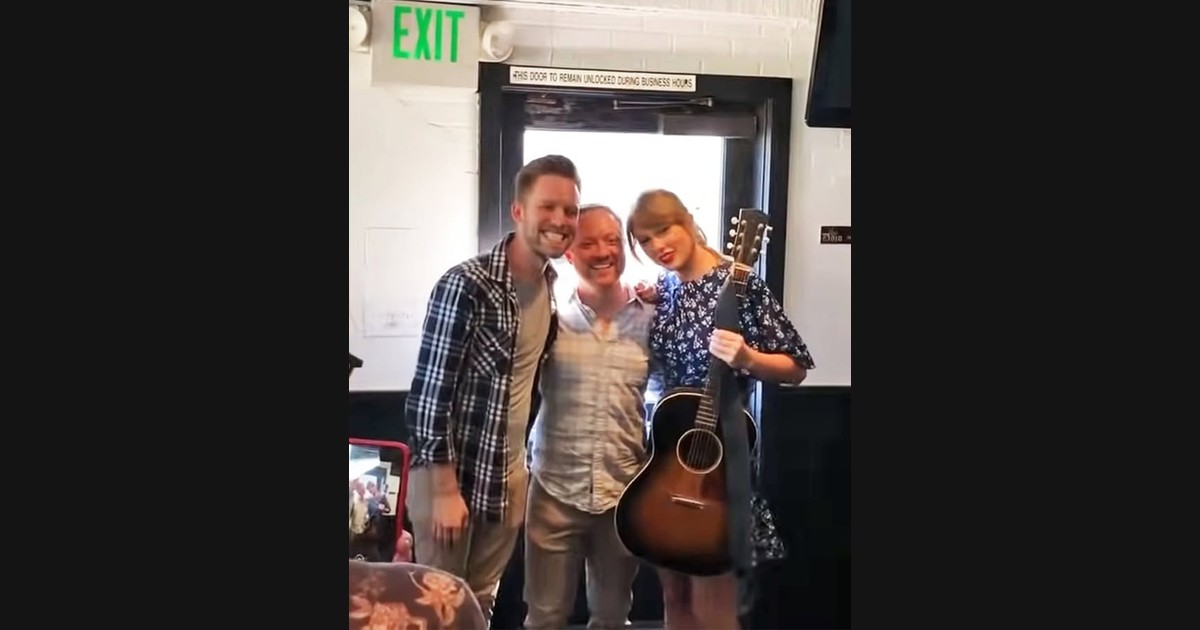
A dedication changes the relationship around a song without requiring its words to be rewritten. At Alex Goldschmidt’s engagement-party appearance, Taylor Swift performs “King of My Heart” within a celebration whose meaning belongs to the people being acknowledged. The singer supplies the performance; another person’s connection with the song supplies the dedication.
Goldschmidt’s own upload identifies the occasion. His first-person account in an ABC interview also explains the song’s significance within his relationship with Ross Girard. That documented historical context is enough without inventing the gathering’s private planning or making claims about anyone’s life today.
Watch on YouTube ↗
Three roles in one musical gesture
A dedicated performance can involve a performer, a person offering the gesture, and a recipient. Those roles need not collapse into one. The artist singing a first-person song is not automatically making every statement as a literal personal address to the person in front of them.
The composition already has its own dramatic perspective. A dedication invites someone to hear it within another relationship. That is one way familiar music can become personal without becoming newly authored for the occasion.
Follow the difference between the introduction to the performance and the song itself. Spoken context can identify why the selection matters; the musical account then communicates through phrasing, melody, and accompaniment. Neither layer needs to replace the other.
A shared reference can carry a specific history
For people who have attached a song to a relationship, recognition can bring earlier listening experiences into the present. An outside viewer may not share those memories, but can still understand the public structure of the dedication.
This is different from claiming to know what every guest felt. The event holder’s account establishes his stated connection with the song, while the recording offers a particular performance. The strength of the story does not depend on converting that account into a universal reaction.
It also leaves room for listeners who encounter the composition outside the celebration. The song can function independently while acquiring another meaning for its recipients.
Watch on YouTube ↗
Another upload does not create another celebration
The companion party recording provides another route into the same identified appearance. A different title may emphasize the acoustic setting or the artist’s entrance, but it does not establish a second engagement event.
Compare a recognizable passage before drawing conclusions about differences. Screen framing and captured sound can affect what becomes prominent even when the underlying performance is shared.
Watch on YouTube ↗
The tour reference changes the audience relationship
The stadium-tour selection returns the song to a different public scale. It is useful as a contrast in occasion, not as proof that every performance carries the engagement party’s personal dedication.
The licensed catalog places “King of My Heart” on reputation in 2017. A later event can borrow that established repertoire and give it a particular recipient without rewriting its release history.
For a final note, identify who is singing, who is offering the gesture, and who is being acknowledged. Keeping those roles clear explains why a dedicated performance can feel personally specific while remaining a shared song with a life beyond the room.


