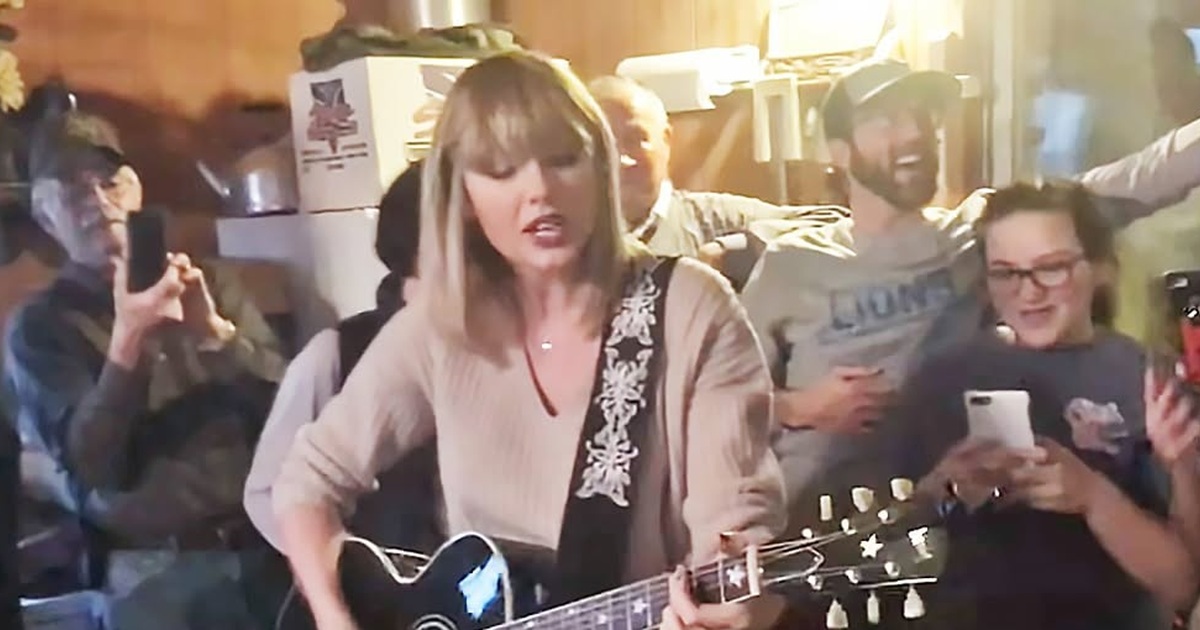
The usual direction of a concert journey is straightforward: a listener goes to the artist. Taylor Swift’s visit to Cyrus Porter reversed that arrangement. Porter had already been to her shows; in December 2016, the singer came to his home in New Madrid, Missouri, and played Shake It Off.
Local broadcaster KFVS interviewed Porter and relatives about the visit. Its reporting identifies him as a 96-year-old World War II veteran and places Swift’s arrival on December 26. Those facts give the encounter a specific person, place and date. They also establish something more useful than the simple surprise of a celebrity appearing: Porter’s interest in the music existed before the visit became a news story.
A news report about an existing fan
Watch on YouTube ↗
The first video is Taste of Country’s report about the encounter. It should be approached as a report, rather than mistaken for an uninterrupted concert recording. A news edit brings together a story and selected material; its boundaries differ from those of a complete performance.
Recognition changes direction
Porter’s account to KFVS included earlier concert trips to Memphis and St.Louis. He was not simply an older person meeting a performer whose songs happened to be available. He was a listener with a preference and a history of choosing to hear that artist.
That difference matters because a human-interest story can accidentally reduce its central person to an age. The generational distance is a striking fact, but it cannot explain the whole relationship. Musical interest does not have to follow an assumed demographic boundary. A listener may discover a connection through a voice, a song or the experience of going to a show, without needing to represent an entire age group.
The visit makes that established connection reciprocal in a practical way. The performer acknowledges a particular listener, and the song supplies something to do together during the meeting. The interest lies in the changed circumstances around familiar material, rather than in a claim that a different song was somehow created in the room.
Keep the song and the occasion separate enough to compare
A piece can carry an occasion without literally describing it. Shake It Off did not need to become a narrative of Porter’s life to belong at his family gathering. Familiarity can be sufficient: people who know a song bring their own earlier encounters with it to a new setting.
That offers a more precise way to discuss an informal performance than assuming that small scale automatically means greater sincerity. A home visit and a broadcast each involve real people and musical choices. Their difference is in the purpose, participants and presentation, not a simple contest between authentic and artificial music.
The same song in a broadcast setting
BBC Radio 1’s Live Lounge recording of Shake It Off provides a useful comparison because the composition stays the same while the frame changes. The published performance is offered to an audience through a named broadcast series, rather than through a report about a particular fan.
Watch on YouTube ↗
Begin the comparison with what can be established: the song title, the presenting organization and the purpose of each video. Then consider how much of your response comes from the music and how much comes from knowing why the occasion occurred. Both can be meaningful without being identical.
A different song, another institution
The final selection is Swift’s official upload of Wildest Dreams at the GRAMMY Museum. It changes both the repertoire and the setting. That makes it a companion to the earlier clips, rather than a controlled comparison in which every difference can be attributed to the room.
Watch on YouTube ↗
Together, the selection moves from one listener’s story to two presentations centered on the performer. Porter’s visit retains its particular character because it begins with his existing enthusiasm. The celebrity surprise supplies the headline; the fact that a listener had already made space for these songs supplies the relationship.