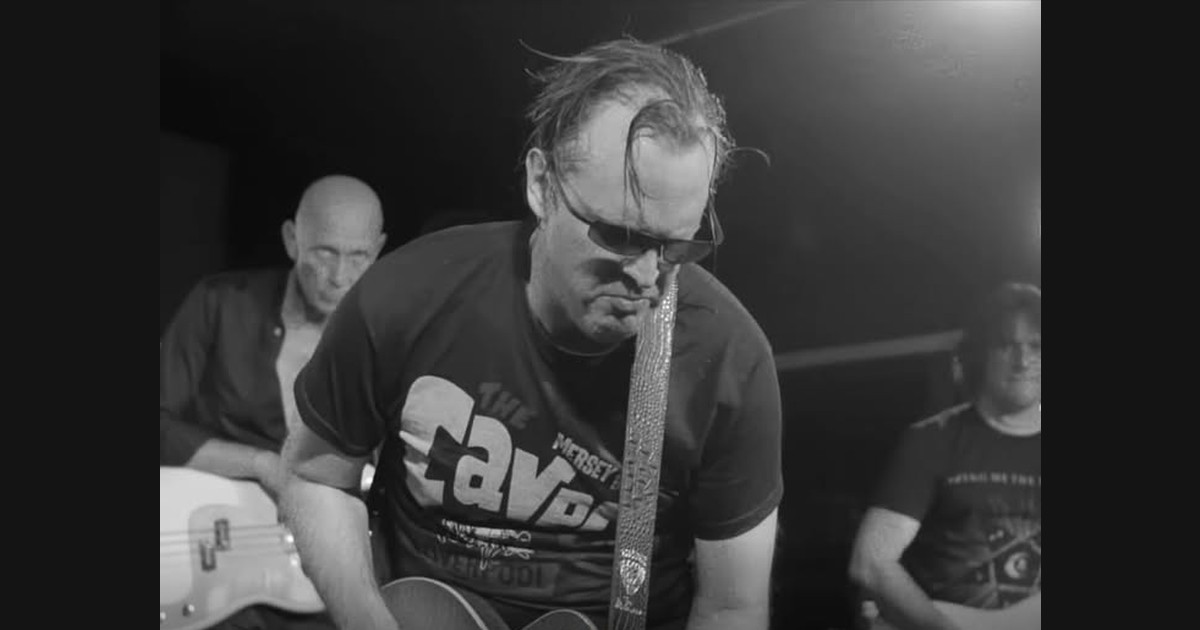
Joe Bonamassa’s Cavern Club “Taxman” performance brings a Beatles song into a venue closely associated with the band. That connection is real, but it is not a reconstruction of the Beatles playing this song in their early club years. The dates describe a more interesting relationship: a later tribute places mature Beatles repertoire inside a setting associated with their beginnings.
The Cavern’s own history dates the Beatles’ first appearance there to February 9, 1961, and their last to August 3, 1963. “Taxman” belongs to Revolver, released in 1966. The song therefore sits after their documented Cavern run, rather than inside it.
Read the setting as a tribute choice
Bonamassa’s artist-issued account identifies the performance as part of Howard Stern’s fiftieth-anniversary tribute to Revolver in 2016. That provides a reason for the repertoire. The Cavern supplies another layer: a place whose Beatles associations can frame a new performance even when the chosen song comes from a later period.
Watch on YouTube ↗
There is no need to imagine an undocumented early performance to connect those layers. A tribute can deliberately bring together material and setting that did not originally coincide. This is similar to presenting an artist’s later work at a venue associated with their youth: the location supplies a perspective on a career rather than a literal recreation of one historical evening.
A short timeline prevents a large misunderstanding
| Period | Relevant connection |
|---|---|
| 1961–1963 | The Beatles’ Cavern appearances, according to the venue’s history. |
| 1966 | “Taxman” appears on Revolver. |
| 1984 | The reconstructed Cavern reopens. |
| 2016 | Bonamassa’s performance is presented for the album anniversary tribute. |
The reconstruction matters too. The venue’s history explains that the original cellar could not simply be reopened in its original form; the later Cavern incorporated bricks recovered from the earlier site. Describing a modern performance as happening in an untouched 1960s room would flatten that history.
The recording and the room answer different questions
The Beatles video provides a reference for the composition and recording tradition behind the cover. The Cavern footage documents Bonamassa’s later interpretation in a historically resonant setting. One supplies the musical source; the other shows how that source can be presented anew.
Watch on YouTube ↗
A useful comparison keeps location and arrangement separate. The venue name tells a viewer why the setting may matter culturally. It does not, by itself, establish the instruments, the musical form, or the interpretation. Those belong to the performance and its documented production rather than to the building’s reputation.
The Stevie Ray Vaughan recording offers a further contrast because its relationship to “Taxman” rests on interpretation, not on the Cavern location. Comparing it with Bonamassa can shift attention from historical scenery back to how a guitarist approaches shared repertoire.
Watch on YouTube ↗
Use precise language for the connection
“A Beatles tribute at the Cavern” is a useful description. “A recreation of the Beatles playing ‘Taxman’ there” would imply a historical event that this timeline does not support. The more precise wording leaves room for both the venue’s importance and the later performers’ independence.
The appeal is in the distance between the dates: an early-career setting, a later Beatles composition, and a modern guitarist’s anniversary contribution. Knowing those layers makes the homage more legible without asking the building to supply a false memory.


