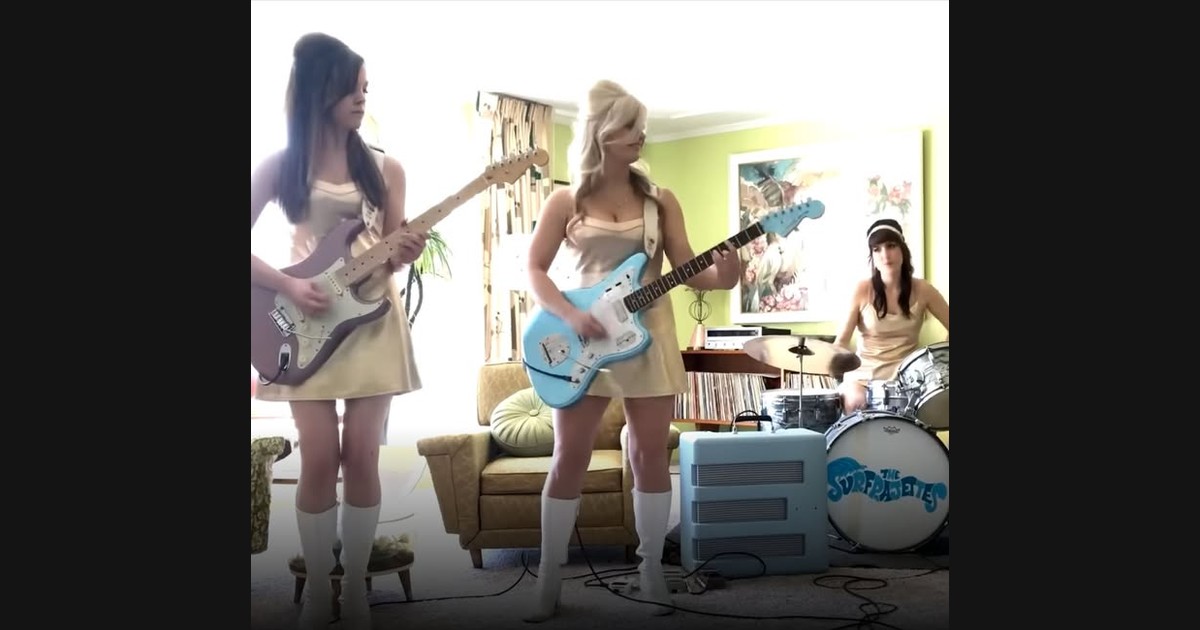
The Surfrajettes’ “Toxic” is more than one filmed reinterpretation of a Britney Spears song. The three recordings here connect a band-published performance, an artist audio release and festival footage. The composition becomes part of a continuing instrumental repertoire.
The group’s own description calls the opening video its surf cover and credits Courtney Reader for filming at Surfrajette HQ. That gives the clip a specific production source. The later live recording is another occasion, rather than another view of the room where the first video was filmed.
Watch on YouTube ↗
A cover can become a band’s calling card
A familiar composition gives new listeners an entry point. Recognition of “Toxic” can direct attention toward the Surfrajettes’ instrumental approach, after which the band has an opportunity to introduce its broader identity and repertoire.
The group’s official biography describes a Toronto instrumental quartet and places “Toxic” beside “Party Line” on a 2018 single. That pairing matters because it locates the cover inside a release, rather than leaving it as an isolated online joke about a pop song played on guitars.
The artist audio removes one visual frame
The second recording presents “Toxic” through the band’s artist catalog. Without concentrating on the room and musicians’ appearance, a listener can give more attention to the arrangement’s continuing musical identity.
Watch on YouTube ↗
A useful focus is the material that connects sections. An instrumental cover needs more than a recognizable opening; supporting patterns and melodic returns help it remain coherent after the first moment of recognition.
The same principle applies to a band’s identity. A particular visual style may make an introduction memorable, but a complete recording still needs an arrangement that carries the listener through the composition.
A festival gives the song another public setting
The final uploader identifies the footage as Tiki Oasis in 2019. It provides another presentation of “Toxic” before an audience, distinct from the band-room video.
Watch on YouTube ↗
Compare the role of the setting rather than assuming identical recording conditions. A live-event camera documents an occasion; an artist audio release presents a track; a band-published performance film gives the musicians a controlled visual introduction. Each can lead listeners toward the same repertoire piece.
A fan video’s sound or image should not be used as a precise measure of how the band changed an arrangement. Camera position and recording choices can affect what is apparent. The stable reference is the musical material and the identified performers.
Repetition is part of repertoire work
Playing the same cover again is not automatically repetition without purpose. A band can make a selection part of its public identity and continue presenting it in different rooms. The work needs to remain recognizable while each occasion supplies another relationship with listeners.
The Surfrajettes’ “Toxic” is useful to hear across these frames because it shows that continuing life. The familiar song introduces an instrumental vocabulary; the single places it inside a release; the festival recording makes it part of a live set. The cover is a piece the band carries forward, not merely an unexpected sound attached to one short video.


