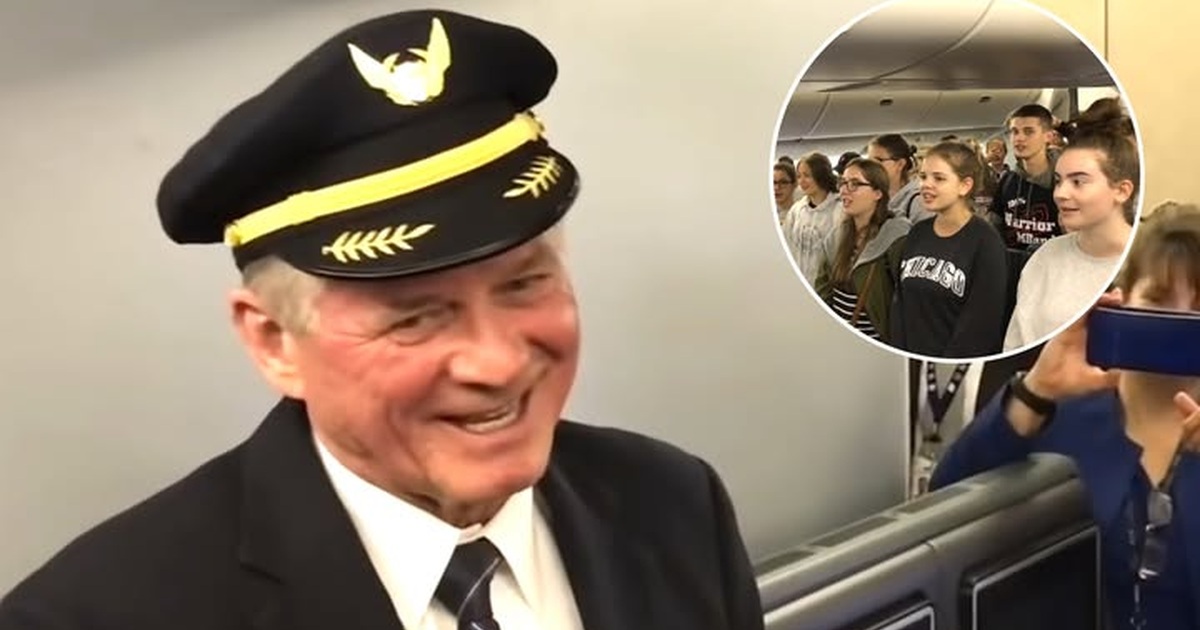
A familiar song does not have to describe someone’s profession to become a meaningful farewell. In this recording, a student choir uses Coldplay’s Viva La Vida to thank an airline captain after his last flight. The connection comes from the people singing, the person they address and the occasion they have chosen.
The original uploader, Nicolas Elsen, identifies the captain as Ronald Smith and the route as Chicago to Brussels on August 18, 2017. His description names the choir of Luxembourg’s Lycée des Garçons d’Esch-sur-Alzette and says its members sang after the flight to thank Smith for 32 years at United Airlines. Those are the uploader’s account of the occasion, rather than details supplied by an airline service record.
The choir’s farewell
Watch on YouTube ↗
The song supplies form; the occasion supplies the address
A retirement tribute needs some way to mark the transition from ordinary work to farewell. A spoken thank-you can do that directly. A song adds duration, a shared activity and an ending that the group can reach together. The singers do not only name their appreciation; they undertake something in the recipient’s presence.
Viva La Vida is not an account of an airline career. Treating every part of its narrative as if it were a factual parallel to Smith’s life would create a biography the performance does not establish. A known melody can carry a gesture without its original story becoming literally applicable to the person being thanked.
That separation makes the choice easier to understand. There are at least two meanings available: the meaning within the song and the meaning of choosing to sing it here. They can interact without matching in every detail. The farewell belongs to the second relationship even for a listener who approaches the song’s narrative differently.
Why the original credit matters
Short descriptions of unexpected performances often become increasingly elaborate as they are retold. Naming the uploader’s account keeps this one connected to a specific choir and captain. It also makes it unnecessary to add private conversations, a relative’s supposed explanation of the song choice or an imagined plan for every stage of the surprise.
The group’s named institution is an important part of that credit. “Passengers sing for a pilot” gives the broad situation. Identifying a school choir explains that the performance came from a particular collective, with a shared activity beyond the flight itself. The people involved remain participants in their own story rather than anonymous ingredients in a celebrity-style reveal.
Another farewell, a different form
The second video changes both place and tradition. Palmerston North Boys’ High School identifies its school haka for teacher Dawson Tamatea’s funeral as his hearse arrives. It is not a second version of the airline event, nor does it need to be interpreted as a pop-song tribute.
Watch on YouTube ↗
The useful connection is narrower: a group addresses a person through a shared performance at a transition. Keeping the differences visible matters just as much. Retirement and bereavement are distinct circumstances; a particular school haka carries cultural and community associations that should not be reduced to a generic farewell soundtrack.
A choir presented as a featured ensemble
The final supplied recording is the United States Air Force Band’s Singing Sergeants performing Hallelujah. Its institutional credit provides another contrast: a named professional ensemble presented for its musical performance, rather than a recording introduced primarily through an unexpected passenger encounter.
Watch on YouTube ↗
These selections are connected by people singing or performing together, but each has a different frame. The captain’s farewell remains distinctive because a particular school choir directed an existing song toward a particular thank-you. The words did not have to become an aviation story. The occasion gave the performance its immediate purpose.