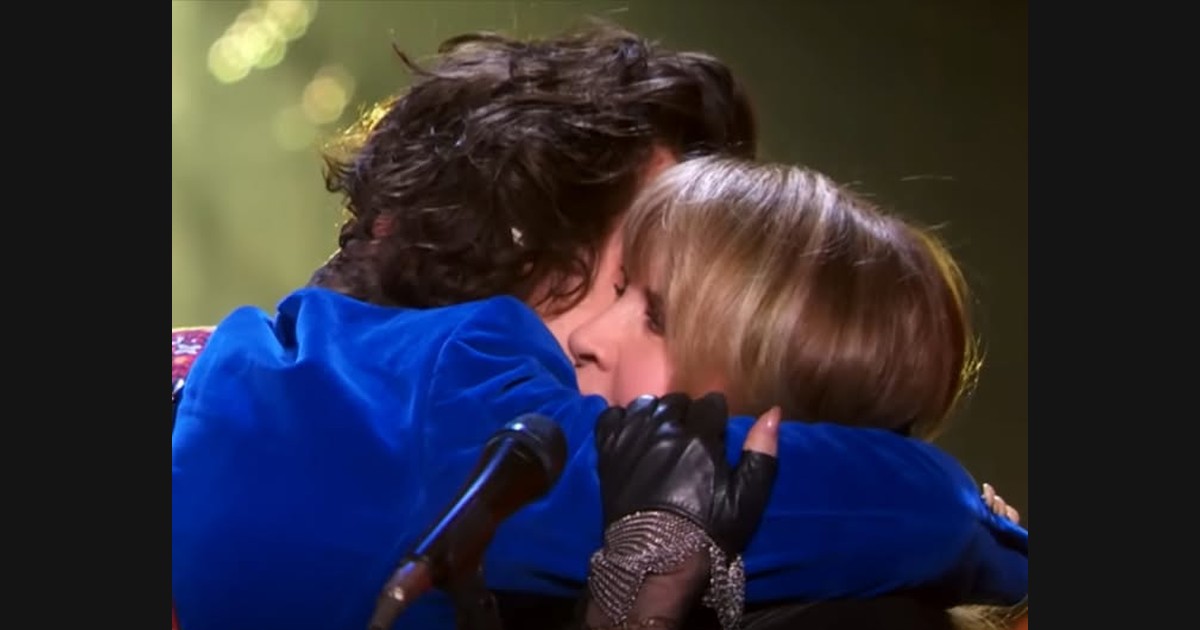
A duet does not have to put two singers in agreement. Stop Draggin’ My Heart Around gives its performers a relationship under strain, with the title expressing a demand rather than a simple celebration. Stevie Nicks and Harry Styles bring that unsettled conversation to the 2019 Rock & Roll Hall of Fame ceremony.
The Rock Hall’s official account identifies Styles taking the part originally sung by Tom Petty on the 1981 recording. That preserves a particular dramatic relationship inside a new partnership, rather than requiring the song to become a statement about the current performers.
Watch on YouTube ↗
The song arrived through another collaboration
Mike Campbell has explained that he wrote the music and Petty wrote the words. The Heartbreakers had recorded a version with Jimmy Iovine before Nicks became involved. The eventual recording brought her voice into that existing musical foundation.
This history gives collaboration more than one meaning. Campbell and Petty built a song together; Nicks and Petty became its familiar vocal partnership; Styles later joined Nicks to perform that established material on another occasion.
Keeping those stages distinct makes the repertoire’s continuity clearer. A new duet can respect an earlier relationship without pretending the work begins with the most recent people singing it.
A demand creates dramatic pressure
The title asks for a change in how one person is being treated. It implies that a continuing relationship has become a source of frustration. That gives the singer an action: draw a boundary, ask for clarity or resist being kept in uncertainty.
In a shared performance, another voice adds the possibility of response. The music can accommodate both connection and disagreement, which is why the duet need not resolve into uncomplicated unity.
A useful distinction is between singing together and saying the same thing. Two voices can share a refrain while retaining the tension established by the surrounding material. Their musical coordination does not erase the dramatic problem in the song.
Watch on YouTube ↗
Different timbres can carry an established relationship
The additional Rock Hall upload returns to the same 2019 pairing. It offers another presentation of the occasion, not proof of a second induction performance. The composition remains the common reference across its online versions.
Styles does not need Petty’s exact vocal identity for the role to be intelligible. A performer can carry a part through its phrasing and dramatic purpose while bringing a different sound. The listener can recognize continuity without demanding impersonation.
Watch on YouTube ↗
The occasion honors an artist through shared repertoire
The final upload also preserves the Rock Hall duet. Hearing the whole exchange keeps the relationship between individual lines and shared material in proportion. An isolated chorus can suggest agreement more readily than a complete song whose subject includes tension.
The performance’s particular interest lies in that combination: a new partner, an established work and a relationship that remains unsettled within the writing. Nicks and Styles make a shared musical statement by carrying the song’s argument together, rather than by removing its complications.


