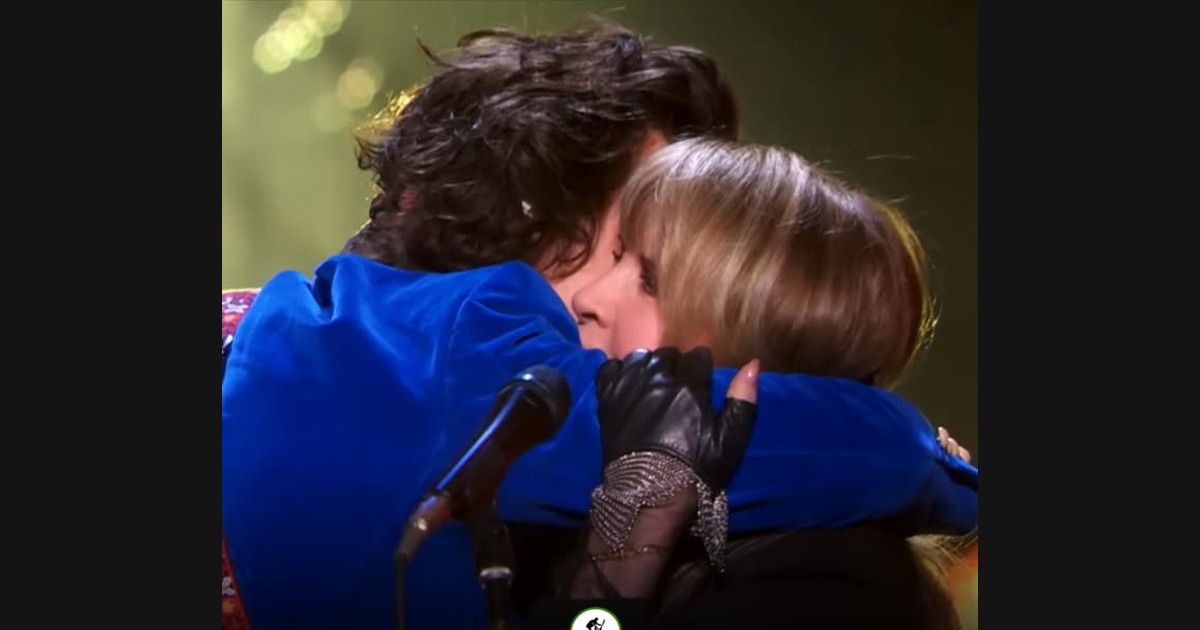
“Stop Draggin’ My Heart Around” arrived at Stevie Nicks’s 2019 Rock & Roll Hall of Fame induction with a vocal partnership already built into its history. Harry Styles took the part originally sung by Tom Petty. That makes the performance a new casting of an established musical relationship, rather than simply an extra singer added to a solo number.
The Rock Hall identifies Styles as both Nicks’s induction presenter and her partner in the performance. Its official account connects the song with her 1981 debut solo album, Bella Donna, where it was released as a duet with Petty and the Heartbreakers.
Watch on YouTube ↗
A solo career can begin with collaboration
“Solo” describes the artist’s career identity, not a requirement to work alone. The original recording placed Nicks at the center of her own release while preserving the recognizable contribution of another performer and band.
That distinction is useful at an induction celebrating her individual work. The song demonstrates how an artist can establish a solo identity through a collaboration rather than by removing every other musical personality from view.
The partner occupies a dramatic position
A duet is more than two timbres alternating. The composition’s address creates a relationship that each performer needs to make understandable. A new singer enters that relationship without needing to become an exact imitation of the earlier partner.
For a focused listen, attend to the points where attention passes between the voices. Ask whether the exchange continues one thought, supplies another perspective or changes the immediate weight of a phrase. These functions make the partnership more specific than a comparison of whose tone is stronger.
Return to the Nicks and Petty reference
Nicks’s official original video provides the earlier partnership directly. It gives listeners a reference for the vocal role Styles later undertakes, while allowing the new performance to retain its own occasion and identity.
Watch on YouTube ↗
The comparison does not require deciding that one singer replaces another permanently. A tribute can acknowledge a recording’s history through a particular choice of guest. The Rock Hall’s own 2019 annual report describes the performance as honoring Petty, placing that acknowledgment inside Nicks’s celebration.
The band underneath the exchange also matters. A consistent musical framework allows the focus to move between vocalists without making each entrance feel like the start of an unrelated performance. The duet’s continuity belongs to the whole arrangement.
The pairing returns in another setting
The final uploader labels its recording as Nicks and Styles performing the same song in London in 2024. It supplies another public setting for the partnership, distinct from the induction ceremony.
Watch on YouTube ↗
Keeping those occasions separate helps the listener hear a continuing repertoire choice rather than one endlessly repeated event. The same part can be performed again while its context changes.
The 2019 performance is especially meaningful because its roles are so clearly connected: Nicks is the inductee, Styles is the presenter and guest singer, and Petty’s original contribution remains part of the song’s history. The collaboration makes those relationships audible through a work that had always depended on more than one musical identity.


