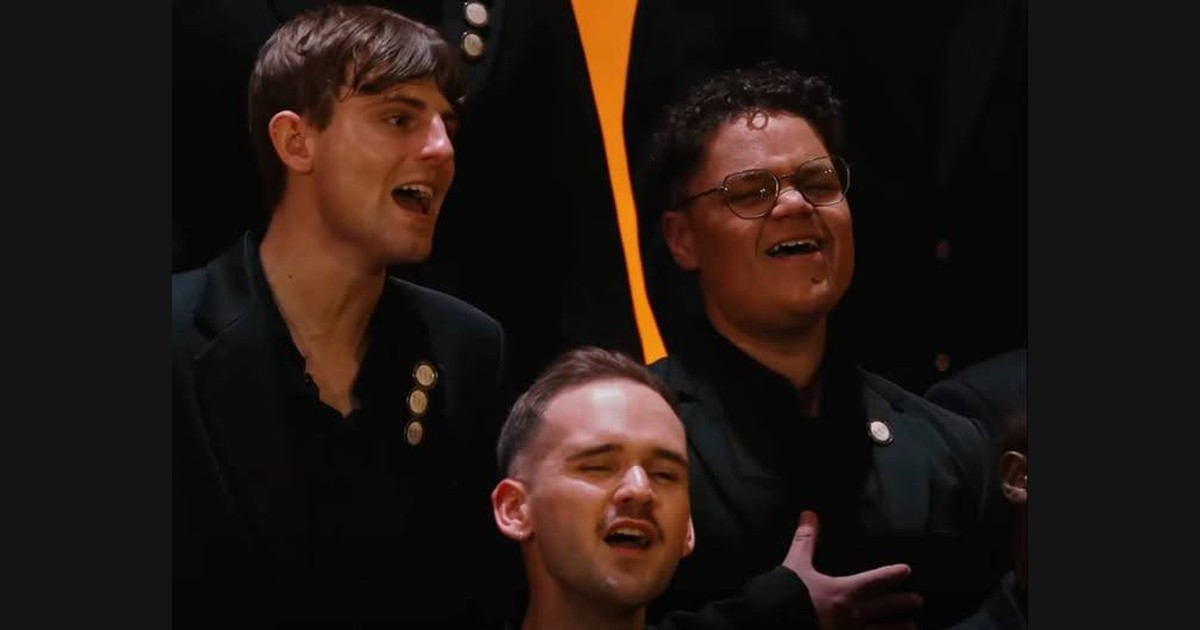
The Stellenbosch University Choir’s “The Circle of Life” names André van der Merwe twice: once as arranger and once as conductor. Those credits identify two connected kinds of work. One concerns how a familiar composition is organized for the ensemble; the other concerns its realization in performance.
The choir’s own description dates the recording to October 6, 2024, in Endler Hall at the Stellenbosch University Konservatorium. It also names Liyema Jacobs and Lithemba Macanda for percussion. The result is a documented ensemble interpretation with identifiable musical roles.
Watch on YouTube ↗
An arrangement distributes the material
A choral setting needs decisions about which parts carry a principal idea and which support it. Voices can move together, create harmony or establish a repeated foundation. Percussion adds another resource for defining the musical timeline.
The arrangement does not merely increase the number of people delivering a tune. It gives those people relationships that can be followed across the complete work. A familiar melody remains an anchor while the surrounding texture creates another performing identity.
Conducting coordinates a live realization
A conductor works with the ensemble’s shared timing and musical direction. An entrance, a change of emphasis or a release needs to make sense across many people. That is related to the arrangement but not identical to writing it.
For a focused viewing, choose one complete phrase and notice how its beginning and ending are shared. Then listen to what continues underneath the main idea. These relationships can be understood without identifying every written part or guessing the conductor’s rehearsal instructions.
The university describes the choir as drawing students from a wide range of academic disciplines and backgrounds. That institutional context gives the collaboration another dimension: the performing ensemble is a shared activity among people whose studies need not all be music degrees.
A second work tests the same ensemble resources
The choir’s official “Baba Yetu” recording provides another selection through which to follow its sound. A continuing group identity meets different musical material.
Watch on YouTube ↗
Compare what establishes continuity within each piece. It might be a recurring rhythmic idea, a melodic return or the relationship between featured and supporting material. The same ensemble can use its resources differently depending on the work.
A third selection extends the repertoire
“The Crossing,” also published by the choir, gives another route through its catalog. It is a separate composition and recording, not an additional section of “The Circle of Life.”
Watch on YouTube ↗
The comparison is useful because it directs attention toward choices rather than assuming one permanent texture defines every choral performance. A choir can retain a recognizable identity while its arrangements organize the musical space in different ways.
The opening video’s credits also name recording, videography and editing staff. The finished publication combines musical and production work. Keeping those contributions visible makes the performance more substantial than a generic claim about many voices sounding powerful: a named arranger gives the work its choral shape, a named conductor leads its realization, and a wider team makes that occasion available to listeners.


