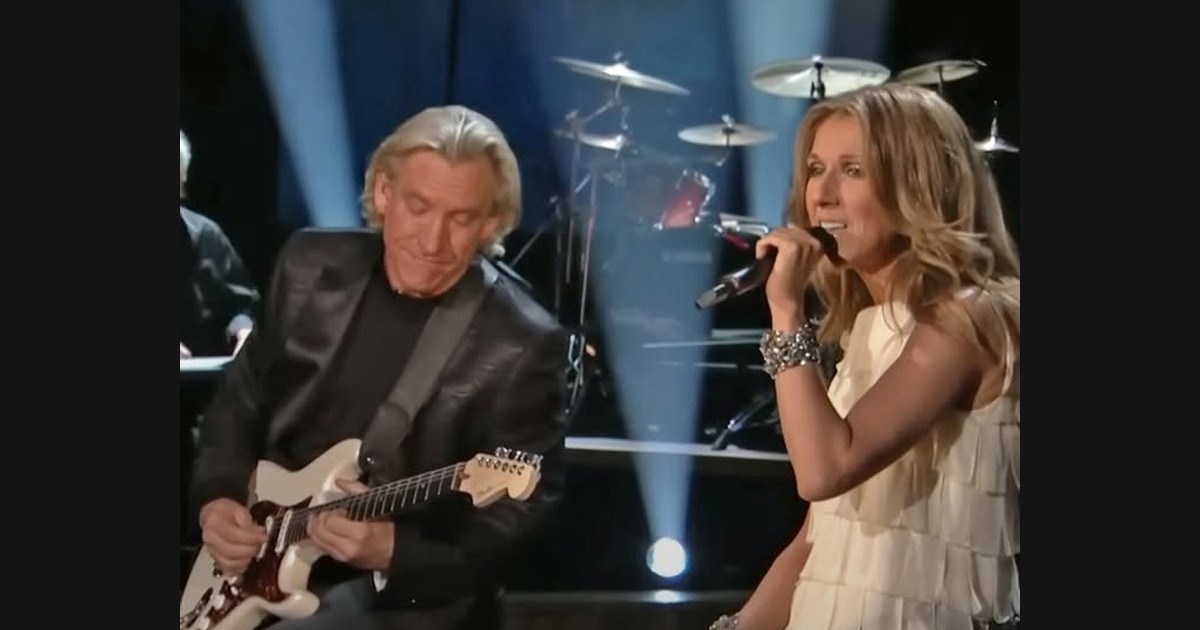
Joe Walsh is the connecting performer in this set of “Something” videos, but he is not surrounded by the same collaborators in every clip. The first two uploads present Céline Dion with Walsh. The third presents Jeff Lynne, Dhani Harrison, and Walsh. Reading that change of company is essential before combining the videos into a single story.
The shared composition is George Harrison’s “Something,” associated with the Beatles’ 1969 album Abbey Road. A common song and a returning guitarist can link separate performances without making them parts of one event. Here, the useful comparison is between two performing configurations rather than between three assumed appearances by Dion.
Begin with the singer–guitarist pairing
The principal upload identifies Dion and Walsh and labels the footage 2008. That upload label is useful for locating the clip, but it should not be stretched into a complete account of the occasion. The video’s immediate subject is the partnership: a featured singer and a guitarist sharing an established song.
Watch on YouTube ↗
Vocal and instrumental roles provide a clear way to follow that partnership. A singer carries the verbal phrase; a guitar can accompany it, answer it, or become the foreground voice during an instrumental passage. Those functions do not require the performers to have equal amounts of solo material. A collaboration can depend on complementary responsibilities rather than matching ones.
Two uploads do not double the lineup
The next video is another presentation labeled Dion with Walsh. Its place in the sequence reinforces the same pairing before the cast changes. Treat differences of framing and editing as differences between documents unless the footage itself establishes a separate performance.
Watch on YouTube ↗
| Video group | What to keep attached to it |
|---|---|
| First and second uploads | Dion and Walsh; the 2008 date appears in the upload labeling. |
| Third upload | Lynne, Dhani Harrison, and Walsh; a different performing lineup. |
| All three | The same George Harrison composition, rather than identical personnel or event context. |
This small inventory prevents a familiar mistake in tribute compilations: a well-documented fact about one clip gradually becoming the caption for every related clip. The presence of Walsh in each is not enough to place Dion at the later Beatles salute.
The Grammy salute has its own documented credits
The Recording Academy’s program for The Beatles: The Night That Changed America — A Grammy Salute, broadcast in February 2014, lists Dhani Harrison, Jeff Lynne, and Joe Walsh for “Something.” That primary event credit gives the third lineup a specific context independent of the Dion uploads.
Watch on YouTube ↗
It also changes the nature of the comparison. The first pairing centers a featured vocalist with an instrumental collaborator. The later credited group brings several musicians together under an explicitly Beatles-focused program. Their relation to the song is shared repertoire within different performance settings, not a single continuous duet with interchangeable participants.
Compare roles before ranking voices
A productive second viewing follows the handoffs: who begins a phrase, who supports it, and when the instrumental part becomes the focus. Keep the ensemble size in mind. A passage distributed across several performers creates different opportunities from one organized around a singer–guitarist pairing.
That approach avoids a false contest over which version “replaces” another. The song remains the reference point, while personnel and occasion explain the different kinds of collaboration gathered around it.


