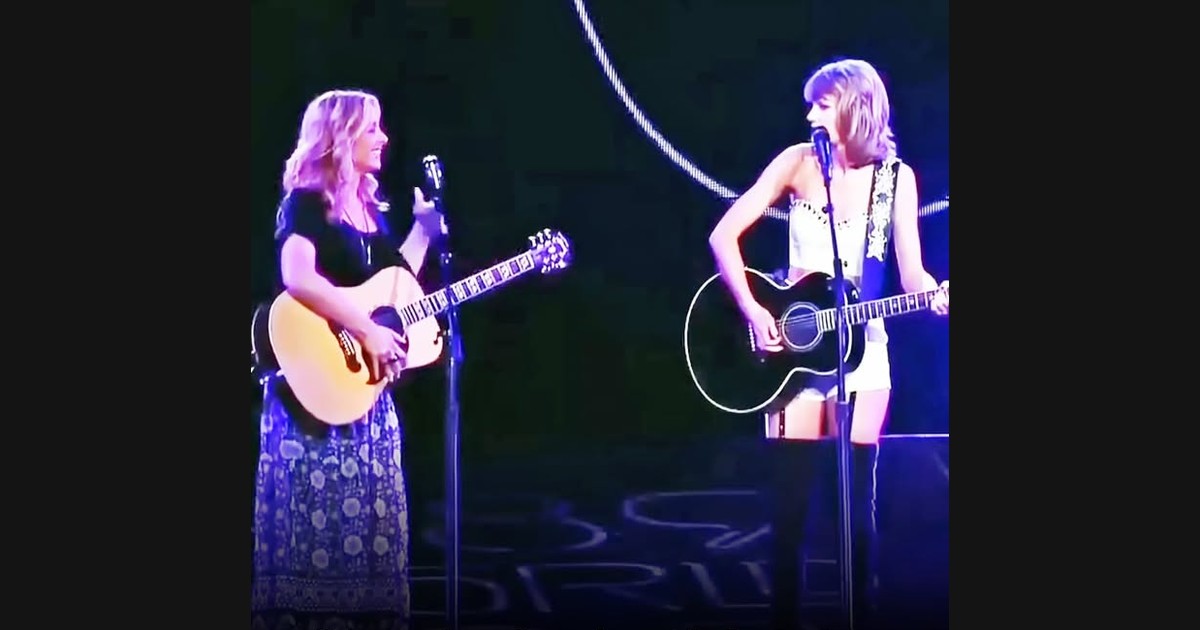
A concert guest spot has to establish its purpose quickly. A performer enters another artist’s program, familiar material supplies a connection, and the brief encounter needs a shape of its own. Taylor Swift and Lisa Kudrow’s “Smelly Cat” appearance is especially useful because the material brings a television-comedy association into a large concert.
Storyful’s contemporary record identifies the pairing at Swift’s Staples Center concert in Los Angeles in August 2015. The song’s association with Phoebe in Friends supplies context, but the musical occasion is Swift and Kudrow performing together. The short cameo does not need to become a full theatre production or an album collaboration to work.
Recognition can perform some of the introduction
In a brief guest spot, familiar material reduces the amount of explanation needed. The audience can connect an artist, a song, or a character association before the number develops. That connection gives the performers a starting point rather than a guarantee of any particular audience reaction.
Watch on YouTube ↗
Comedy adds another timing problem. A musical phrase may need room for an exchange or a pause, and resuming the song has to feel like part of the same encounter. The useful unit is the movement between setup, musical statement, interruption, and continuation, rather than an isolated funny face or a single high note.
That is a framework for following a comic musical spot, not a transcript of undocumented stage directions. The finished performance does not disclose every rehearsal choice or establish which parts were planned beforehand.
A television busking segment uses another frame
The related Tonight Show “Subway Busking with Ed Sheeran” clip gives a different public-performance format. The official program identity matters: this is a television segment that uses a public location, rather than another event on Swift’s tour.
Watch on YouTube ↗
Its larger structure includes the host’s entertainment premise as well as music. A performance can therefore carry two kinds of progression at once: the movement of the song and the movement of the segment’s reveal or encounter. Treating it only as a detached concert recording misses part of its form.
“Angels” supplies the concert-repertoire contrast
Swift’s official Robbie Williams “Angels” upload identifies a reputation Stadium Tour duet. Here, the shared material is a song established in Williams’s recording career. The guest relationship is organized around repertoire rather than a sitcom character’s comic musical identity.
Watch on YouTube ↗
| Example | What supplies the immediate frame |
|---|---|
| Swift and Kudrow | A familiar song connected with television comedy. |
| Sheeran and the Tonight Show | A host-led public-performance television premise. |
| Swift and Williams | A concert guest sharing established recording repertoire. |
The comparison does not require equal duration or identical musical ambition. Each appearance has to establish the partnership and bring its own small sequence to a conclusion within a larger program.
Follow the handoff back to the host
A guest number is bounded by the surrounding event. Its opening establishes the visitor; its ending has to allow the program to continue. Those boundaries are part of its design, even when a short upload removes some of the introduction or closing exchange.
That is why the Swift–Kudrow cameo is best approached as a complete small encounter rather than a fragment of a hypothetical full collaboration. Its combination of recognition, comic timing, and shared song gives the guest spot a purpose at the scale it actually occupies.


