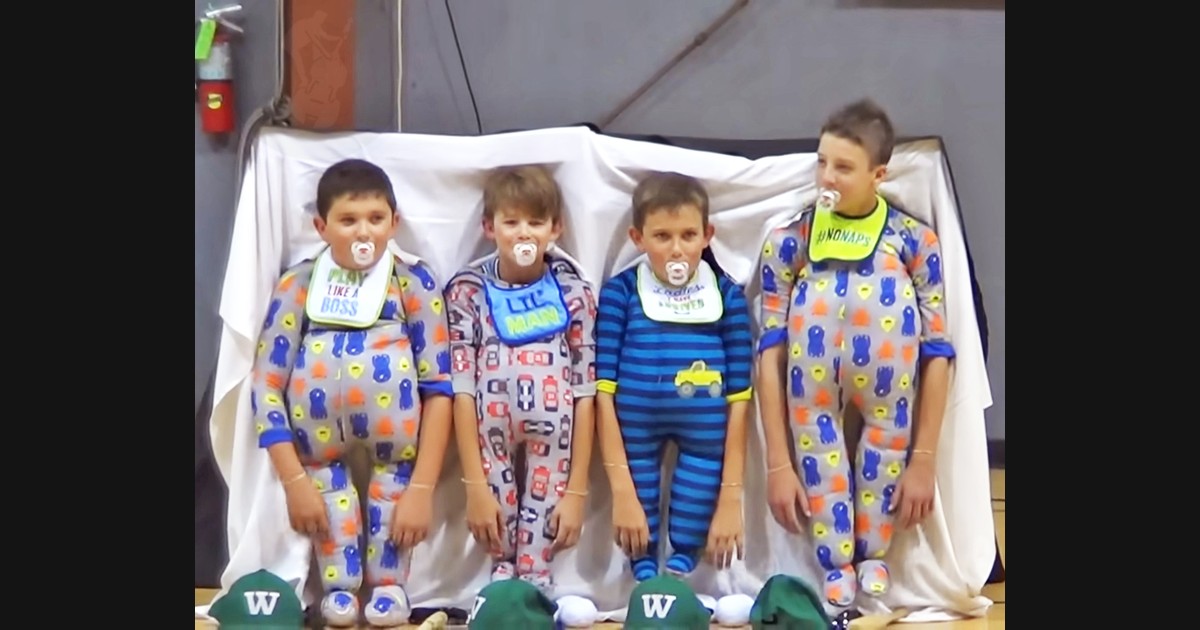
A visual reveal can establish a joke immediately, but it cannot repeat the surprise indefinitely. The fifth-grade puppet-style talent-show routine from New Braunfels Christian Academy faces that ordinary stage problem: once the audience understands the altered proportions, what gives the act somewhere else to go?
The original uploader identifies the performance as part of the school’s 2017 elementary talent show. Its premise uses familiar faces above much smaller apparent bodies. Recorded pop music provides a changing framework in which that single visual idea can keep generating actions.
Watch on YouTube ↗
The reveal introduces a vocabulary
Once the figures are visible, a movement that would look ordinary at human scale can acquire a different character. A small gesture may seem exaggerated because of the proportions around it. The audience has learned the act’s visual rule, so the performers can develop it without explaining the premise again.
The next requirement is structure. A routine needs beginnings and endings within its overall running time. Music can provide those boundaries through a new section, a recognizable accent or a change of character. The movement then has a shared timeline rather than becoming a collection of disconnected jokes.
A musical cue is more than background
A recorded track can tell performers when an action belongs. It can also prepare the audience to expect a change. That double function is especially useful in an act with little spoken narrative: the same musical event can coordinate the performers and orient the people watching.
Imagine a hypothetical sketch in which a character freezes when the music stops, then begins a different action with the next selection. The pause separates two ideas, while the return supplies permission to move again. This illustrates how a cue can work; it is not a transcription of an exact incident in the school recording.
For a focused viewing, follow the boundaries between actions. Ask whether a change feels prepared by the music or whether the movement itself announces the transition. This reveals how the routine is organized beyond the initial costume surprise, without requiring guesses about rehearsal time or the performers’ private intentions.
A different visual world with the same structural need
The fifth-grade synchronized-swimming skit below offers another school-stage premise. Its illusion differs, but the act still needs the audience to understand when one idea has finished and another begins.
Watch on YouTube ↗
Compare how each routine establishes a world quickly. Once the basic fiction is clear, repeated musical references or coordinated movement can keep it consistent. A comic act can change its immediate activity while continuing to obey the same overall rule.
From character illusion to a recognizable dance song
The Whitmer teacher flash mob uses “Uptown Funk” within a school homecoming presentation. Its original production identifies the occasion as Homecoming 2017. Here the performers themselves, rather than miniature-looking characters, become the shared visual subject.
Watch on YouTube ↗
Across these recordings, music does practical dramatic work. It supplies a common pace, introduces a change and helps an audience recognize the shape of a short act. The puppet routine’s reveal gives it an entry point; the organization of what follows is what allows that premise to become a complete performance.