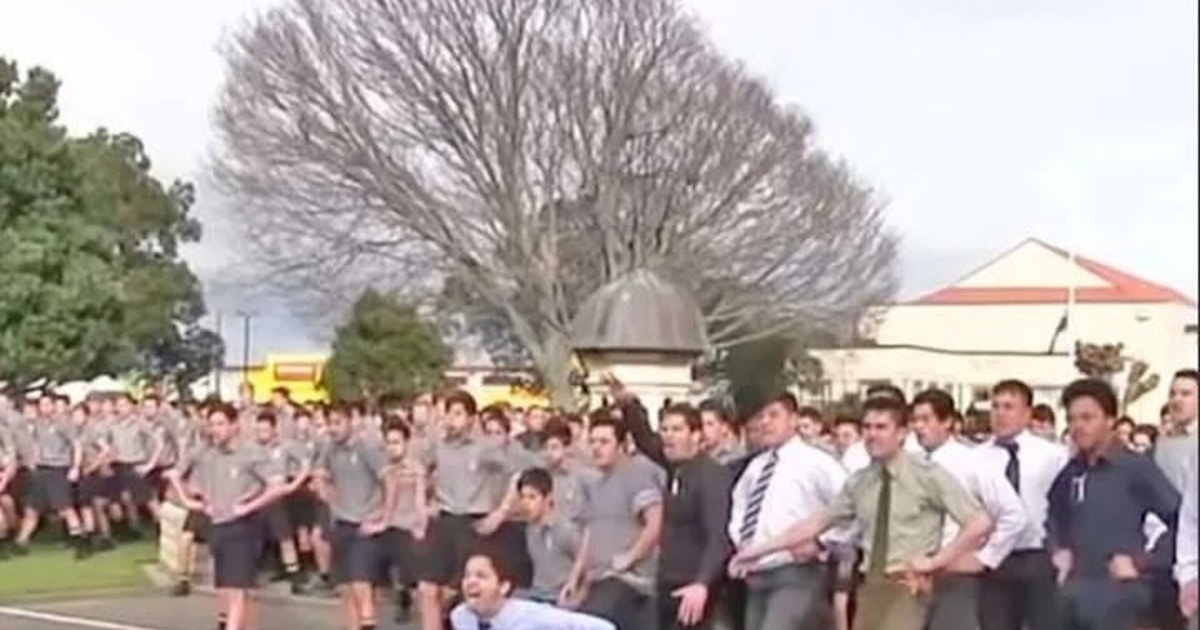
A collective performance needs more than people doing something at roughly the same time. It needs a shared sense of when an action begins, how it continues and where it is directed. The Palmerston North Boys’ High School recording of its haka for Dawson Tamatea’s funeral offers an occasion to consider that relationship between individual participation and collective address.
The school identifies the action and the circumstances: its school haka is performed as the hearse carrying Tamatea arrives. The ceremony supplies the reason for gathering. Looking at coordination can help explain one aspect of the performance, provided that aspect remains connected to the farewell rather than being treated as a detached display.
The farewell and the group
Watch on YouTube ↗
Shared time is a relationship
In group performance, timing is not simply an individual achievement repeated many times. Each participant acts in relation to other people. An entrance has to belong to a common moment; a continuation has to leave the group able to proceed together. The result depends on maintaining relationships through time.
That is why counting the performers is a limited explanation. A larger gathering does not automatically produce a coherent statement. Numbers describe scale. Coordination describes how that scale becomes available for a common action.
Nor should collective performance be described as the disappearance of individuals. Each person contributes to the shared act. A group’s direction depends on those contributions being connected, rather than on the people becoming indistinguishable.
Voice and movement cannot be reduced to separate tracks
Te Ara’s discussion of haka leadership emphasizes the timing of voice and movement. Its account of Māori composition also explains that the composer of haka may work through choreography and dance: purpose can involve the whole body. Those points give a useful basis for considering coordination as more than keeping a vocal line against a visual backdrop.
Voice and action can establish relationships within the same phrase. An analysis that treats every gesture as decoration around the sound misses that possibility. At the same time, noticing that a sound and action occur together does not establish a translation of the words or the cultural meaning of that particular action.
Those are different tasks. One describes an observable relationship in a recording. The other requires knowledge of language, composition and context. A careful viewer can do the first without pretending to have completed the second.
A practical way to focus attention
For a closer viewing, follow one transition rather than trying to explain the entire performance at once. Notice how the group moves from one shared action to the next. Consider whether your attention is drawn first by a voice, a movement or the relationship between them.
Keep the note descriptive: “the group moves together here” is a narrower claim than assigning a specific spiritual or emotional meaning. This is an observation exercise for viewing a record, not an instruction to reproduce the haka or remove its gestures from their setting.
One school, a different service
The companion PNBHS upload names Steve Burnley and his funeral service on November 24, 2015. A second occasion lets viewers consider shared time within the school’s collective practice while keeping a different person and farewell in view.
Watch on YouTube ↗
The event label is part of the interpretation. Similar coordination can serve different occasions, and the presence of a shared form does not collapse those occasions into one story.
Another community’s collective voice
Hereworth’s recording identifies its own school haka for Mr Bibby. It extends the comparison to another school. The strongest link is the practical problem of a group addressing someone together, rather than an assumption that the compositions or local associations are identical.
Watch on YouTube ↗
Thinking about shared time provides a concrete way into these recordings. It makes room to notice how people coordinate without treating coordination as the whole meaning of the ceremony. In the Tamatea recording, the common action remains a farewell: its timing belongs to a community’s address to someone it has lost.