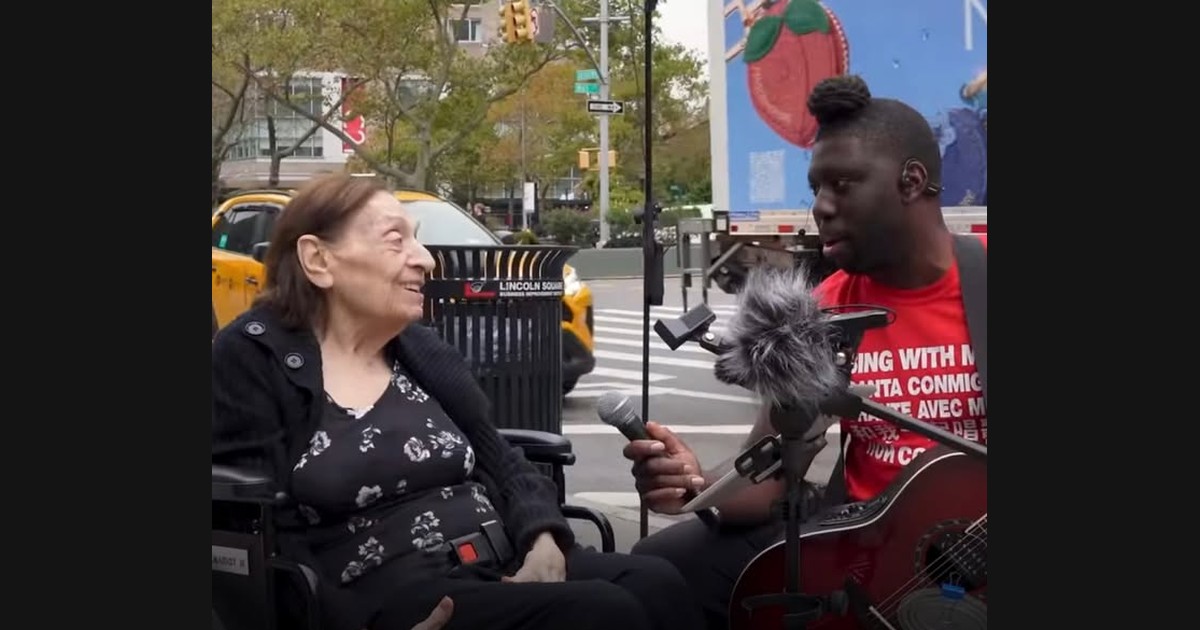
A street performance can begin with a participant choosing the repertoire. Guitaro 5000’s account of Sandra describes her asking to join the music and selecting a song popular in her past. The number is You’ll Never Know, a work with a longer history than the encounter itself.
The filmmaker introduces her return to singing through the context of a personal loss and a long break. That account belongs to this individual scene. It does not require a broader claim about age, memory or what music can do for every person experiencing bereavement.
Watch on YouTube ↗
The participant supplies more than a voice
A request changes the direction of an open musical encounter. The accompanist is no longer simply presenting a prepared set for passers-by; another person brings a piece of repertoire and a reason for choosing it.
That gives Sandra a role beyond being the subject of a reaction headline. She contributes knowledge of a song and a wish to sing it. The performance begins from that choice, while the shared task is to make the material work in the current setting.
A familiar song can connect different kinds of knowledge. One person may remember a particular recording; another may know its harmonic shape or be able to support the melody. The collaboration depends on finding usable common ground.
The song has identifiable writers
The Academy’s record for the 1944 Oscars lists You’ll Never Know from Hello, Frisco, Hello, honoring a film released in 1943. It credits music by Harry Warren and lyrics by Mack Gordon.
That history is distinct from the particular recorded version a participant remembers. A song can be associated with several singers while its writing remains a separate credit. Naming the work accurately gives the encounter another dimension without requiring a catalogue of every cover.
The title also gives a performer a clear dramatic position: someone tries to express a depth of feeling that ordinary explanation may not fully communicate. Its intimacy comes from that act of address, rather than from an audience having access to the singer’s entire life.
Watch on YouTube ↗
The companion encounters have other participants
DØVYDAS’s Ain’t No Sunshine video provides a separate musical meeting. It should be approached through its own performers and song, rather than treated as another part of Sandra’s story.
Comparisons between open performances are most useful when they preserve those differences. The same broad format can make room for different repertoires, different kinds of accompaniment and different reasons for taking part.
Watch on YouTube ↗
A request creates a practical conversation
The final DØVYDAS upload centers on another participant requesting Journey material and giving instructions. It offers a related example of a guest helping define what happens next, rather than simply receiving a performance.
Sandra’s choice remains the central thread of the opening recording. An older composition becomes present through a person who wants to sing it and an accompanist who shares the task. The encounter is valuable in those concrete terms: a request, a recognizable work and people making room for it together.


