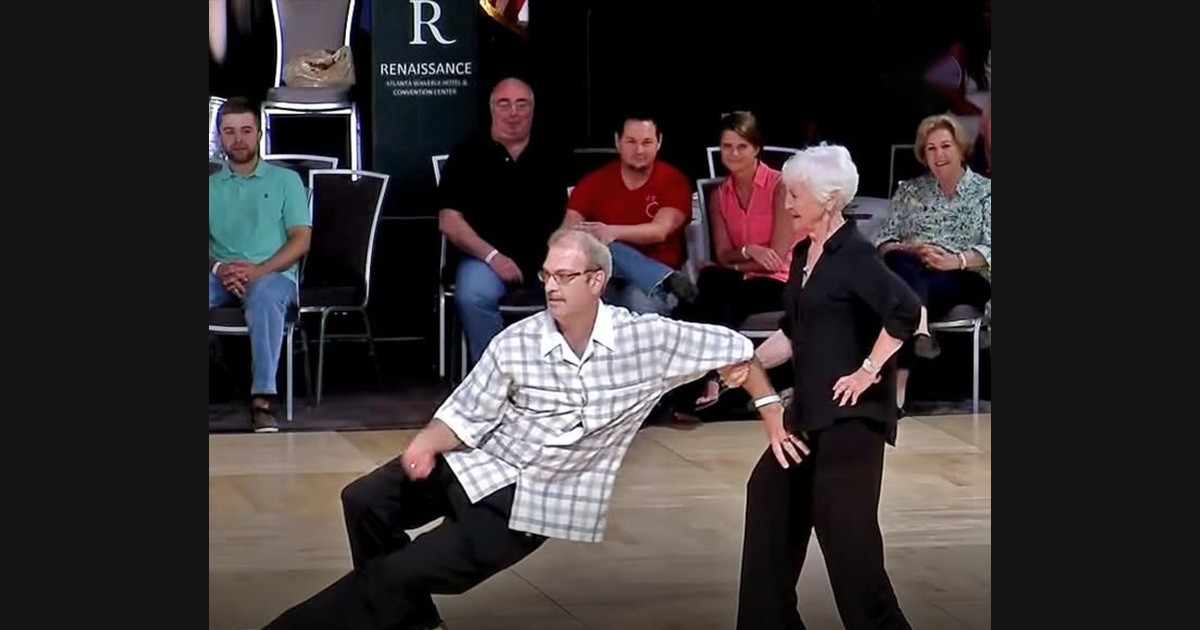
A dance clip can attract attention through the promise of an extraordinary result, an unexpected age, or a claim that difficult movement is effortless. Sam West and Ellen Taylor’s performance offers a more substantial subject: the work two partners share in keeping a dance intelligible from one moment to the next.
The main upload labels the footage as a 2017 Grand Nationals performance and describes a first-place result. That wording should not be treated as a complete competition record. The World Swing Dance Council’s biography of Taylor separately lists a second-place Strictly Shag result with West at the 2017 GNDC; different categories can produce different results.
Watch on YouTube ↗
Separate the label from the dance
Without matching an official result to the exact division and recording, the useful starting point is the partnership itself. A performance can be worth watching without first resolving it into a ranking. Nor does a lively dance establish how much effort its performers are making internally.
For a first viewing, watch the space between the partners. Changes in that distance can help a viewer follow an approach, a separation, or a return. The point is not to prescribe footwork from a video, but to recognize how the relationship between two people creates a readable shape.
On another pass, follow transitions rather than the most conspicuous movement. A turn has to lead somewhere, and a change of direction has to connect with what follows. The continuity between figures often supplies a better subject for attention than a single move lifted out of context.
A shared pulse permits different jobs
Two partners need not make identical movements to appear coordinated. Their roles can complement one another while relating to the same musical pulse. Watching only for synchronized steps can therefore miss the more interesting relationship between their actions.
A useful observation names both sides: one partner makes space while the other travels, or a moment of separation prepares a return. Treat these as things to identify in the clip, not as a claim about a particular unseen instruction or private signal.
An earlier pairing gives the comparison depth
The second upload identifies Taylor and West at the 1999 US Open. Its value here is the opportunity to watch the same named partnership in another presentation, rather than an invitation to assume that every movement has remained unchanged.
Watch on YouTube ↗
Compare the way each recording lets the dance unfold. Follow the beginning of a phrase, a transition within it, and the point at which the partners seem to complete a unit. Camera position and framing can make those relationships easier or harder to see, so a difference in visibility is not automatically a difference in skill.
Change the partnership
Charlie Womble and Jackie McGee supply the final selection, identified as shag dancing. Changing the pair prevents the comparison from becoming only a timeline of two individuals.
Watch on YouTube ↗
Keep the same viewing subject: spacing, transitions, and the relation between complementary actions. Another partnership may make the musical structure readable through different proportions or emphases. There is no need to declare one universally superior.
Taylor’s documented place in the dance community provides context, but biography should not replace attention to the performance. The clips are most rewarding when the partnership’s continuing choices become visible, rather than when the dancers are reduced to an age-based surprise or an incompletely verified prize label.