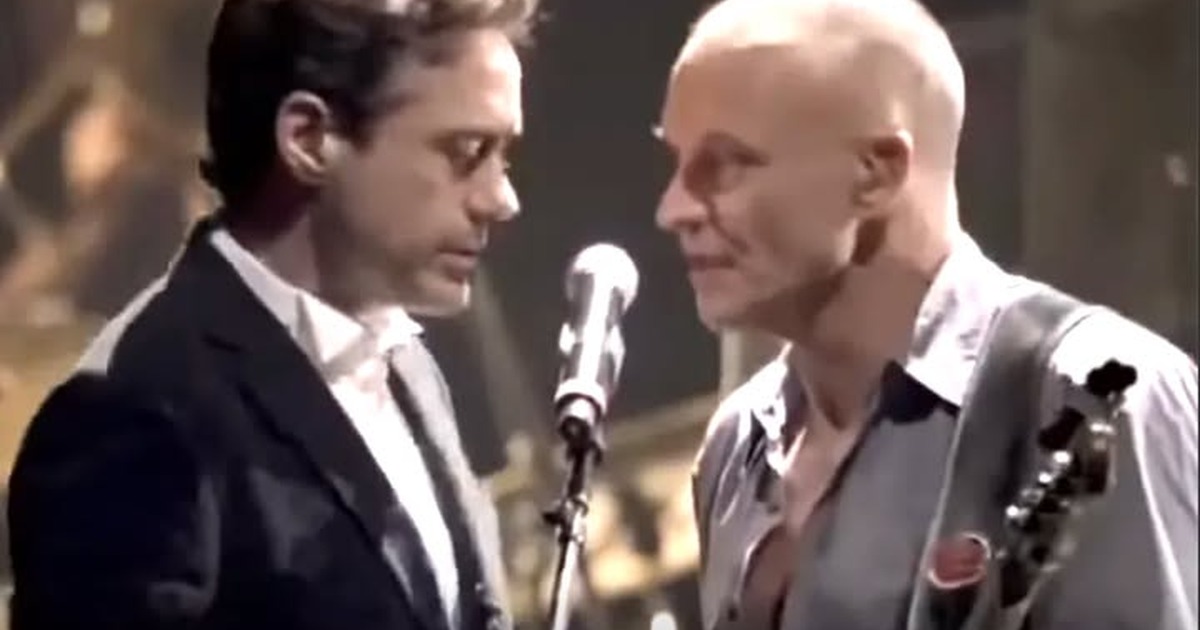
A well-known actor singing beside a well-known musician can become a story about surprise before anybody discusses the song. Robert Downey Jr.’s Driven to Tears appearance with Sting is more interesting when that surprise is treated as an entry point rather than the entire subject. The performance still depends on a featured line fitting a continuing musical framework.
Sting’s event archive places Downey’s appearance within the 2011 concert celebrating his 60th birthday. That supplies a concrete setting without requiring a claim that Downey had never sung publicly before or that the collaboration happened without preparation.
The guest enters an existing musical world
Watch on YouTube ↗
A song associated with a particular artist brings expectations of rhythm, phrasing and instrumental relationships. A guest can work inside that identity without duplicating every characteristic of its familiar singer. The useful question is how the new featured voice relates to the material around it.
Follow a complete vocal line and include the accompaniment before and after it. The line does not begin from silence in an abstract test of vocal skill; it arrives within a setting that already suggests movement and emphasis. A successful entrance belongs to that setting.
Similarity is not the only measure
Listeners sometimes describe a guest performance by saying that the person sounds like the host. A resemblance may be part of an individual’s response, but it is not a complete explanation. The song itself supplies a melodic and rhythmic vocabulary that can make different voices seem related.
For example, two singers can place emphasis at comparable points while retaining different vocal colors. Conversely, similar voices can organize a phrase very differently. Distinguishing color from placement gives a more precise way to discuss what a guest brings.
The same distinction applies to stage presence. A familiar screen identity can shape expectations, but it does not tell the listener how the musical sentence is constructed. Keeping the voice, the song and the celebrity association separate makes room to notice each one.
The same song in a different public event
Watch on YouTube ↗
Sting’s official Live Aid Driven to Tears selection keeps the composition constant while changing the occasion and featured configuration. Choose one responsibility to compare, such as beginning a phrase against an established instrumental pattern. A stable criterion is more useful than asking which entire performance has more energy.
The recordings also come from separate events. Differences in camera presentation and recording should not be converted into confident claims about what the musicians heard on stage or how the sound was produced.
A tribute with another singer and other songs
Watch on YouTube ↗
Bruno Mars’s Kennedy Center tribute to Sting changes both the repertoire and the guest. It offers a reference for how a recognizable performer can honor another artist while retaining an independent musical identity. A tribute need not function as an impersonation to make the connection clear.
Across these selections, the most durable subject is the relationship between a voice and an existing song. Downey’s presence may be what makes a viewer press play, but following the musical responsibilities gives the clip value after that initial surprise passes. The guest is doing a specific job within a group performance, not merely demonstrating that a famous actor can sing.