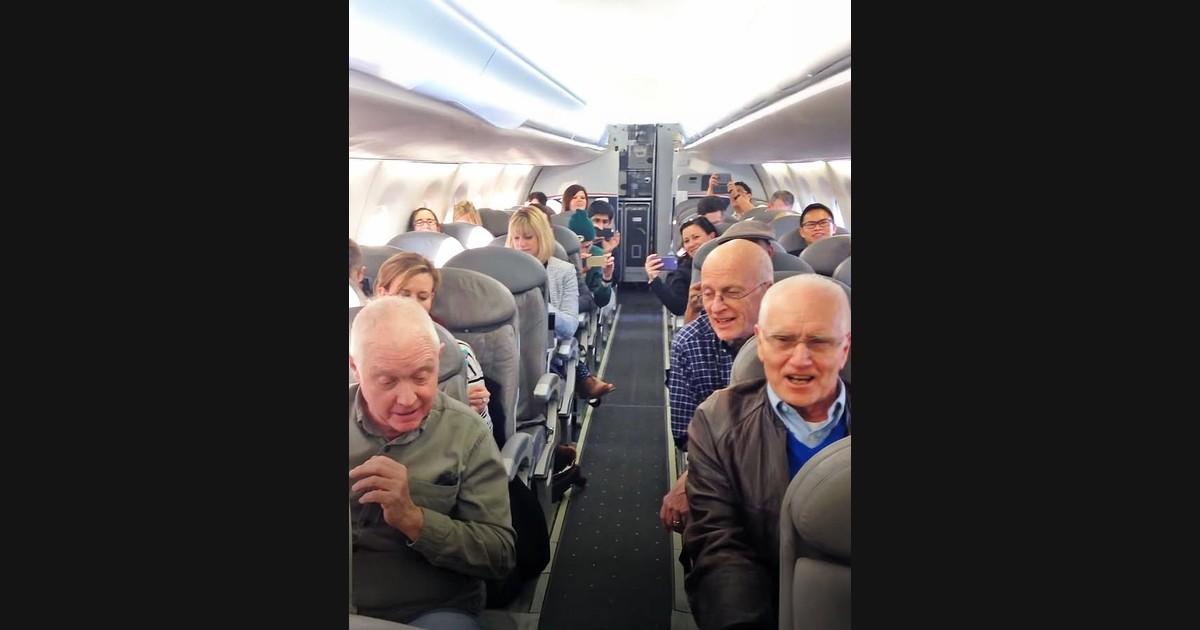
The Port City Sound flight-delay video records an established quartet in an unusual public setting. It does not show four strangers discovering a complete group identity during a few minutes in an aircraft cabin. The Barbershop Harmony Society’s account identifies the ensemble and traces the circulating recording to flight attendant Kari Mann.
The society’s other Port City Sound performances provide a useful next step. They reconnect the widely shared travel clip with a continuing group, giving the singing a context beyond the circumstances that made that particular recording distinctive.
Watch on YouTube ↗
A new setting can reveal existing work
An unexpected performance location and an unpracticed piece are different things. A quartet can bring established repertoire and familiar coordinating habits into a setting that was not designed as a concert venue.
That distinction makes the musical encounter more substantial. The interest is not only that singing happens on a delayed flight; it is that a prepared ensemble can make a piece intelligible within another kind of public situation.
The society’s account names Walt Dowling, Fred Moore, Jim Curtis, and Jim Simpson. Keeping the group and its members identifiable prevents the clip from becoming a generic story about anonymous travelers whose musical history begins when the camera appears.
The audience relationship changes
In a scheduled performance, people generally know that they are about to hear music. In a travel setting, singing enters an activity organized around another purpose. The quartet has to become a point of attention within that circumstance.
The recording gives later viewers access to one part of the encounter, not a survey of every passenger’s response. A specific performance can be appreciated without declaring that everyone present was transformed in the same way.
For listening, follow a complete phrase and notice how the group establishes a shared musical statement. The location may lead the first encounter with the clip, while the coordination offers something to hear on a return.
Restore the ensemble’s name
The second selection is published by the Barbershop Harmony Society under the Port City Sound name. It gives the viewer another route to the group, through a platform directly associated with its vocal practice.
Watch on YouTube ↗
Compare the sense of address rather than assume that a different presentation must require a different group identity. The same ensemble can make its repertoire available to listeners under different public conditions.
A more formal publishing frame also supplies a different kind of context from a travel clip’s headline. The music remains the subject, while the reason for encountering it changes.
Another composition broadens the repertoire
“(I’m Afraid) The Masquerade Is Over,” also published by the society, changes the named work. It lets the quartet be heard beyond the one song associated with the aircraft recording.
Watch on YouTube ↗
Follow what makes this piece’s musical course recognizable. A continuing ensemble can retain its identity while giving another composition different proportions and emphases.
The three selections are most useful together: the cabin recording introduces a public encounter, and the society’s recordings restore the ensemble around it. Port City Sound remains a quartet with repertoire and continuing work, rather than a musical identity created entirely by one widely circulated delay.