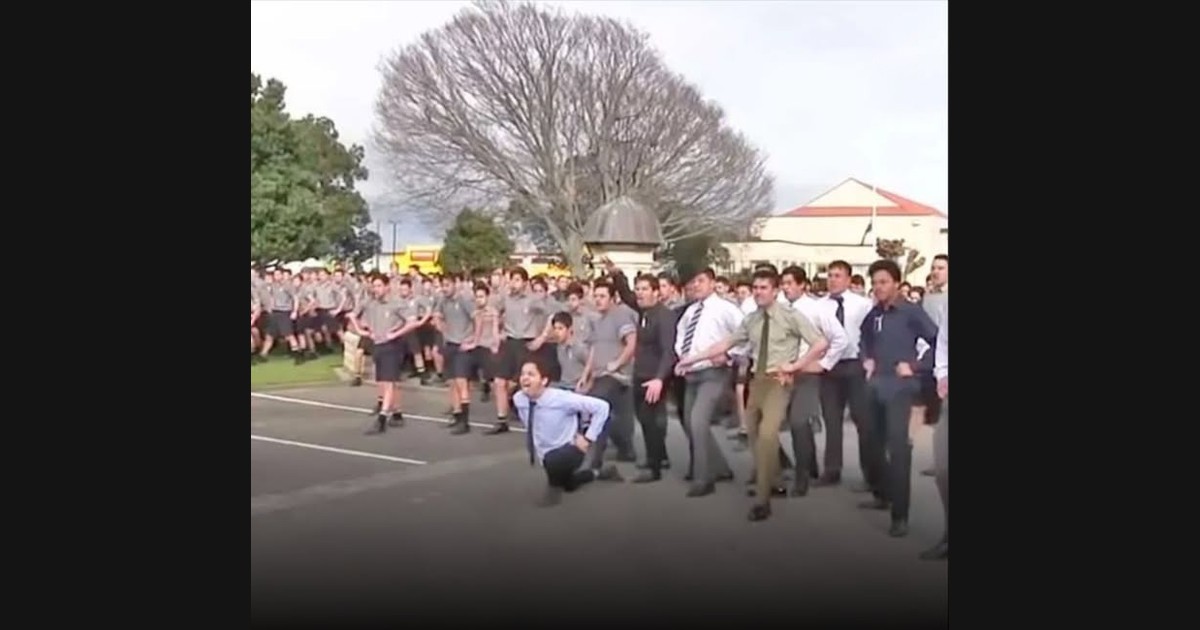
These three Palmerston North Boys’ High School recordings share an institutional publisher, but they do not all document funerals. The first names Dawson Tamatea’s funeral service; the second names a farewell to John Adams; the third identifies Year 13 leavers in 2022.
That difference is essential context. A shared form and school identity can connect the selections without making their circumstances interchangeable. The event label should travel with each recording rather than being inferred from the first clip in a playlist.
Watch on YouTube ↗
The funeral is a specific address
The school identifies its haka as the hearse carrying Tamatea arrives. That locates the performance within a particular farewell to a named teacher. It should not become a generic description of every later school haka encountered nearby.
An outside viewer can recognize that the gathering addresses a loss while still needing the school’s account to identify the precise occasion. The camera alone does not supply every relationship among participants, language, composition, and person being honored.
Three labels preserve three occasions
| Recording | Documented context |
|---|---|
| Dawson Tamatea | Funeral service |
| John Adams | Staff farewell connected with his final assembly |
| Year 13 leavers | A named student-leaving occasion in 2022 |
The table does not translate the haka or identify every shared musical feature. It keeps the public event information clear before any comparison is attempted.
John Adams’s farewell has its own school record
Watch on YouTube ↗
The school’s May 2016 newsletter says Adams had been its guidance counsellor for eleven years and describes his final assembly at the end of the first term. That primary account supplies a staff-departure context, rather than a funeral.
The distinction is more useful than guessing from the intensity of the performance. Strong collective delivery does not have one fixed occasion or one emotion that an unfamiliar viewer can reliably assign.
Keep the job title and date attached to the school’s account, but avoid extending it into an unsupported explanation of why he left. A documented final assembly is enough to identify the relevant kind of event.
The leavers’ clip changes the address again
Watch on YouTube ↗
The third school upload explicitly names its Year 13 leavers in 2022. Here the named group of students and the leaving occasion supply the context. Its presence beside a funeral recording does not turn it into a memorial service.
Compare how each published title identifies whom the performance addresses. That is a concrete starting point even for a viewer who does not know the language or the local composition.
Context comes before interpretation
Te Ara, New Zealand’s national encyclopedia, describes haka as serving a range of occasions, including welcomes and respect for the dead. That wider account explains why a general category cannot substitute for the school’s specific labels.
A useful note for each video contains publisher, named person or group, and occasion. Add an observation about voice and movement only after those fields are clear. Recognizing a coordinated action is different from translating a gesture or a line.
The three recordings then remain connected without being collapsed into one story. Each preserves a particular use of the school’s public performance practice, directed toward different people and different moments of departure.


