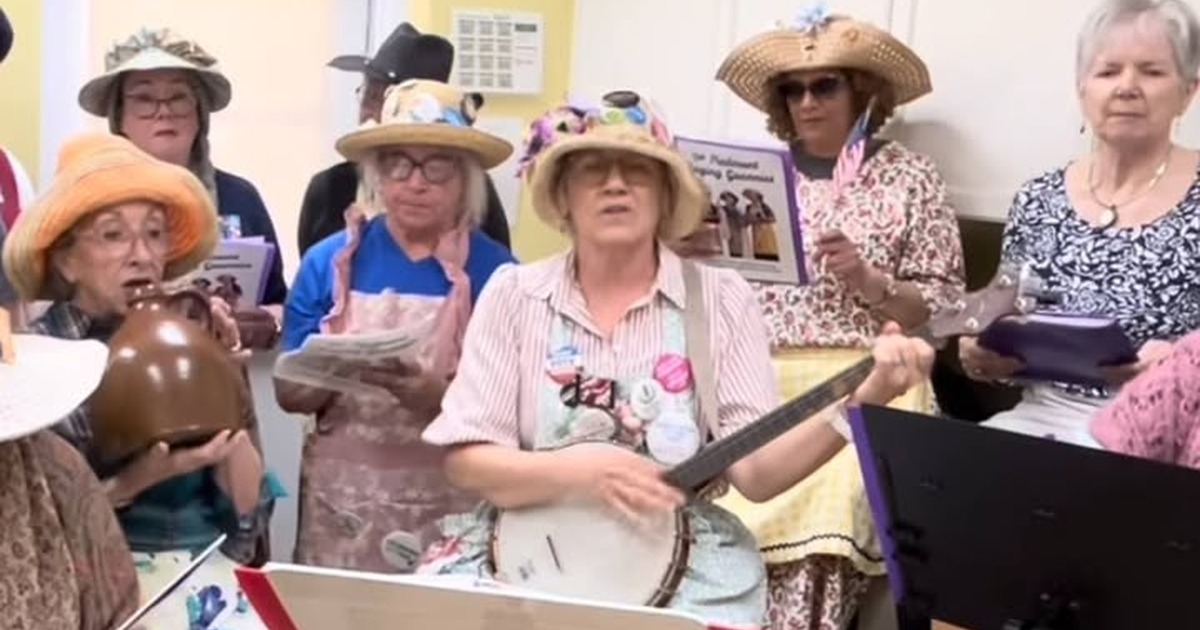
A protest song can be current without being newly written. That is the useful distinction behind the Piedmont Raging Grannies’ “All You Fascists Bound to Lose.” The performance places an inherited political song in the hands of a present-day group. It does not establish that the performers originated its words or that every reference in its history describes the immediate occasion.
Woody Guthrie’s official publishing archive lists “All You Fascists,” crediting Guthrie and identifying a Billy Bragg derivative. That source establishes a lineage for the work. It does not, on its own, identify every textual or musical choice in the Piedmont performance, so the recording is best discussed without assigning it an unverified exact version.
Watch on YouTube ↗
Continuity is part of the message
Reusing a protest song can place today’s performers in conversation with earlier musical activism. The choice of repertoire communicates an affiliation as well as a position. A listener who recognizes the song hears both the current singers and the history attached to the material.
That does not make a song a substitute for evidence. Political language often compresses distinctions that reporting would need to unpack. The performers’ position should remain attributed to them, rather than being adopted as an independent factual classification of unnamed people or institutions.
What belongs to the performers?
Even when a group inherits a song, it still makes decisions about presentation: who begins, how voices join, how long a refrain continues, and what surrounds the selection in a program. Those are meaningful contributions that do not require a false claim of authorship.
The Raging Grannies network describes local groups as autonomous. Naming Piedmont therefore does useful work. It identifies the particular performers instead of assuming that one clip represents the exact repertoire or position of every group using the wider name.
For a careful viewing, distinguish three things: the work’s credited history, this group’s presentation, and the contemporary associations you bring to it. They can interact without becoming the same claim.
A topical adaptation makes a different connection
The Santa Fe Raging Grannies’ “Hit the Road, ICE!” provides the first comparison. Its title explicitly redirects a familiar musical reference toward a named contemporary institution. That is a different kind of connection to inherited material from performing an already political song under its established title.
Watch on YouTube ↗
Both methods can use recognition, but recognition does different work. An inherited protest song can emphasize continuity across time. A topical adaptation can emphasize a new application. Neither method guarantees that all listeners share the same political conclusion.
An original song offers another route
The final selection is the official America’s Got Talent: All-Stars upload of Ndlovu Youth Choir’s “We Will Rise,” labelled an original song in 2023. This changes the comparison from local protest performance to a televised choir presentation and from inherited repertoire to original material.
Watch on YouTube ↗
The common thread is collective musical address: several voices present something that reaches beyond an isolated soloist. The differences are equally important. A competition stage, an activist group, and an established protest text bring different expectations to the listener.
Understanding those distinctions allows the Piedmont performance to stand on its actual terms. Its interest lies in the continuing public life of a song, not in a claim that one recording invented the tradition or settled the political arguments around it.