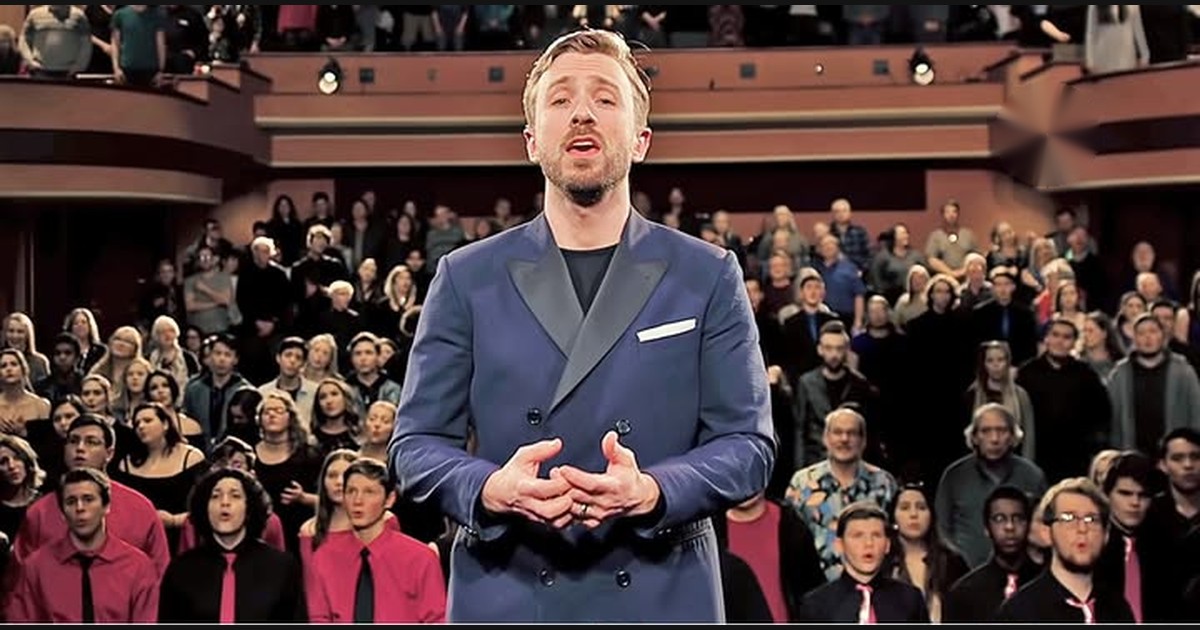
A cappella describes a focus on voices; it does not mean that a finished recording has no production. Peter Hollens’ “You Raise Me Up” project makes that distinction unusually easy to document because his own page identifies collaborators beyond the singers: arrangement by Tom Anderson, mixing by Ed Boyer, and video production by One Voice Productions.
The page also identifies the Bend A Cappella Festival choirs. That gives the large ensemble a specific project identity rather than leaving it as an anonymous group assembled only to illustrate a dramatic headline.
Watch on YouTube ↗
Four contributions behind one presentation
| Contribution | What it can organize |
|---|---|
| Singing | The performed voices and their relationships in the musical material. |
| Arrangement | The distribution of material among parts and the progression of the account. |
| Mixing | The balance and presentation of recorded elements. |
| Video production | The images through which the audience encounters the project. |
The credits establish that these roles are present. They do not reveal every particular decision, so the recording should not be used to invent a detailed session history. Their practical value is to keep the musical result from being attributed to a single voice alone.
A large ensemble is not one giant unison
Several singers can share a melody, but an arrangement can also distribute different musical jobs. A lead idea, supporting harmony, a continuing pattern, and transitions between sections may all be carried by voices.
Listen for function before trying to count people. Which sound gives you the clearest melodic reference? What continues around it? When the texture becomes fuller, does that mean more voices share the same line, or can you distinguish additional material?
These questions connect the ensemble’s scale with the arrangement rather than treating a large number as an artistic explanation in itself. A more concentrated passage can be just as purposeful as a broadly combined one.
Watch on YouTube ↗
The audio reference changes what guides attention
The Hollens audio presentation lets the musical structure remain central without a changing screen image supplying the route through it. Follow a recognizable passage, then return to the main video and consider what its visual presentation adds.
A cappella should also remain separate from claims such as “single take,” “unprocessed,” or “everyone recorded simultaneously.” Those are production circumstances that need their own evidence. An arrangement of voices can be carefully assembled and still be accurately described as voice-centered music.
Watch on YouTube ↗
Another choir supplies a different comparison
COLOR MUSIC’s cover keeps the song while changing the ensemble and project. It is a separate recording, not another angle on the Bend Festival collaboration. Compare how the lead material is supported and how a section’s arrival is prepared.
There is no need to assume that younger singers all have the same musical role or to turn a historical video into a statement about their present ages.
After listening, connect one audible relationship with one credited contribution. For example, distinguish the distribution of parts from their recorded balance. That makes the collaboration easier to appreciate: many voices are involved, and several kinds of creative work help those voices become one intelligible presentation.


