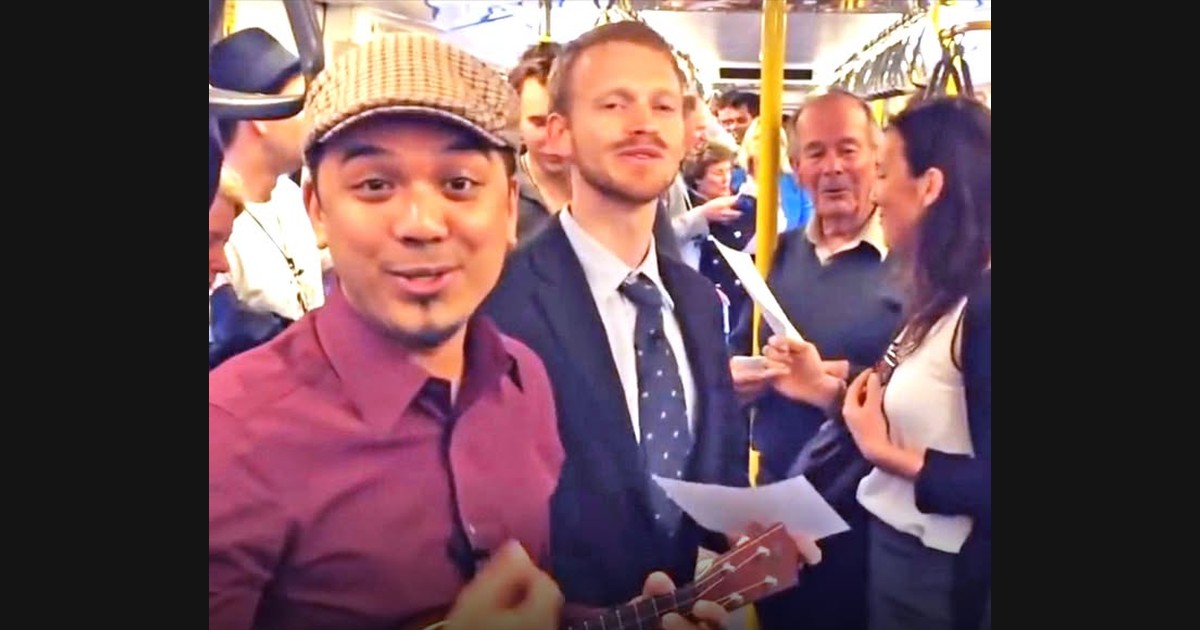
Over the Rainbow imagines a place beyond ordinary experience. In the Liberators’ train recording, that wish is sung during an ordinary journey, bringing a familiar musical elsewhere into a shared present. The change of setting is the interesting part, rather than a claim that every passenger had the same reaction.
The original publisher introduces the event as a Monday-morning singalong. It credits Peter Sharp with editing and names several people involved in capturing the video. The online recording is a prepared presentation of a public musical encounter, with a documented making history of its own.
Watch on YouTube ↗
Participation has more than one form
A singalong usually has people establishing the music and others deciding how to respond. Some may take a prominent vocal role, some join a familiar phrase, and some remain listeners. A shared event does not require identical participation.
This matters when watching public-space music. A visible group response can be enjoyed without turning it into a statement about everyone present. The recording preserves selected moments from a particular encounter, not a complete survey of passengers’ feelings.
The familiar song gives the event a useful common reference. Recognition reduces the amount of new material participants have to learn, making it possible for a phrase to become shared before every person knows every detail.
A song about elsewhere changes an ordinary setting
The composition’s broad wish for another world does not remove the train from view. It places imagination and a continuing journey beside each other. The contrast can give a modest public performance its character without needing a large stage.
That is different from treating music as proof that an everyday difficulty has been solved. A brief gathering can be valuable as a gathering: people share time around a known melody, then the wider day continues.
Its musical continuity comes from maintaining a common pace and recognizable phrases. A participant does not need a polished solo voice to contribute to that shared sequence. The relevant task is relating a voice to what other people are already singing.
Watch on YouTube ↗
Israel Kamakawiwoʻole’s version is another interpretation
The Mountain Apple Company’s official video gives the song a separate recorded identity through Israel Kamakawiwoʻole. The label credits Jon de Mello as producer. This is a companion recording, not the train event’s audio history or proof that the singer wrote the original composition.
The comparison keeps the difference between an established recording and a communal rendition clear. A signature version can shape listeners’ familiarity while a public singalong gives the material another use.
Watch on YouTube ↗
The wider project joins different places through a format
The Liberators’ final compilation lists participating cities across several countries. That extends the idea through separate locations; it does not mean all the scenes share one train or one continuous moment.
The useful connection is a repeatable invitation to make music together. The opening recording remains one particular encounter within that idea. Its strongest interest is the relationship between a familiar song, an everyday space and the different ways people can choose to share the same musical time.


