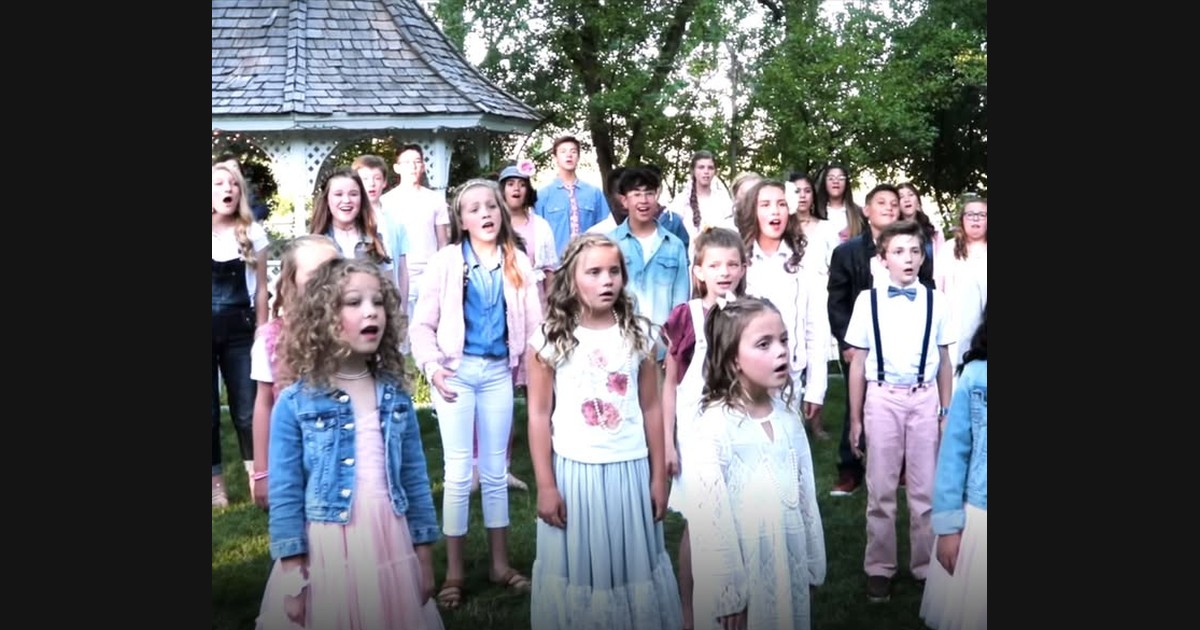
A question changes when a group asks it. One Voice Children’s Choir’s What About Us gives the song’s collective address a literal ensemble, while retaining room for individually credited singers. The title is an appeal to be accounted for, rather than a complete answer in itself.
The choir’s official description credits P!nk, Steve Mac and Johnny McDaid with words and music. Masa Fukuda is identified as producer, arranger and director, with recording and mixing also credited to him. The interpretation has a making history beyond the familiar song title.
Watch on YouTube ↗
The question identifies a relationship
A phrase such as the title implies people making an appeal and someone expected to respond. It gives the composition direction: a group that feels overlooked asks where it stands in promises made around it.
That position can remain legible without a performer assigning the song to one current political event. A public question may be broadly available while still requiring a specific expressive attitude. The singer has to make the need for a response intelligible.
Children performing the material add another layer of interpretation, but the recording does not authorize a viewer to invent each child’s personal experience. The ensemble can inhabit a shared dramatic viewpoint without every word becoming a biographical disclosure.
Seven named soloists keep individuals in view
The official credits list Blake, Jane, Kenya, Liliana, Ava, Mya and Cosette in order of appearance. Those names provide a concrete reminder that the collective sound is made through individuals with different responsibilities.
A solo line within a choir arrangement can establish an address before a broader group carries it, or create contrast within a larger passage. The specific distribution belongs to the arrangement. Recognizing the credited voices encourages attention to those relationships rather than treating the ensemble as an anonymous mass.
The arranger’s work also includes deciding how the composition moves between scales of sound. A group can share a question while using contrast to prevent every return from feeling identical.
Watch on YouTube ↗
A lyric video changes where attention goes
The second upload presents the choir’s cover with a lyrics label. That gives another viewing aid, but the words alone cannot explain the entire performance. Musical phrasing supplies duration, emphasis and the relationship between statements.
It is useful to distinguish recognizing a sentence from understanding how it functions in a song. A returning question can become more insistent because of the material heard before it, even if the wording remains familiar.
Watch on YouTube ↗
The public film has its own collaborators
The final upload gives another presentation of the choir’s interpretation. The original production credits name RJ Idos for cinematography and editing, alongside other production contributors. A finished music video joins a musical arrangement with decisions about what the viewer sees.
The choir describes a wider charitable mission, but the particular value of this recording can be considered concretely: a known composition, a named arrangement and identifiable singers carrying a collective appeal. Keeping those contributions visible allows both the group question and the individual voices to remain part of the account.


